Death
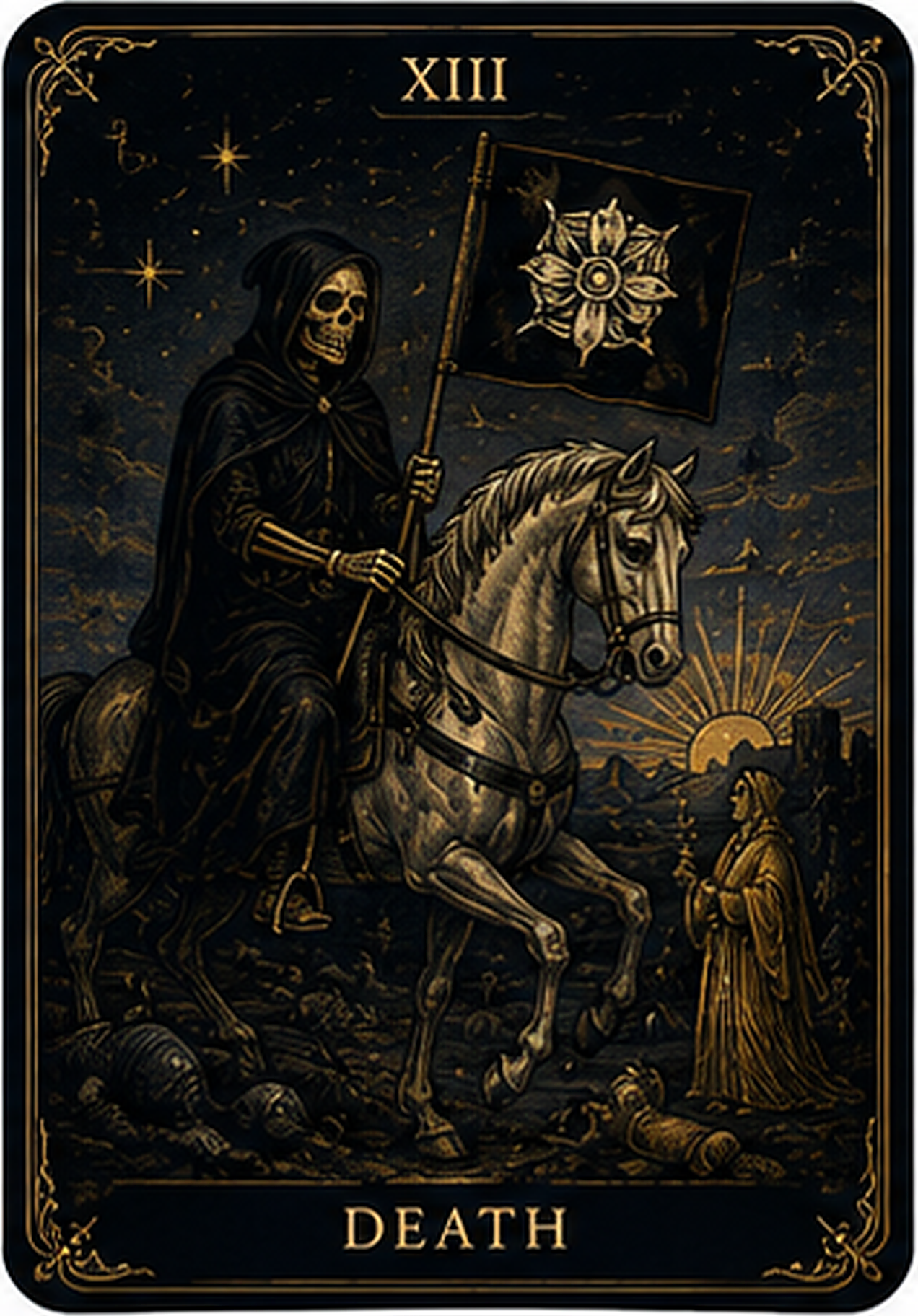
Death
The One Word Everyone Fears Before They Even See the Card
Say this plainly, before anything else: in the overwhelming majority of tarot readings, across every serious tradition this Archive has traced, this card does not predict a literal death. It is one of the deck's clearest, most consistent symbols of transformation, the end of one chapter that makes real room for the next one to actually begin. Readers who see this card and panic are almost always reacting to the name alone, not to what centuries of practice have actually taught it to mean.
Numbered XIII, a number this Archive's own Numerology chapter already traced as unusually unlucky across Western superstition, Death arrives directly after the Hanged Man's small, willing pause, and answers the question that pause was always quietly building toward: some endings cannot simply be waited out. They have to actually happen. This card is the moment one finally does.
The Dance That Left No One Out
The Danse Macabre, "Dance of Death," was a hugely popular artistic and literary tradition across late medieval Europe, gaining particular force after the Black Death devastated the continent in the fourteenth century. Its central image showed a skeletal figure leading a procession of the living toward death, popes, kings, merchants, peasants, and children alike, each one pulled into the same dance regardless of any earthly rank they had spent a whole life accumulating. This card's rider, trampling a fallen, crowned king beneath its horse's hooves, draws directly on that exact tradition.
What that older tradition emphasised, and what this card has quietly kept, was never really morbidity for its own sake. It was levelling: proof that no amount of power, wealth, or status ever actually exempts anyone from the same fundamental cycle of ending and renewal. A king trampled beneath the horse is not a threat aimed at kings specifically. It is a reminder aimed at everyone who has ever mistaken status for permanence.
What the Card Actually Shows
The Black Flag's White Rose — beauty, surviving the ending
A five-petaled white rose decorates the rider's dark banner, the same flower this Archive already traced in the hands of the Fool, purity and beauty continuing even in death's own wake.
The Fallen King — status offers no exemption
A crowned figure lies trampled beneath the horse's hooves, proof that no earthly power ever actually bought anyone permanent exclusion from this card's reach.
The Praying Bishop — faith cannot bargain either
A robed clergyman clasps his hands in prayer rather than protest, spiritual authority meeting the same limit worldly authority has already met on the ground beside him.
The Unafraid Child — innocence, meeting the end calmly
A young child offers flowers to the rider without any visible fear, too new to the world to have learned yet that this moment is supposed to be terrifying.
The Turned-Away Maiden — a far more human response
A young woman looks away or has fainted, the card's one figure whose fear looks entirely understandable, and entirely permitted.
The Rising Sun Between the Towers — renewal, already arriving
Far in the background, a sun climbs between two distant towers, the same quiet promise this Archive has already traced through several earlier cards: something new begins exactly where something else has just ended.
Upright and Reversed
Upright, Death favours real, necessary transformation: a chapter genuinely closing, a version of a life, a habit, or an identity that has quietly finished its purpose and is finally being allowed to go. It rarely appears to punish; it appears when clearing the ground, however uncomfortable, is exactly what the next real growth actually requires.
Reversed, the card points most often not to a darker ending, but to no ending at all: resistance to a change that was always going to happen eventually, clinging to a job, a relationship, or a version of oneself that has already, quietly, run its course. Some readers use the reversed card to describe stagnation caused specifically by refusing this card's own upright invitation the first time it appeared.
Death in Love
Drawn upright in a love reading, Death rarely predicts a literal breakup, though it can describe one that genuinely needed to happen. More often it marks the end of a particular phase inside an ongoing relationship, an old dynamic, a pattern, a version of one or both people that has to be let go of before the relationship can actually keep growing. It favours honest release over the exhausting work of keeping something dead on life support.
For someone single, the card frequently describes the necessary end of an old relationship pattern, the type of partner repeatedly chosen for the wrong reasons, finally being released to make room for something genuinely different. Reversed, it can point to a relationship, or a version of oneself inside it, being kept alive well past its natural end, fear of the vulnerability real transformation actually requires standing in the way of a change both people already know is coming.
Death in Work and Money
In a career reading, Death commonly appears at the genuine close of a job, a role, or an entire industry chapter, a position that has quietly stopped offering any real growth, a business model that has run its natural course. It favours a clean, deliberate ending over a slow, half-hearted one, closing a chapter fully rather than leaving it painfully half open.
With money specifically, the card can describe the necessary end of an old financial habit or plan that no longer actually serves its purpose, clearing space for a genuinely better one. Reversed, it warns of clinging to a failing venture well past the point it could realistically recover, or resisting an organisational change that, one way or another, was always going to happen regardless of how hard it was fought.
Strengths, Weaknesses, and the Thin Line Between Them
The Light
- Transformation. Real, necessary change, finally allowed through.
- Release. Letting go of what has already finished its purpose.
- Clarity. Seeing plainly that a chapter has actually closed.
- Renewal. Ground cleared, genuinely, for the next real growth.
- Acceptance. Meeting an ending without needing to fight it.
The Shadow
- Denial. Refusing to see that something has already ended.
- Clinging. Holding onto a chapter well past its purpose.
- Stagnation. Growth blocked by an ending never actually allowed.
- Fear. Resisting change purely because it is unfamiliar.
- Prolonged suffering. A slow ending, dragged out far longer than it needed.
Death Beside Other Cards
Beside the Hanged Man, card XII, the promise this Archive named plays out exactly as expected: a small, willing pause, finally meeting the real, unavoidable ending it was always quietly preparing someone for. Later in the deck, beside the Tower, card XVI, this card sets up a meaningful contrast in kind: Death's ending arrives gradually, almost gently, riding at a walking pace, where the Tower's arrives suddenly and without any warning at all.
Her most immediate pairing sits with the very next card in the sequence, Temperance, card XIV: the stark, decisive clearing away this card performs, met directly afterward by patient, gradual blending and healing, the deck's clearest emotional arc from devastation into genuine integration.
Correspondences of Death
Death Across the Great Traditions
Tarot de Marseille — the unnamed card
Many historic printings leave this card entirely without a title, a skeletal figure with a scythe standing among scattered body parts and severed heads, the only card in the whole deck denied a printed name.
Rider-Waite-Smith — the armoured rider
The white horse, the black flag, and the fallen king this chapter has already described in full, transformation given a genuine narrative scene rather than a bare emblem.
Thoth — Death, and alchemical decay
Crowley and Harris leaned further into Scorpio's own symbolism and alchemical imagery of decay preceding transmutation, framing the card explicitly around metamorphosis rather than any literal mortality at all.
What Survives Every Version — an ending, without malice
Nameless scythe-bearer, armoured rider, or alchemical decay, every tradition keeps the same essential figure: an ending that arrives without anger, and without any real interest in who happens to be standing in its way.
What This Card Actually Asks of You
The question is not what you are afraid of losing. This card rarely appears to threaten something a person still genuinely needs; it appears, almost always, at the exact point something has already, quietly, finished. The real question is whether you are willing to actually let it go, cleanly, rather than keeping its shape propped up out of habit or fear long after its purpose has run out.
Drawn in a reading, Death is rarely asking the querent to lose anything they were not already, secretly, ready to release. This Archive's opening Tarot chapter called the whole deck a mirror rather than a fortune, and this card holds up one of its most misunderstood reflections: proof that an ending, however unwelcome its name sounds, is very rarely the tragedy its reputation suggests, and is very often exactly the clearing a genuinely new chapter actually needed.
a child still offers flowers without a trace of fear,
and a sun keeps quietly rising between two distant towers, exactly on schedule.
A medieval dance that led popes and peasants to the very same grave, an entire tradition too cautious to even print this single card's name, a rider who has never once looked back at what it just passed: every version of this card has always been asking the same plain question. Not what you are losing, but whether you are finally willing to let it actually finish.
FOR THE CURIOUS
The Danse Macabre tradition is documented across art historical scholarship on late medieval European art, particularly following the Black Death. The Marseille tradition's unnamed printing of this card is noted across tarot historical scholarship. The Rider-Waite-Smith imagery described in this chapter is Pamela Colman Smith's 1909 design. The Thoth deck's reinterpretation is Aleister Crowley and Lady Frieda Harris's, completed across the 1940s.
Next in Tarot: Chapter Sixteen, Temperance, the ground this card cleared, finally met with patient healing.
The rest of this is yours, not a type.
Reveal my chart