Judgement
Judgement
One Joyful Rider, Becoming an Entire Awakening
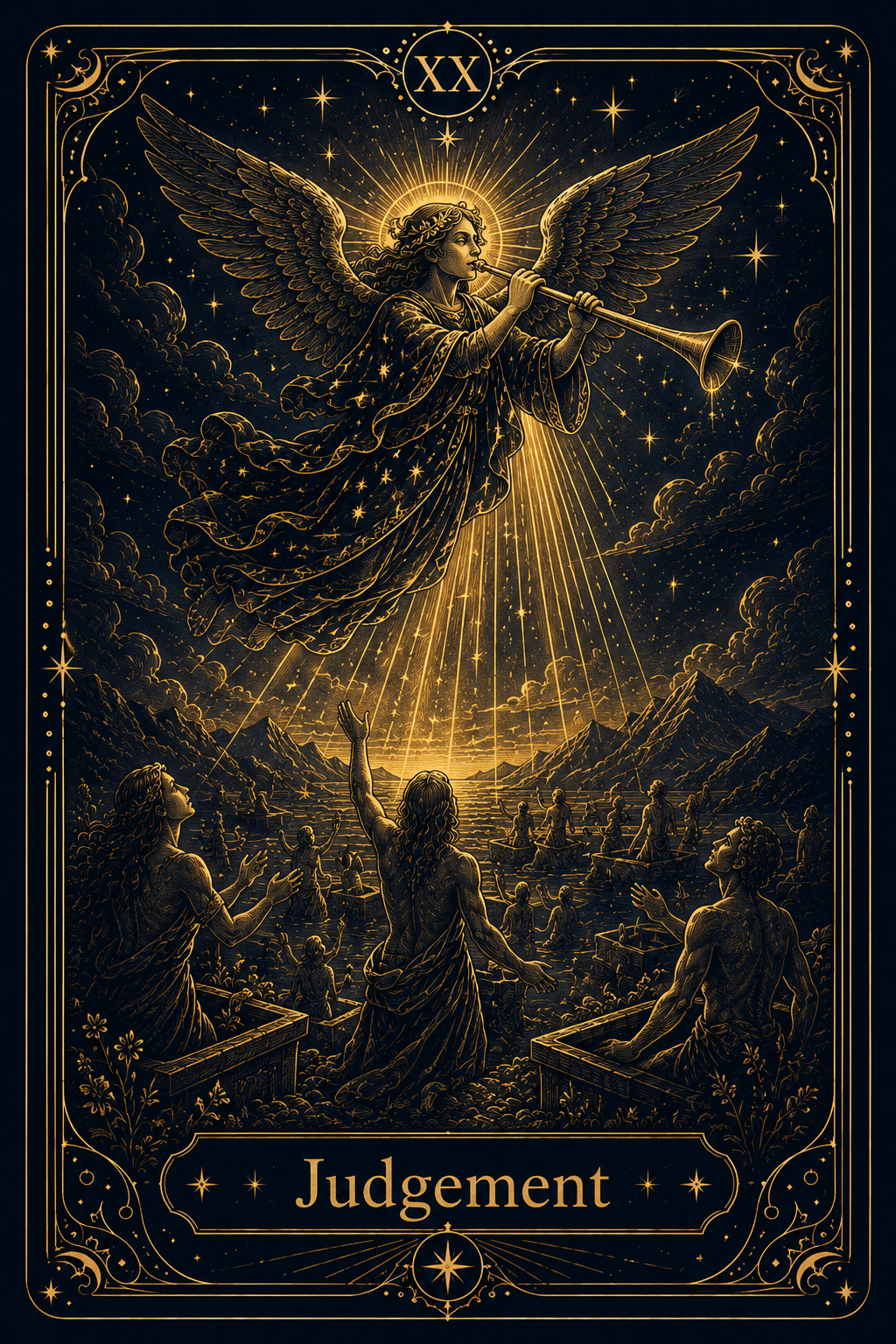
Agreat angel hovers in the sky, blowing a long trumpet from which hangs a white banner marked with a red cross. Below, human figures rise up out of open graves, arms raised toward the sky, a family rather than a single individual, a man, a woman, and a child together, echoing the entire span of a life rather than any one stage of it. Snow-capped mountains sit calmly in the distance, and a wide sea stretches beneath the rising figures.
Numbered XX, Judgement is the deck's clearest picture of a collective moment, following twenty chapters that mostly followed one figure, or at most a pair, at a time. Nearly every card before this one has quietly asked something of a single person. This card asks the same question of everyone at once, arms already raised, already answering before the trumpet has even finished sounding.
An Ending Borrowed Directly From Scripture
The Book of Revelation describes the dead being called forth from the sea itself at the end of days: "the sea gave up the dead which were in it," summoned to a final reckoning. A related passage in the First Letter to the Corinthians describes the same moment through its most recognisable detail, "the trumpet shall sound, and the dead shall be raised," the exact sound this card's angel is caught mid-breath delivering.
This card sits alongside the Hierophant and the Tower as one of the Major Arcana's most openly, specifically religious images, drawing directly on the Christian tradition rather than smoothing its source into something broader or more universal, the way several earlier cards in this Archive have done. Modern readers, though, rarely treat it as a literal end-of-the-world prediction. It is read almost universally as something considerably more personal: an inner calling, a moment of honest self-reckoning, and, crucially, a genuine invitation to actually rise.
What the Card Actually Shows
Gabriel's Trumpet — a summons, not a sentence
Traditionally identified with the archangel Gabriel, herald of divine announcements, the trumpet calls rather than condemns, an invitation to rise rather than a verdict already delivered.
The White Banner, Red Cross — an echo of the white rose
A white flag marked with a red cross hangs from the trumpet, directly recalling the white rose this Archive already traced on Death's own dark banner, purity persisting through both this card's ending and its own.
The Rising Family — every stage of a life, together
A man, woman, and child rise together rather than a single figure alone, the whole span of a life answering the same call at once, rather than any one age or role standing in for all the rest.
Their Raised, Open Arms — welcome, not defence
Every figure lifts their arms upward and open, a posture of welcome and awe rather than fear or resistance, already answering before the sound has even finished.
The Open Sea Beneath Them — a direct scriptural echo
Water surrounds the rising graves directly, a literal nod to the sea giving up its own dead, the exact image this chapter's opening section already traced to its source.
The Distant, Calm Mountains — what remains unmoved
Snow-capped peaks sit quietly in the background, untouched by the upheaval below them, the same steady world this Archive has watched survive every earlier ending it has traced.
Upright and Reversed
Upright, Judgement favours honest self-reckoning that leads somewhere: a wake-up call finally, genuinely answered, forgiveness extended to oneself for a past that can no longer be changed, a readiness to rise into a new stage of life rather than stay buried in an old one. It rarely appears to threaten a person with their own past; it appears when that past is finally ready to be examined honestly enough to actually be released.
Reversed, the card most often describes a calling ignored out of fear, or self-judgment applied so harshly it forecloses any real path toward renewal at all. Some readers use the reversed card to describe someone stuck rehearsing old guilt on a loop, mistaking punishment for the actual reckoning this card was always offering.
Judgement in Love
Drawn upright in a love reading, Judgement often points to a relationship reaching a genuine moment of honest accounting, old hurt finally acknowledged rather than avoided, forgiveness extended and genuinely received rather than merely gestured toward. It favours a real calling, fully committing at last to a relationship worth committing to, or, just as often, finally releasing one that has already, quietly, run its course.
It can also describe reconciliation after real difficulty, a relationship genuinely reborn rather than simply patched over. Reversed, it can point to old resentment kept alive rather than released, a refusal to forgive or be forgiven, or a clear calling toward honesty being avoided out of simple fear of what answering it might actually require.
Judgement in Work and Money
In a career reading, Judgement frequently appears at a real turning point, a wake-up call toward more meaningful work, an honest reckoning with past professional choices that leads somewhere constructive rather than merely regretful. It favours rising toward a genuine calling rather than settling permanently for whatever simply happened to be convenient at the time.
With money specifically, the card can describe an honest financial reckoning, past mistakes acknowledged and genuinely learned from rather than endlessly relitigated. Reversed, it warns of self-doubt blocking a professional leap that a person already, quietly, knows is theirs to take, or harsh self-criticism that offers no real path toward doing anything differently.
Strengths, Weaknesses, and the Thin Line Between Them
The Light
- Rebirth. A genuine chance to rise into something new.
- Absolution. Forgiveness, offered and genuinely received.
- Calling. A wake-up call actually, honestly, answered.
- Reckoning. Honest self-evaluation that leads somewhere.
- Renewal. A past released rather than endlessly carried.
The Shadow
- Self-doubt. A calling heard, and quietly ignored anyway.
- Harsh judgment. Forgiveness withheld from oneself entirely.
- Avoidance. A wake-up call postponed out of simple fear.
- Guilt. Reckoning that loops without ever actually resolving.
- Stagnation. A past carried forward instead of finally released.
Judgement Beside Other Cards
Beside the Sun, card XIX, the promise this Archive made last chapter plays out exactly as expected: one rider's private joy, finally widened into something that calls everyone forward at once. Beside Death, card XIII, an older thread closes too: that card's single, necessary ending, echoed here at a far larger scale, an entire field of graves answering the same call together rather than one quiet rider passing through alone.
Her final pairing is the one this whole Archive has been building toward since its very first Tarot chapter: the World, card XXI, the last card in the entire Major Arcana. This card's calling, finally answered, leads directly into the actual completion the Fool's whole journey set out toward twenty chapters ago.
Correspondences of Judgement
Judgement Across the Great Traditions
Tarot de Marseille — Le Jugement, an old consistency
Shown with the same trumpet and rising figures this chapter has already described, one of the more stable compositions across the deck's long history, sometimes with two rising figures rather than three.
Rider-Waite-Smith — a family, called together
Gabriel's trumpet, the white and red banner, and the rising family this chapter has already described in full, a collective reckoning given genuine human warmth.
Thoth — the Aeon, entirely reimagined
Crowley renamed the card completely, calling it the Aeon and replacing Gabriel's trumpet with the Egyptian goddess Nuit and the god Horus, the single most drastic reinvention of any card in his entire deck, deliberately severed from Christian resurrection imagery altogether.
What Survives Every Version — a calling, before any verdict
Christian trumpet or Egyptian sky goddess, every tradition keeps the same core structure: a summons arrives first, and whatever judgment eventually follows happens only after it has already been answered.
What This Card Actually Asks of You
The question is not whether you deserve to be called forward. Every figure in this card is already rising, arms already open, before any verdict has actually been delivered at all. The real question is whether you are willing to answer honestly, past mistakes and all, trusting that this particular reckoning was built to lead toward rising rather than toward condemnation.
Drawn in a reading, Judgement is rarely asking the querent to relitigate every past mistake in exhausting detail. It is asking them to finally, honestly, answer the call that has probably already been sounding for some time. This Archive's opening Tarot chapter called the whole deck a mirror rather than a fortune, and this card holds up one of its most direct reflections: proof that the past can be examined honestly without being carried forever, and a plain, clear invitation to actually rise while the trumpet is still sounding.
a whole family still rises together with their arms already open,
and a sea that once gave up its dead keeps glittering quietly beneath all of it, patient, unhurried, exactly on time.
A sea that gave up its dead, a trumpet whose sound was recorded almost word for word in scripture centuries before any tarot deck existed, a whole family rising together rather than one solitary figure answering alone: every version of this card has always been asking the same plain, direct question. Not whether you deserve to rise, but whether you are finally willing to.
FOR THE CURIOUS
The sea giving up its dead is described in Revelation 20:13. The trumpet call and resurrection are described in 1 Corinthians 15:52. The Rider-Waite-Smith imagery described in this chapter is Pamela Colman Smith's 1909 design. The Thoth deck's reinterpretation as "The Aeon" is Aleister Crowley and Lady Frieda Harris's, completed across the 1940s.
Next in Tarot: Chapter Twenty-Three, The World, the final card in the Major Arcana, and the place this whole journey has been walking toward since the Fool first stepped off the edge.
The rest of this is yours, not a type.
Reveal my chart