Justice
Justice
The Wheel's Blind Turning, Finally Made to Answer
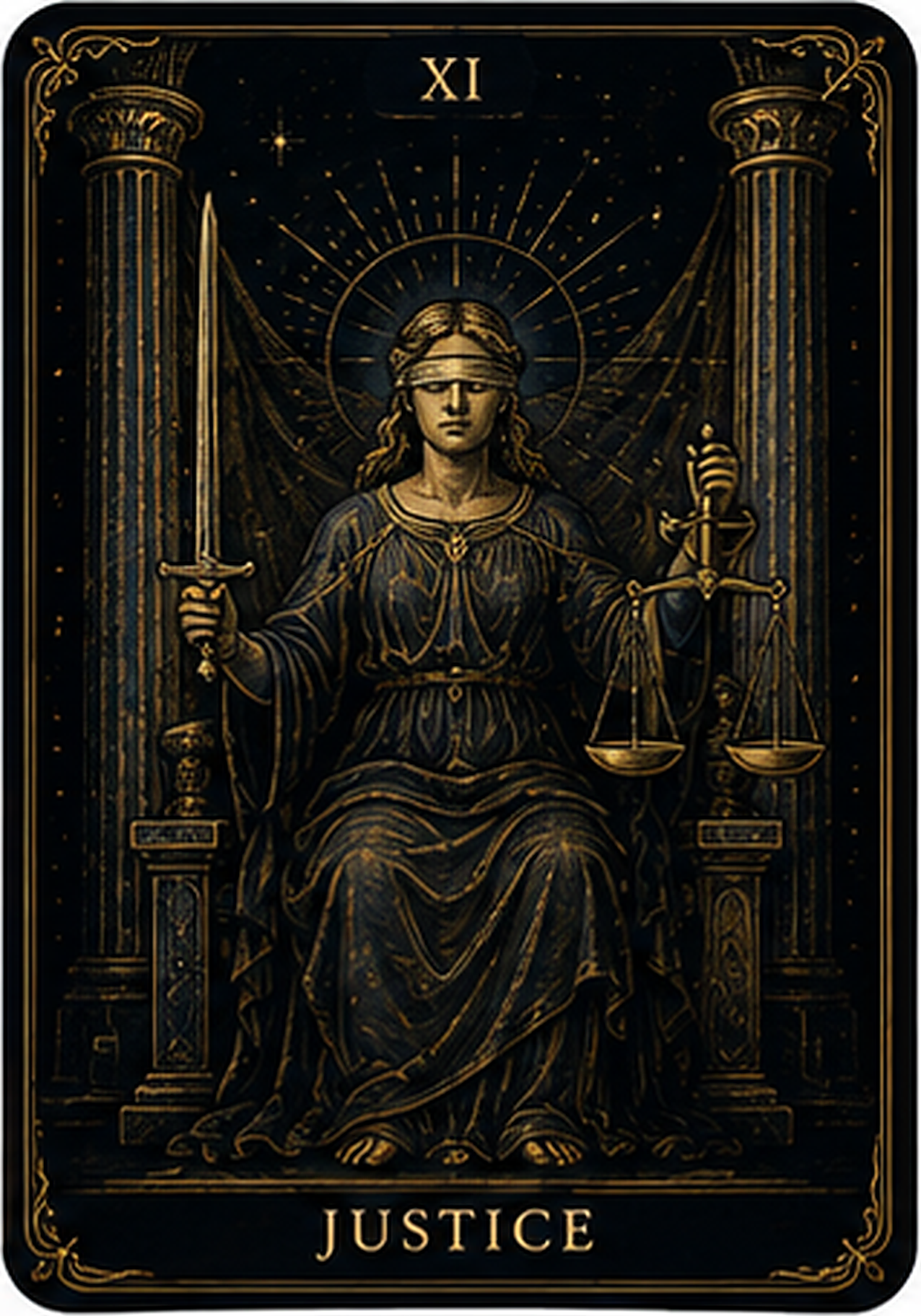
Acrowned figure sits perfectly upright and perfectly centred on a stone throne between two grey pillars, facing the viewer directly, without the faintest tilt of the head. A raised sword, double-edged, points straight upward in one hand. A set of balanced scales hangs level in the other. Unlike almost every earlier figure in this sequence, Justice looks straight out of the card, eyes fully open, meeting whoever is looking back without flinching.
Numbered XI, Justice answers the exact silence the Wheel of Fortune left behind. Where that card turned without ever once explaining itself, this one exists specifically to explain: to weigh, to judge, and, once judged, to cut cleanly and decisively with a sword that never once wavers. Chance ruled the last chapter. Consequence rules this one.
The Blindfold This Card Deliberately Refuses
The English word justice descends directly from Justitia, the Roman goddess of law and fair dealing, whose iconography spread across centuries of Western art and eventually gave the modern legal system its most familiar symbol. The now-standard blindfold, though, is a considerably later addition, most art historians date its widespread adoption to roughly the fifteenth and sixteenth centuries, layered onto a figure who, for most of antiquity, was actually shown seeing clearly.
This Archive's own zodiac chapter on Libra already traced a closely related figure, the Egyptian goddess Ma'at, who weighed a person's heart against a single feather with eyes fully open, since her tradition held that true judgment required seeing every circumstance clearly, not being shielded from it. The Rider-Waite-Smith card makes the same deliberate choice: no blindfold, a direct, level gaze meeting the viewer's own, justice imagined as clear-eyed discernment rather than the more modern ideal of studied impartiality.
What the Card Actually Shows
Her Open, Direct Gaze — seeing clearly, not blindly
Facing the viewer without a blindfold, her open eyes mark this card's judgment as something requiring full, clear-eyed attention to circumstance, not a refusal to look.
The Raised Sword — consequence, once decided
Held upright and pointed straight toward the sky, the double-edged blade marks a decision already made, decisive and irreversible once it actually falls.
The Level Scales — the weighing that comes first
Held perfectly balanced in her other hand, the scales represent the careful, unhurried comparison that always has to happen before the sword is ever allowed to move.
Her Perfectly Frontal Pose — no side she favours
Unlike nearly every other figure in this sequence, she sits facing straight ahead, symmetrical and unturned, refusing to lean toward either side of whatever she is weighing.
The Two Grey Pillars — an echo of earlier authority
The same muted pillars this Archive has already traced through the High Priestess and the Hierophant reappear here, judgment claiming its place alongside the deck's other seated authorities.
Her Purple Cloak — authority, not warmth
A deep, formal purple drapes the throne, marking real power without any of the Empress's softer, more nurturing colour palette.
Upright and Reversed
Upright, Justice favours truth, fair dealing, and consequences that finally, cleanly catch up with their cause, a contract honoured, a wrong acknowledged, a decision made only after every relevant fact was actually weighed. It rarely appears to suggest an easy outcome; it appears when an honest reckoning, whatever it ultimately reveals, is exactly what a situation genuinely needs.
Reversed, the card points either to dishonesty and unfairness, a process corrupted or a truth deliberately avoided, or to judgment rendered too quickly, harshly, or without the compassion this card's own careful weighing was always supposed to require. Some readers use the reversed card to describe consequences delayed rather than avoided entirely, a debt still owed that has simply not yet come due.
Justice in Love
Drawn upright in a love reading, Justice commonly points to a relationship built on real fairness, honesty spoken plainly rather than managed carefully, a genuine, mutual give-and-take neither partner is quietly keeping score against the other over. It favours decisions made with clear eyes rather than convenient blind spots, a difficult conversation held honestly rather than avoided to keep the peace.
It can also mark a formal turning point, an engagement, a marriage, a legal separation, any moment where a relationship's terms are finally made explicit and binding rather than left comfortably vague. Reversed, it can describe real imbalance, one partner giving considerably more than they receive, dishonesty finally catching up with a relationship that was built partly on avoiding an uncomfortable truth, or a breakup handled unfairly by one side.
Justice in Work and Money
In a career reading, Justice frequently appears around legal agreements, contracts, negotiations, and formal decisions, and favours careful, honest dealing over any shortcut that looks appealing only because no one has checked the fine print yet. It can also describe overdue recognition, a promotion or reward finally arriving for work that genuinely earned it, or, just as often, accountability finally arriving for work that quietly did not.
With money specifically, the card describes financial honesty, a budget that actually reflects reality, a debt acknowledged rather than avoided, taxes and legal obligations handled properly rather than gambled on going unnoticed. Reversed, it warns of legal complications, an unfair contract, or dishonesty in a financial matter that has simply not yet been caught, a debt still quietly accruing interest.
Strengths, Weaknesses, and the Thin Line Between Them
The Light
- Fairness. A genuine, careful weighing of every side.
- Honesty. Truth spoken plainly, even when inconvenient.
- Accountability. Owning a consequence rather than dodging it.
- Clarity. Seeing a situation exactly as it actually is.
- Integrity. Decisions that hold up under real scrutiny.
The Shadow
- Rigidity. Fairness applied with no room for real nuance.
- Harshness. Honesty delivered without any actual care.
- Self-righteousness. Accountability demanded of everyone but the self.
- Coldness. Clarity that has stopped noticing anyone's feelings.
- Punitiveness. Integrity twisted into an excuse for cruelty.
Justice Beside Other Cards
Beside the Wheel of Fortune, card X, the pairing this Archive named plays out exactly as promised: chance's blind turning, finally met by a figure who insists on weighing every outcome properly before deciding what it actually means. Beside the very next card in the sequence, the Hanged Man, card XII, the deck sets up a pointed contrast in method: this card decides, cuts, and acts, while the Hanged Man, deliberately, chooses to do none of those things at all.
A further echo waits much later in the deck, beside Temperance, card XIV: two different pictures of balance, one held perfectly still on a fixed set of scales, the other kept alive through constant, patient motion between two vessels.
Correspondences of Justice
Justice Across the Great Traditions
Tarot de Marseille — La Justice, at position VIII
Seated frontally with sword and scales in the same basic composition this chapter has already described, but numbered VIII in the original sequence, before the Golden Dawn's later reordering this Archive's Strength chapter already traced.
Rider-Waite-Smith — open eyes, at position XI
The clear-eyed, frontal figure this chapter has already described in full, moved to XI specifically to match Libra's place in the deck's astrological correspondence.
Thoth — Adjustment, not Justice
Crowley renamed the card entirely, calling it Adjustment rather than Justice, shifting the emphasis away from human legal judgment and toward a more impersonal, cosmic principle of cause and balance correcting itself.
What Survives Every Version — the scales, always level
Whatever name or number she carries, every tradition keeps the same essential image: a seated figure, a sword, and a set of scales that never once appears tipped in either direction.
What This Card Actually Asks of You
The question is not whether life is fair. This card has already made its own position on that clear enough, cause and effect, weighed carefully and answered eventually. The real question is whether you are willing to look directly at your own part in whatever is currently being weighed, without a blindfold, without a convenient excuse, the same clear-eyed honesty this card refuses to look away from in anyone else.
Drawn in a reading, Justice is rarely asking the querent to punish themselves, or anyone else, more severely. It is asking for an honest accounting, first, before any sword is allowed to actually move. This Archive's opening Tarot chapter called the whole deck a mirror rather than a fortune, and this card holds up one of its most exacting reflections: proof that consequence was always coming, and a plain invitation to meet it with open eyes rather than wait, blindfolded, for it to simply arrive.
a sword stays raised but has not yet fallen,
and a pair of open eyes keeps watching, clearly, for the exact moment the weighing is finally finished.
A Roman goddess whose blindfold arrived centuries after her own name did, an Egyptian goddess who weighed a whole heart against a single feather with her eyes wide open, a card that chose, deliberately, to see rather than to look away: every version of this figure has always been asking the same plain question. Not whether the outcome will be kind, but whether you are willing to actually look at it clearly before it arrives.
FOR THE CURIOUS
Justitia's iconography and the later historical addition of the blindfold are documented across art historical scholarship. Ma'at's open-eyed weighing of the heart is discussed further in this Archive's own Libra chapter. The Rider-Waite-Smith imagery described in this chapter is Pamela Colman Smith's 1909 design. The Thoth deck's reinterpretation as "Adjustment" is Aleister Crowley and Lady Frieda Harris's, completed across the 1940s.
Next in Tarot: Chapter Fourteen, The Hanged Man, the decisive cut this card just made, met with a deliberate refusal to act at all.
The rest of this is yours, not a type.
Reveal my chart