Strength
Strength
The Same Lesson, Without a Closed Fist
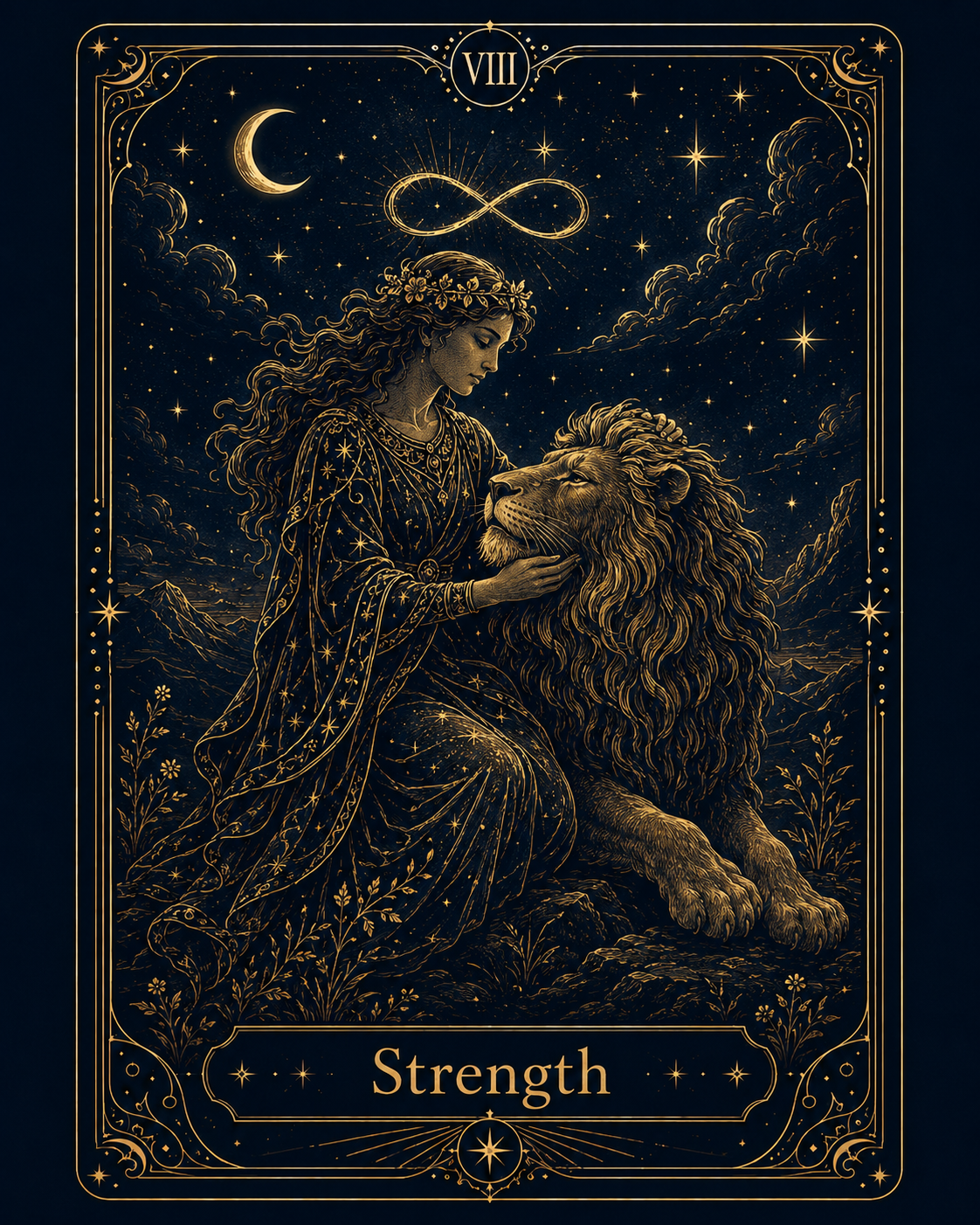
Awoman in flowing white stands calmly beside a lion, flowers woven through her hair and around her waist, both hands resting on the animal's open jaw without the faintest sign of tension in her posture. The lion is not straining against her. It looks, if anything, almost affectionate, its whole enormous body settled and at ease beneath her bare, unarmoured hands. Above her head floats the same infinity symbol this Archive already traced above the Magician's own raised hand.
Numbered VIII, Strength answers the exact question the Chariot left open: whether opposing force can only ever be held together by will and control. Here, the same essential task, mastering something powerful enough to tear a person apart, is accomplished instead through patience, calm, and a closeness the lion has apparently chosen not to fight. Nothing here was won by force. Everything here was won by staying gentle long enough for the force to stop needing to resist at all.
The Myth This Card Was Built to Reverse
One of the Twelve Labours of Hercules required him to defeat the Nemean Lion, a beast whose hide could not be pierced by any weapon, forcing Hercules to wrestle and strangle the creature with his bare hands, a victory won entirely through overwhelming, violent force. It is one of classical mythology's clearest images of strength as raw physical domination, exactly the kind of strength this card's title would seem, at first glance, to be about.
The Rider-Waite-Smith card offers the opposite image on purpose: no wrestling, no visible struggle, a lion whose jaw is held not shut by force but calmed into stillness. A separate biblical thread offers a closer parallel than Hercules ever could: Daniel, thrown into a den of lions and left entirely unharmed, survived not by overpowering the animals but by remaining, through faith and calm, someone the lions had no real reason to attack. This card borrows Hercules' animal and Daniel's method, strength measured not by what a person can force, but by what no longer needs forcing at all.
What the Card Actually Shows
Her Bare Hands — no weapon, no armour
She touches the lion with nothing but her own unarmoured hands, the clearest possible sign that whatever is holding this animal calm was never going to be force.
The Infinity Symbol — an echo of the Magician
The same lemniscate that floated above the Magician's raised hand in card I appears again here, unlimited capability, this time turned inward on the self rather than outward onto a table of tools.
The Flowers in Her Hair and at Her Waist — softness, worn openly
Echoing the Magician's own garden and the acolytes' floral robes this Archive has already traced, the flowers mark gentleness as a genuine strength, not a decorative afterthought.
Her Calm, Untroubled Expression — composure, not suppression
Nothing in her face suggests strain or restrained fear; her composure looks entirely genuine, mastery that costs her visibly nothing to maintain.
The Lion's Relaxed Posture — trust, not submission
The lion's body shows no tension, no crouch, no bared teeth, closer to a creature that has chosen to stay than one that has simply been overpowered.
The White Robe — purity, echoed from earlier cards
Her plain white dress recalls the same purity this Archive has already traced through the Lovers and the High Priestess, innocence here proven strong enough to hold something genuinely dangerous.
Upright and Reversed
Upright, Strength favours patience, compassion, and quiet inner confidence over any louder, more visible show of dominance, a difficult person or situation handled through steadiness rather than confrontation, an instinct or fear mastered gently rather than suppressed by force. It rarely appears to suggest a fight is coming; it appears when calm, sustained presence is genuinely the more effective response.
Reversed, the card most often points to self-doubt, a courage that has quietly gone missing exactly when it was needed, or the opposite extreme entirely: force used where gentleness was actually called for, aggression standing in for a composure that has run out. Some readers use the reversed card to describe someone forcing an issue precisely because they no longer trust their own calm to be enough.
Strength in Love
Drawn upright in a love reading, Strength commonly points to a relationship steadied by patience and compassion rather than confrontation, real conflict met with calm instead of escalation, a partner's rougher edges handled with gentleness rather than an attempt to control or suppress them. It favours emotional courage: the willingness to stay present through a difficult conversation rather than either fighting it or fleeing from it entirely.
It can also describe the quiet, unglamorous work of mastering one's own more difficult instincts inside a relationship, jealousy, insecurity, a temper, held with the same calm hands this card's whole image is built around. Reversed, it can point to a relationship where force, control, or raw emotional volatility has replaced genuine patience, or to someone so depleted by constant self-restraint that their calm has become suppression rather than actual peace.
Strength in Work and Money
In a career reading, Strength frequently appears when patience and steady composure will accomplish more than confrontation, a difficult colleague handled with calm rather than escalation, a setback absorbed without panic, leadership that earns trust through consistency rather than demanding it through authority. It favours quiet persistence over dramatic, forceful gestures, the slow, visible proof of competence over any single loud display of it.
With money specifically, the card describes financial discipline maintained through patience rather than anxious control, weathering a difficult stretch calmly instead of making panicked, forceful decisions under pressure. Reversed, it warns of burnout from constant self-restraint, insecurity dressed up as false confidence, or a genuinely difficult situation finally handled through force after patience alone was pushed well past its limit.
Strengths, Weaknesses, and the Thin Line Between Them
The Light
- Compassion. Meeting something difficult with genuine care.
- Patience. Staying present without forcing a faster outcome.
- Inner courage. Calm that holds even near real danger.
- Self-mastery. Instinct held gently, not simply suppressed.
- Quiet confidence. Strength that never needs to be performed.
The Shadow
- Self-doubt. Courage that quietly goes missing when needed.
- Impatience. Calm abandoned the moment it gets difficult.
- Suppression. Instinct forced down rather than genuinely met.
- Burnout. Self-mastery maintained until nothing is left.
- Bravado. Confidence performed loudly to hide its absence.
Strength Beside Other Cards
Beside the Chariot, card VII, the comparison this Archive named plays out exactly as promised: the same underlying task, mastering a powerful, opposing force, solved once through will and once through calm. Beside the Magician, card I, a quieter echo surfaces: the same infinity symbol crowns them both, unlimited capability, though the Magician turns his outward onto a table of tools while this card turns hers entirely inward, onto her own instinct.
Her most forward-looking pairing sits with the very next card in the sequence, the Hermit, card IX: taming accomplished here in the open, beside a very real lion, followed immediately by a figure who withdraws from the world entirely to examine that same instinct alone, in private, by lantern-light.
Correspondences of Strength
Strength Across the Great Traditions
Tarot de Marseille — La Force, at position XI
A woman in a hat shaped like the number eight forces open, or shut, a lion's mouth with visibly more effort than the Rider-Waite-Smith deck's calm serenity, strength here still leaning closer to a real physical contest.
Rider-Waite-Smith — the gentle taming
The flower-crowned, calm-handed figure this chapter has already described in full, at position VIII, moved there deliberately to match her sign.
Thoth — Lust, force embraced rather than tamed
Crowley controversially renamed the card entirely, depicting a woman riding a seven-headed beast in considerably more primal, Dionysian imagery, strength here less about calming raw force than about riding it fully, awake and unafraid.
What Survives Every Version — a woman, and something wild
Wrestled, calmed, or ridden outright, every tradition keeps the same core relationship: a woman and a dangerous animal, sharing the same card, never once actually enemies.
What This Card Actually Asks of You
The question is not whether you are strong enough to win the fight. This card almost never appears to suggest a battle needs winning at all; the lion, by the time the reader ever sees it, has already stopped fighting. The real question is whether you are calm enough, and patient enough, to be the reason it stopped, rather than reaching for force the moment things felt genuinely dangerous.
Drawn in a reading, Strength is rarely asking the querent to become more powerful. It is asking them to trust that the gentler, quieter response was never actually the weaker one. This Archive's opening Tarot chapter called the whole deck a mirror rather than a fortune, and this card holds up one of its most reassuring reflections: proof that the hardest, most dangerous things in a life do not always require a raised fist to hold, only a steady hand willing to stay.
flowers still woven through hair that never once needed to brace for a fight,
and the exact same infinity that once crowned a raised hand now crowns a gentle one instead.
Hercules strangled the Nemean Lion with his bare hands, a victory measured in force. Daniel survived a den of lions through faith alone, a victory measured in calm. This card borrowed the animal from one story and the method from the other, and never once suggested that gentleness was the weaker choice between them.
FOR THE CURIOUS
The myth of Hercules and the Nemean Lion is recorded across classical sources on the Twelve Labours. The story of Daniel in the lions' den appears in the Book of Daniel, chapter 6. The Marseille-to-Rider-Waite-Smith reordering of Strength and Justice is documented in tarot historical scholarship on the Golden Dawn's astrological correspondence system. The Thoth deck's reinterpretation as "Lust" is Aleister Crowley and Lady Frieda Harris's, completed across the 1940s.
Next in Tarot: Chapter Eleven, The Hermit, the same calm mastery, now turned entirely inward.
The rest of this is yours, not a type.
Reveal my chart