Temperance
Temperance
The Cleared Ground, Finally Beginning to Heal
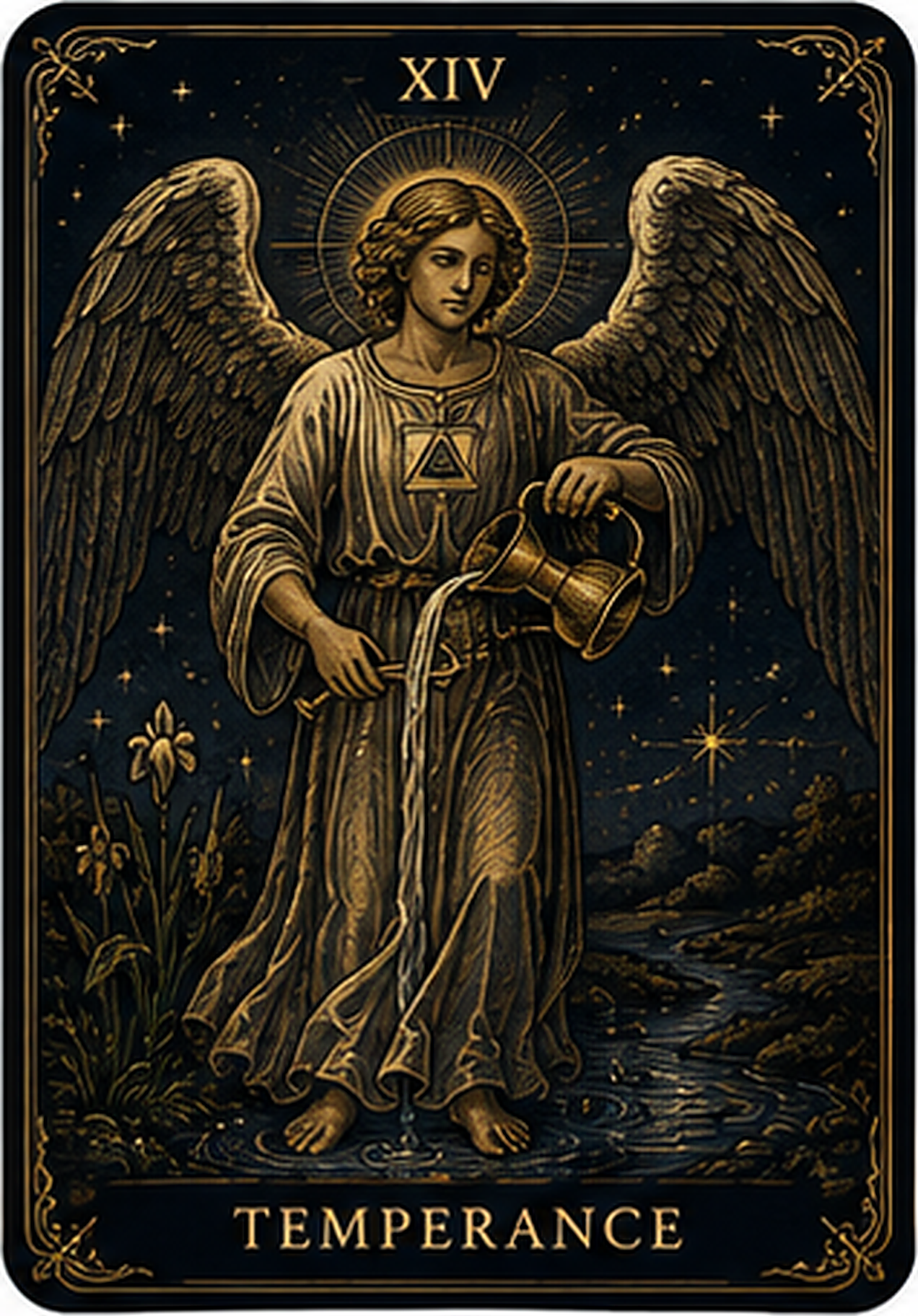
Awinged figure stands with one foot resting on solid ground and the other submerged in flowing water, pouring a stream of liquid between two cups held in either hand, never spilling a single drop despite never once looking down to check. Behind the figure, a quiet path leads toward distant mountains, where a soft light glows above the peaks like the promise of a summit not yet reached.
Numbered XIV, Temperance answers the raw, stark clearing of the previous card with something considerably gentler: not a new beginning built from nothing, but a patient, careful blending of what remains. Where Death cut cleanly and moved on without looking back, this card stays, and mixes, and waits, for exactly as long as genuine healing actually takes.
A Virtue Older Than the Deck Itself
Plato's Republic named four virtues considered foundational to a well-ordered soul and a well-ordered state: wisdom, courage, justice, and temperance, later carried into Christian moral theology by thinkers including Thomas Aquinas, who treated moderation not as a mild absence of excess but as an active, disciplined skill in its own right. This Archive has now traced three of those four classical virtues directly into the Major Arcana, Strength standing in for courage, Justice keeping its own name outright, and this card carrying temperance's old philosophical weight forward almost unchanged.
A second, equally old tradition runs alongside the philosophical one: alchemy's endless pouring between two vessels, an image tied to the alchemical principle solve et coagula, dissolve and combine, the patient, repeated blending required to transform base material into something considerably finer. The angel's continuous stream, never spilled despite the impossible physics of pouring uphill between two cups at once, borrows directly from that alchemical imagination: opposites blended not through force, but through endless, careful patience.
What the Card Actually Shows
One Foot on Land, One in Water — standing between two worlds
The angel occupies neither the solid, material shore nor the fluid, emotional water fully, balanced deliberately between both at once.
The Continuous Pour — blending, without spilling
Liquid streams between two cups without a single drop lost, patience skilled enough to keep two different things flowing together rather than colliding.
The Alchemical Symbol on the Robe — spirit and matter, united
A square set within a triangle marks the union of the material and the spiritual, the exact combination this card's whole patient blending is quietly working toward.
Large, Watchful Wings — guidance, close at hand
Often associated by readers with the archangel Michael, the wings mark this figure as guidance offered gently rather than authority imposed from a distance.
The Distant Mountains and Light — a summit, not yet reached
A path leads toward far-off peaks crowned with a soft glow, the destination this careful blending is heading toward, patiently, one step at a time.
The Irises at the Water's Edge — hope, growing where healing happens
Flowers bloom quietly where land meets water, life returning precisely at the point where two different states are learning to meet each other.
Upright and Reversed
Upright, Temperance favours patience, moderation, and the careful, unhurried blending of two things that need each other to actually work: two personalities, two priorities, two halves of a life pulled in different directions. It rarely appears to describe an easy stillness; it appears when active, ongoing effort is exactly what a healthy balance genuinely requires.
Reversed, the card points to imbalance, one side of the pour taking over entirely at the other's expense, impatience that abandons the slow blending process before it was ever actually finished, or extremes that refuse each other's company at all. Some readers use the reversed card to describe a healing process interrupted too soon, forced back into ordinary life before it had genuinely finished doing its work.
Temperance in Love
Drawn upright in a love reading, Temperance commonly points to real compromise, patiently reached rather than grudgingly forced, two different personalities, backgrounds, or paces finding a genuine middle ground neither person had to fully sacrifice themselves to reach. It favours healing after conflict, a relationship rebuilding trust slowly and deliberately after real damage, rather than pretending the damage never happened.
It can also describe the particular skill of loving someone genuinely different from yourself, blending two ways of seeing the world without either one erasing the other. Reversed, it can point to a relationship out of balance, one partner giving considerably more than the other, or impatience derailing a healing process that genuinely needed more time than either person was willing to give it.
Temperance in Work and Money
In a career reading, Temperance frequently appears when steady, patient progress will actually accomplish more than any dramatic leap, competing priorities finally brought into genuine balance, a team or partnership blending different working styles into something that actually functions. It favours the long, careful integration over the fast, fragile shortcut.
With money specifically, the card describes patient, disciplined financial planning, a budget carefully balanced between present needs and future goals rather than swinging between extremes. Reversed, it warns of overextension in one direction, excess spending or excess restriction, a financial plan thrown off balance by impatience, or a partnership whose different approaches have never actually been blended into anything workable.
Strengths, Weaknesses, and the Thin Line Between Them
The Light
- Patience. Willingness to let a slow process finish properly.
- Balance. Two different things, genuinely brought together.
- Healing. Real integration, given the time it actually needs.
- Moderation. Neither extreme allowed to take over entirely.
- Harmony. A blend that genuinely works for everyone involved.
The Shadow
- Impatience. Abandoning the pour before it was finished.
- Imbalance. One side dominating what should have been shared.
- Avoidance. Healing skipped rather than actually undertaken.
- Excess. An extreme allowed to overtake the middle path.
- Discord. A blend that never actually managed to combine.
Temperance Beside Other Cards
Beside Death, card XIII, the promise this Archive named plays out exactly as expected: the stark, decisive clearing that card performed, finally met by patient, careful healing. This Archive's own Justice chapter already named a second pairing: two different pictures of balance, one held perfectly still on a fixed set of scales, the other kept alive through constant, gentle motion between two vessels.
Her most cautionary pairing sits with the very next card in the sequence, the Devil, card XV: healthy, patient blending, immediately followed by the deck's clearest picture of what happens when moderation is abandoned entirely, excess and imbalance taken all the way to their shadow extreme.
Correspondences of Temperance
Temperance Across the Great Traditions
Tarot de Marseille — a simpler figure, pouring
Shown as an ordinary human figure rather than an explicitly winged angel, pouring between two vessels with the same core composition this chapter has already described, but without the Rider-Waite-Smith deck's celestial staging.
Rider-Waite-Smith — the angel between two worlds
The winged, one-foot-on-land figure this chapter has already described in full, balance framed as genuinely spiritual work rather than simple restraint.
Thoth — Art, not Temperance
Crowley renamed the card entirely, calling it Art rather than Temperance, framing the same continuous pour as a creative, alchemical act of composition rather than a moral virtue of restraint.
What Survives Every Version — the pour, never spilled
Ordinary figure, celestial angel, or alchemical artist, every tradition keeps the same core image: two vessels, and a stream between them that never once actually stops.
What This Card Actually Asks of You
The question is not whether you can find balance instantly. This card never once shows the pour finishing; it shows the pour continuing, patiently, for as long as it needs to. The real question is whether you are willing to keep tending two things that need each other, neither one abandoned, neither one allowed to overtake the other, for exactly as long as genuine integration actually requires.
Drawn in a reading, Temperance is rarely asking the querent to choose one side over the other. It is asking them to keep pouring, steadily, between both. This Archive's opening Tarot chapter called the whole deck a mirror rather than a fortune, and this card holds up one of its most patient reflections: proof that healing was never going to arrive all at once, and a plain reminder that the slow, careful blending is not a delay before the real work begins. It already is the real work.
a stream still flows steadily between two cups that never once spill,
and a soft light keeps glowing above distant mountains, patiently, for as long as the walk actually takes.
One of philosophy's oldest virtues, an alchemist's endless careful pour between two vessels, an angel who has never once looked down to check the stream is still flowing: every version of this card has always been asking the same plain question. Not how quickly you can heal, but whether you are willing to keep pouring, patiently, for exactly as long as healing actually takes.
FOR THE CURIOUS
Plato's four cardinal virtues appear in the Republic; their later Christian theological treatment is developed by Thomas Aquinas among others. The alchemical principle solve et coagula is documented across scholarship on Western esoteric and alchemical traditions. The Rider-Waite-Smith imagery described in this chapter is Pamela Colman Smith's 1909 design. The Thoth deck's reinterpretation as "Art" is Aleister Crowley and Lady Frieda Harris's, completed across the 1940s.
Next in Tarot: Chapter Seventeen, The Devil, this card's patient balance meeting its own darkest temptation to simply stop trying.
The rest of this is yours, not a type.
Reveal my chart