The Chariot
The Chariot
The Choice, Finally Given Forward Motion
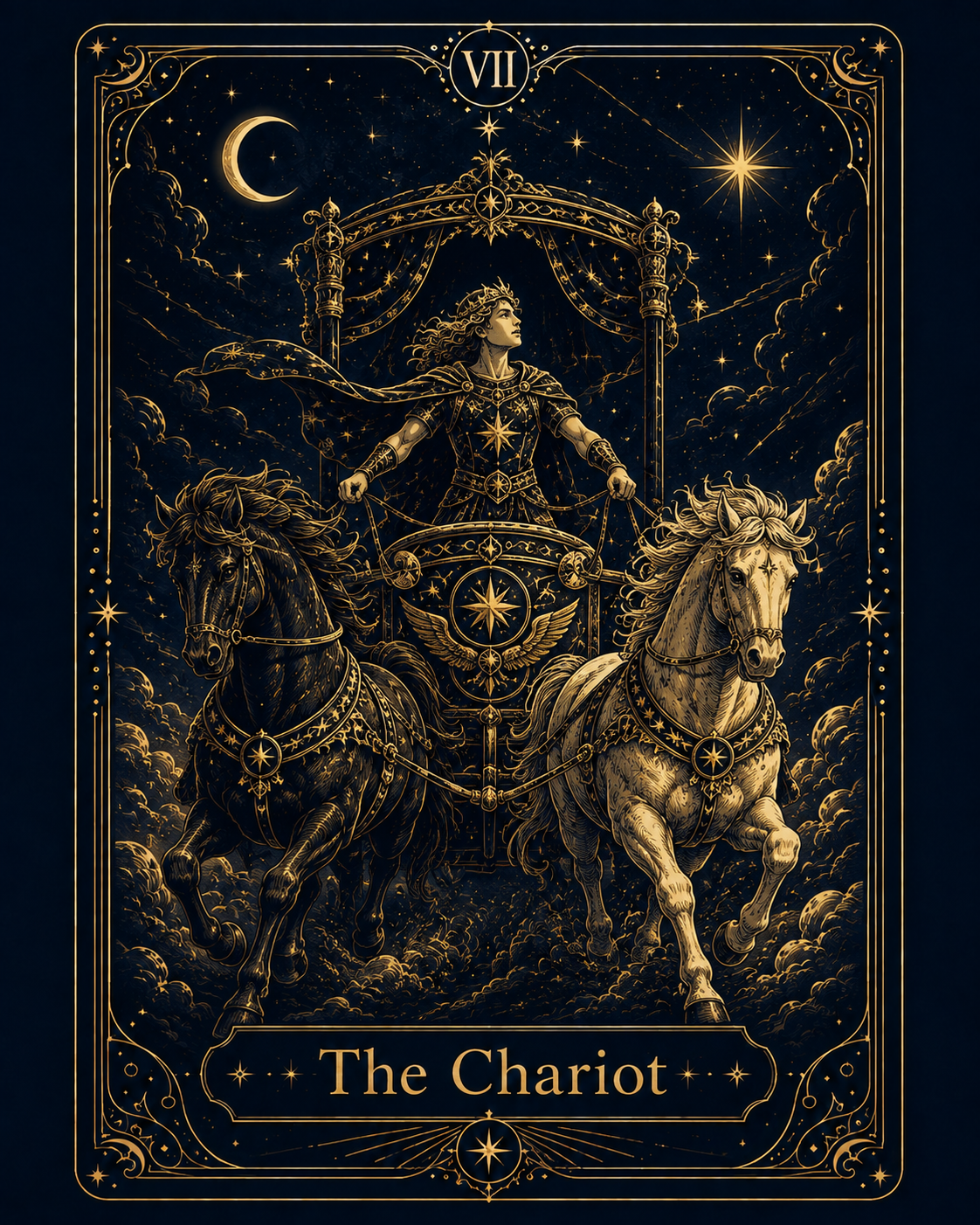
Ayoung warrior stands upright inside a stone chariot, armoured, calm, entirely still despite the vehicle beneath him being built for nothing but motion. Two sphinxes, one black, one white, are harnessed before him, facing in visibly different directions, straining, it would seem, toward two separate outcomes. He holds no reins at all. Whatever keeps this chariot moving forward in one unified line is not attached to his hands.
Numbered VII, the Chariot describes the exact discipline the Lovers' choice actually required all along: two opposing forces, held together and pointed the same direction not through restraint, but through sheer, focused will. Where the Emperor built a fence around his field, this card builds nothing at all. It simply refuses to let two pulling forces tear its own forward motion apart.
The Victory Parade That Never Left the Deck
Ancient Rome staged the triumph, a formal procession granted only to a victorious general, who rode through the city in an ornate chariot while crowds gathered to watch, the closest thing the Roman world offered to a living, breathing tarot card. The earliest Italian decks drew directly on that same image, a triumphant rider crossing from the disorder of battle into the settled order of the city walls behind him, exactly the same walled town that still sits quietly in the background of the modern card.
A second, older thread runs alongside the Roman parade: solar chariot mythology, present across an unusually wide range of cultures this Archive has already traced. Apollo and Helios drive the sun itself across the Greek sky each day; the Vedic sun god Surya, already introduced in this Archive's own Vedic Astrology chapter, rides a chariot pulled by seven horses in a nearly identical image of controlled, radiant motion. The Chariot's rider inherits both stories at once: the mortal general's earned homecoming, and the god's daily, disciplined crossing of the sky.
What the Card Actually Shows
The Missing Reins — will, with nothing to physically hold
The charioteer's hands hold no reins whatsoever, the single clearest sign in the whole card that whatever keeps this vehicle moving forward is discipline, not mechanism.
The Black and White Sphinxes — opposing forces, held in one line
Facing in visibly different directions, the two sphinxes echo the High Priestess's own pillars, opposites this time not merely witnessed, but actually driven forward together.
The Starry Canopy — cosmic backing, overhead
A star-studded awning shelters the rider, the same celestial imagery this Archive already traced through the Empress's crown, abundance now given direction rather than simply grown.
The Crescent Moons on His Shoulders — Cancer, worn as armour
Lunar plates guard each shoulder, tying the rider directly to this card's ruling sign, feeling and instinct here disciplined into something that can actually carry weight.
The City Behind Him — the order he is leaving
A walled town recedes into the distance, the structured world this Archive's Emperor and Hierophant chapters already built, now a starting point rather than a destination.
His Belt of Zodiac Symbols — the whole sky, worn as a sash
A band decorated with astrological glyphs circles his waist, mastery not of one force but of the entire wheel this Archive has spent its whole astrology sections tracing.
Upright and Reversed
Upright, the Chariot favours determination, momentum, and victory earned through sustained, focused effort, an obstacle actually overcome rather than avoided, a goal pursued with the same calm control this card's rider shows despite the visible tension pulling at either side of him. It rarely appears to describe an easy win; it appears when the win was genuinely hard, and happened anyway.
Reversed, the card warns of exactly the opposite outcome: the two opposing forces finally winning, direction lost, effort scattered across too many competing goals to actually move any of them forward. It can describe aggression standing in for genuine control, someone forcing an outcome through sheer stubbornness rather than the calm discipline this card's upright meaning actually requires.
The Chariot in Love
Drawn upright in a love reading, the Chariot commonly points to a relationship, or a pursuit of one, that requires real determination: distance overcome, a difficult conversation finally had, two people with genuinely different instincts choosing, deliberately, to keep moving in the same direction anyway. It favours effort spent holding a relationship's opposing forces, one partner's caution and the other's urgency, one person's need for space and the other's need for closeness, together in forward motion rather than letting either side simply win.
Its shadow surfaces whenever that same determination tips into control: a partner steering the relationship entirely on their own terms, willpower substituted for genuine compromise. Reversed, it can describe a relationship pulled in two directions at once, both people wanting fundamentally different things and refusing to admit it, or someone trying to force forward momentum in a connection that has already, quietly, stopped moving.
The Chariot in Work and Money
In a career reading, the Chariot frequently appears when success is genuinely available, but only through sustained, disciplined effort: a competitive promotion, a difficult negotiation, a project with real obstacles that only actually clears them because someone refused to let it stall. It favours ambition paired with real control, ego and instinct held in the same forward line rather than fighting each other for the wheel.
With money specifically, the card describes financial goals achieved through focused determination, debt paid down through sheer discipline, a target reached because someone simply refused to let two competing priorities derail the plan. Reversed, it warns of burnout from pushing too hard without ever pausing, aggressive tactics that damage relationships they were meant to win, or ambition finally torn apart by two goals that were never actually compatible.
Strengths, Weaknesses, and the Thin Line Between Them
The Light
- Determination. Effort sustained past the point it got difficult.
- Self-mastery. Opposing impulses held in one deliberate line.
- Focus. A single clear direction, chosen and kept.
- Confidence. Calm that holds even while the ride gets rough.
- Triumph. A victory that was genuinely, visibly earned.
The Shadow
- Aggression. Determination that has stopped noticing the cost.
- Control. Self-mastery turned outward onto other people.
- Tunnel vision. Focus so narrow it misses what actually matters.
- Recklessness. Confidence with nothing left backing it up.
- Ruthlessness. A triumph that stopped caring how it was won.
The Chariot Beside Other Cards
Beside the Lovers, card VI, the pairing this Archive named plays out exactly as promised: a choice made honestly, now finally given real forward motion. Beside Strength, card VIII, the very next card in the sequence, the deck sets up its most direct comparison of method: this card masters opposing force through willpower and calm control, while Strength, as this Archive's next chapter will show, masters it through something considerably gentler.
Beside the Wheel of Fortune, card X, willpower meets its own honest limit: everything this card can achieve through sheer determination, set directly against the one force in the entire deck that no amount of will can actually steer.
Correspondences of the Chariot
The Chariot Across the Great Traditions
Tarot de Marseille — Le Chariot, horses in line
Usually drawn with two horses rather than sphinxes, sometimes facing the same direction rather than opposing ones, a gentler, more literal image of a straightforward journey rather than an internal struggle.
Rider-Waite-Smith — the reinless triumph
The opposing black and white sphinxes, starry canopy, and walled city this chapter has already described in full, opposition made explicit rather than smoothed away.
Thoth — the Chariot, Cancer and the Grail
Crowley and Harris leaned further into Cancer's watery, protective symbolism, adding Grail imagery and more elaborate armour, a knight bearing something sacred rather than simply returning from a fight already won.
What Survives Every Version — movement, without visible reins
Horses in line, sphinxes in opposition, or a knight bearing a Grail, every tradition keeps the same core image: real, forward motion, achieved by something other than the ordinary mechanism of control.
What This Card Actually Asks of You
The question is not whether you can make the two opposing sphinxes agree. They never do, in any printing of this card that has ever existed. The real question is whether you are willing to hold both of them in one forward line anyway, calm enough, and disciplined enough, that the disagreement between them stops being able to actually stop you.
Drawn in a reading, the Chariot is rarely asking the querent to eliminate an internal conflict. It is asking them to stop waiting for that conflict to resolve itself before moving forward at all. This Archive's opening Tarot chapter called the whole deck a mirror rather than a fortune, and this card holds up one of its more demanding reflections: proof that victory was always going to require holding two things that disagree, and a plain question about whether you are ready to actually drive with both of them still pulling.
a starry canopy still shelters a rider who holds no reins at all,
and a walled city grows smaller in the distance behind wheels that never stopped turning.
A Roman general riding home through a cheering city, a sun god crossing the sky in a chariot no different from the one worshipped an ocean away, a warrior who never once needed to hold the reins: every version of this card has always been asking the same plain question. Not whether the opposing forces will ever agree, but whether you are willing to keep moving anyway while they don't.
FOR THE CURIOUS
The Roman triumph is documented across classical sources on Roman civic and military ritual. Solar chariot mythology appears across Greek sources (Apollo and Helios) and Vedic sources (Surya), the latter discussed further in this Archive's own Vedic Astrology chapter. The Rider-Waite-Smith imagery described in this chapter is Pamela Colman Smith's 1909 design. The Thoth deck's reinterpretation is Aleister Crowley and Lady Frieda Harris's, completed across the 1940s.
Next in Tarot: Chapter Ten, Strength, the same mastery this card won by force, now won by something gentler.
The rest of this is yours, not a type.
Reveal my chart