The Devil
The Devil
The Chains No One Is Actually Holding Shut
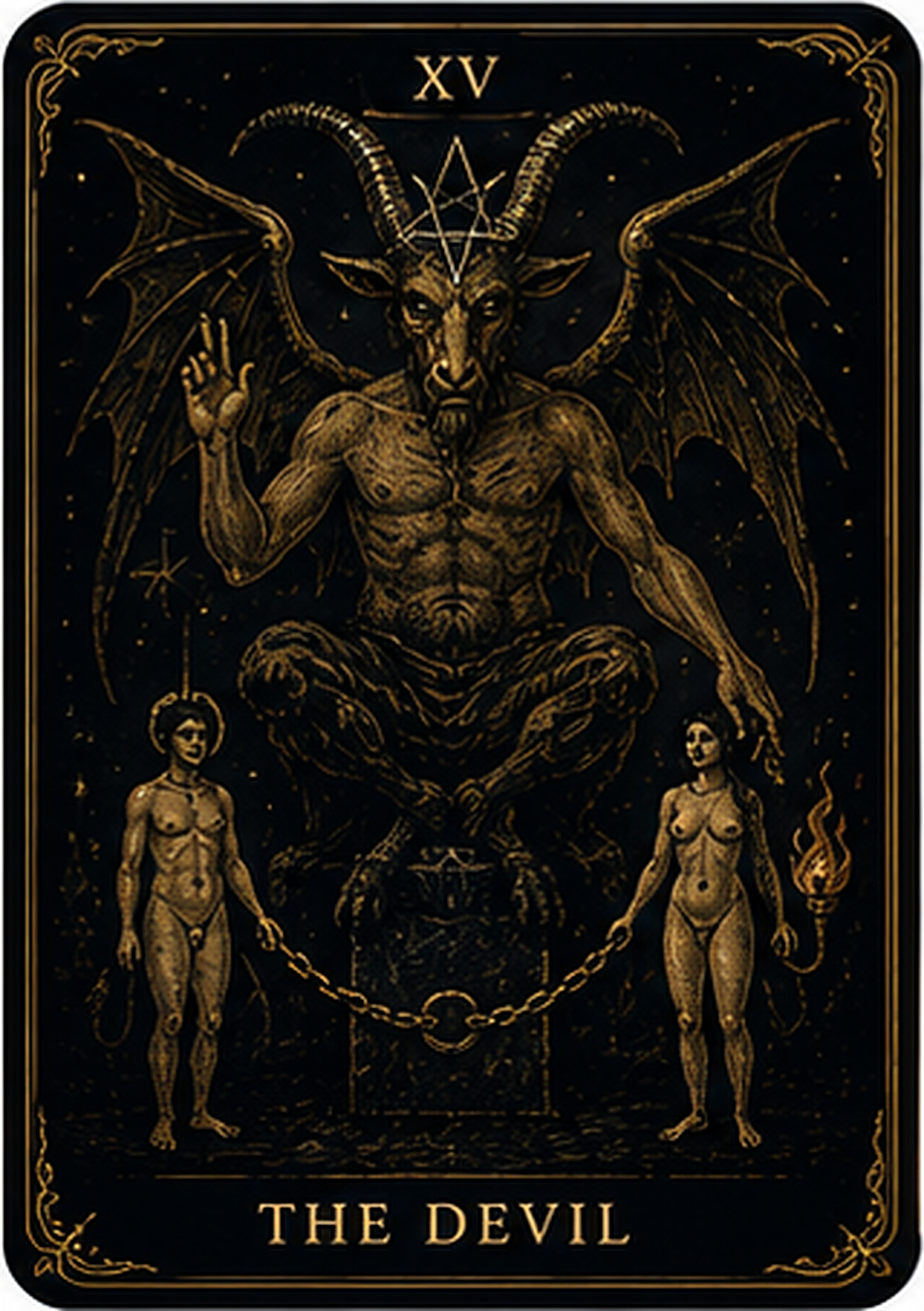
Ahorned, bat-winged figure sits enthroned on a stone pedestal, one hand raised in a dark mockery of the Hierophant's own blessing gesture, the other holding a torch pointed down toward the ground rather than up toward the sky. Beneath the throne stand a naked man and woman, chained loosely by the neck to the same pedestal, small horns and tails already beginning to grow from their own bodies, echoes of the very figure holding them captive.
Numbered XV, the Devil is this deck's clearest, most direct visual parody: the same naked man and woman this Archive already traced beneath the Lovers' blessing angel now stand beneath something considerably darker, and the composition is no accident. Look closely at the chains around their necks, though, and the card's real subject becomes obvious. They are loose enough to lift off with almost no effort at all.
A Pagan God the Church Redrew as Its Villain
Pan, the Greek god of the wild, shepherds, and rustic music, was traditionally shown with a goat's horns and legs, wild, untamed, and closely tied to nature rather than to any moral evil at all, so associated with sudden, overwhelming fear that his name gave English the word panic. Early Christian art borrowed Pan's horned silhouette directly when constructing its own visual language for the Devil, a well-documented case of an older culture's beloved nature-god being redrawn as the new religion's villain.
A second, more direct source shaped this exact card. In the fourteenth century, the powerful Knights Templar were accused, almost certainly as a pretext for seizing their considerable wealth, of secretly worshipping an idol called Baphomet, a name whose true origin remains genuinely disputed by historians. Centuries later, the nineteenth-century occultist Éliphas Lévi created a famous illustration of an androgynous, goat-headed Baphomet, one arm raised, one lowered, unmistakably informing the composition this Archive's Rider-Waite-Smith card would later adopt almost directly.
What the Card Actually Shows
The Inverted Pentagram — spirit, overruled by matter
A five-pointed star sits point-down on the figure's forehead, the same star long associated with the human form, here inverted to mark base material instinct ruling over spirit rather than the reverse.
The Mocking Blessing Gesture — a dark echo of the Hierophant
One raised hand deliberately parodies the Hierophant's own gesture of benediction, guidance twisted into something considerably less trustworthy.
The Downward Torch — light, refused
Where the Hermit raised his lantern to search, this figure holds a torch pointed at the ground, illumination deliberately declined rather than offered.
The Loose Chains — captivity, chosen rather than forced
The chains binding the two figures below are visibly slack, loose enough to simply lift away, the single most important detail in the entire card.
Their Small, New Horns and Tails — becoming what holds you
Both captives have begun growing features resembling the figure above them, a quiet warning that prolonged captivity eventually reshapes the person choosing to stay in it.
The Naked Man and Woman — the Lovers, mirrored on purpose
The exact composition of this Archive's own Lovers chapter reappears here deliberately, free choice made beneath an angel now standing in stark, intentional contrast to bondage made beneath something else entirely.
Upright and Reversed
Upright, the Devil describes real, lived captivity: addiction, an unhealthy attachment, materialism mistaken for security, a shadow pattern repeated so many times it has started to feel like simple identity rather than a genuine choice still being made. It rarely appears to suggest the situation is hopeless; it appears to point directly at the chain, and, quietly, at how loose it actually is.
Reversed, this card breaks from the usual pattern this Archive has traced across nearly every earlier chapter. Rather than describing a darker version of the same theme, it most often describes the chains actually being lifted, real, hard-won release from an addiction, a toxic relationship, or a limiting belief finally seen clearly enough to walk away from. Some readers reserve the harder reading for reversed Devil, denial that the bondage was ever self-imposed at all, but the more common meaning is the more hopeful one.
The Devil in Love
Drawn upright in a love reading, the Devil often points to an unhealthy dynamic, obsession mistaken for passion, control mistaken for care, a relationship kept alive by fear, habit, or codependency rather than genuine, ongoing choosing. It favours honesty about exactly this: whether the connection is still actually wanted, or simply still familiar.
It can also describe intense physical or sexual attraction that has started to override better judgment, a magnetism neither person is especially interested in examining too closely. Reversed, the card most often signals real, hard-won freedom, finally walking away from a toxic pattern, breaking a cycle of jealousy or possessiveness, or simply choosing, again, freely, the same partner the Lovers already blessed, this time with the chains actually removed.
The Devil in Work and Money
In a career reading, the Devil frequently appears around a job kept purely for its paycheque, a role that has quietly stopped offering any real growth, held onto out of fear rather than any genuine remaining reason. It favours honest reckoning over comfortable denial, actually checking whether the chain is still locked before assuming it must be.
With money specifically, the card can describe materialism mistaken for genuine security, compulsive spending, or a scarcity mindset that has calcified into real fear even once the original threat has long since passed. Reversed, it most often describes exactly the freedom this card's reversed meaning usually promises: leaving the safe, dead-end position, breaking a compulsive financial habit, or simply recognising, at last, that the supposed trap was never actually locked.
Strengths, Weaknesses, and the Thin Line Between Them
The Light
- Honesty. Seeing a real attachment clearly, without flinching.
- Self-awareness. Recognising a shadow pattern for what it is.
- Freedom. Actually lifting a chain, once it is finally checked.
- Power. Remembering the choice was always still available.
- Release. Letting go of what was never truly locked at all.
The Shadow
- Denial. Insisting the chain was forced, never chosen.
- Addiction. A pattern repeated until it feels like identity.
- Materialism. Security mistaken for something it can never be.
- Obsession. Attachment so intense it overrides better judgment.
- Helplessness. Believing the chain was never yours to remove.
The Devil Beside Other Cards
Beside the Lovers, card VI, the pairing this Archive named all the way back in its own chapter plays out exactly as promised: the same naked man and woman, once blessed beneath an open sky, now chained loosely beneath something considerably darker. Beside Temperance, card XIV, the promise made just one chapter ago also lands: patient, healthy balance, abandoned entirely for its own shadow extreme.
A third thread, older still, finally closes here too. This Archive's own Emperor chapter warned that every fence he builds is eventually tested, and that some fences, built too rigid to bend, only ever come down through sudden collapse. This card is exactly that fence, grown so comfortable it has quietly become a cage, and the very next chapter, the Tower, card XVI, is where it finally, violently, comes down.
Correspondences of the Devil
The Devil Across the Great Traditions
Tarot de Marseille — Le Diable, cruder and stranger
Shown in a considerably more grotesque, less refined style than later decks, chained figures beneath a horned tormentor establishing the core composition every later version would go on to refine.
Rider-Waite-Smith — Baphomet, loosely chained
The goat-headed, inverted-pentagram figure this chapter has already described in full, its captives given the crucial detail every earlier tradition left out: chains loose enough to simply remove.
Thoth — the Devil, reclaimed as raw force
Crowley and Harris leaned explicitly into Pan and fertility symbolism, framing the card less as moral bondage and more as untamed, generative, natural force, uncomfortable to some readers precisely because it withholds easy judgment.
What Survives Every Version — a captivity, never fully explained
Grotesque tormentor, precise Baphomet, or raw natural force, every tradition keeps the same essential structure: two figures, a larger presence above them, and a bondage the card itself never quite claims is actually permanent.
What This Card Actually Asks of You
The question is not whether something has you trapped. This card rarely appears to describe a genuine, external prison; it appears, almost always, at the exact point a person has stopped checking whether the chain around their own neck is actually still locked. The real question is whether you are willing to reach up, honestly, and find out.
Drawn in a reading, the Devil is rarely asking the querent to fight some outside force. It is asking them to stop assuming the fight is even necessary. This Archive's opening Tarot chapter called the whole deck a mirror rather than a fortune, and this card holds up one of its most confronting reflections: proof that a captivity carried long enough starts to feel permanent, and a plain, patient reminder that very few chains in this particular deck were ever actually welded shut.
a torch stays pointed at the ground rather than the sky,
and no one in the whole scene has ever once reached up to check what was actually holding them there.
A wild god of shepherds and rustic music, redrawn centuries later as a villain; a wealthy order accused of worshipping an idol most historians now doubt ever existed as described; the same two lovers, once blessed beneath an open sky, now standing beneath something else entirely: every version of this card has always been asking the same plain, uncomfortable question. Not what is holding you. Whether you have actually checked.
FOR THE CURIOUS
Pan's iconography and its absorption into later Christian imagery of the Devil is documented across comparative religious scholarship. The Knights Templar's Baphomet accusation and Éliphas Lévi's nineteenth-century illustration are discussed across historical and occult scholarship. The Rider-Waite-Smith imagery described in this chapter is Pamela Colman Smith's 1909 design. The Thoth deck's reinterpretation is Aleister Crowley and Lady Frieda Harris's, completed across the 1940s.
Next in Tarot: Chapter Eighteen, The Tower, the fence this whole Archive has been quietly warning about, finally coming down.
The rest of this is yours, not a type.
Reveal my chart