The Emperor
The Emperor
The Wild Field, Given a Fence
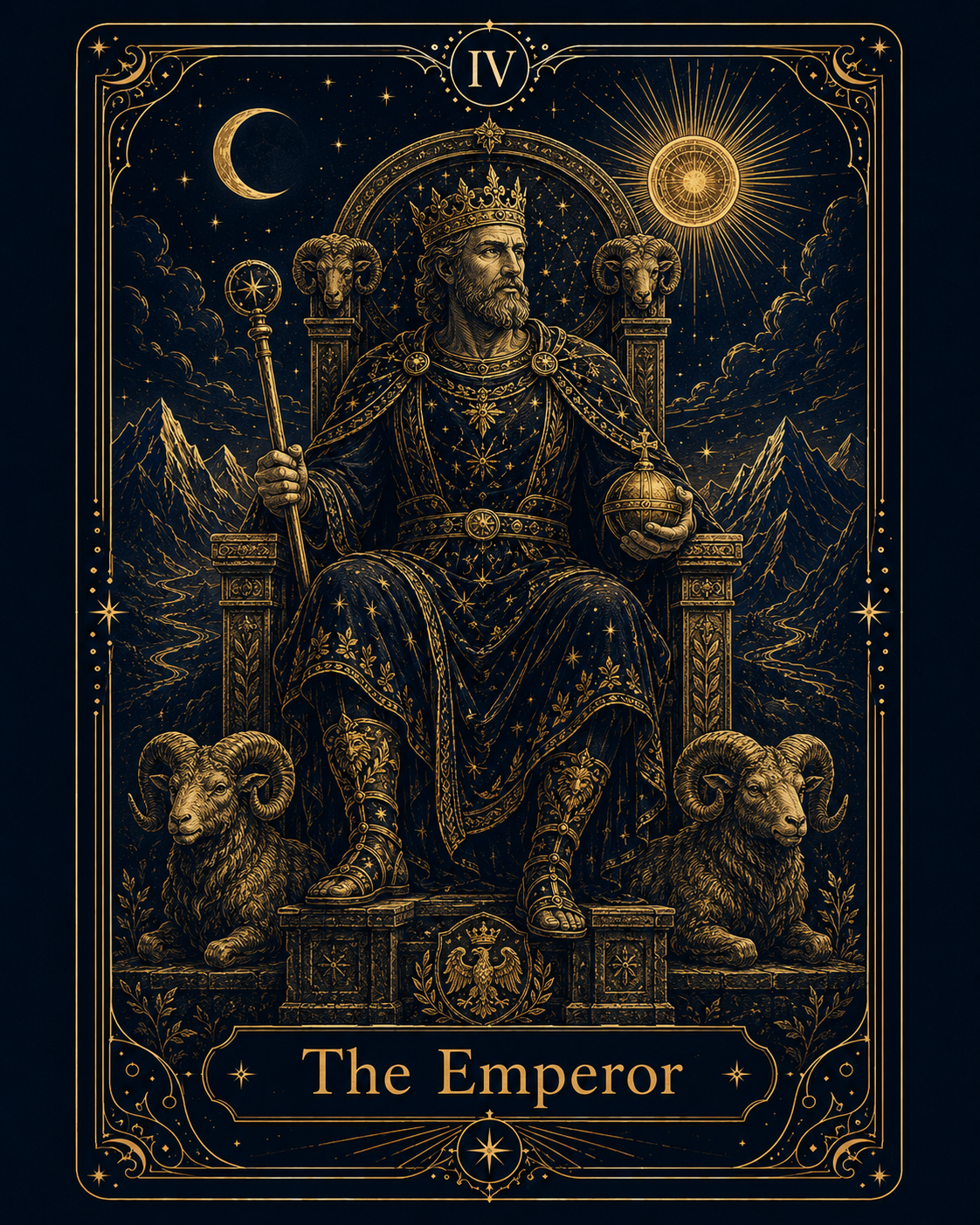
Abearded, armoured king sits rigidly upright on a stone throne carved with ram's heads, his back straight, his gaze forward, a golden ankh-topped sceptre in one hand and a small orb of dominion in the other. Behind him, barren, rocky mountains replace the Empress's lush wheat field entirely, a deliberate, pointed contrast: where she reclined in something already growing freely, he sits upright in something that had to be built.
Numbered IV, the Emperor completes the deck's second matched pair of worldly authority, exactly as this Archive's previous chapter promised: the Empress's organic, natural growth now met by deliberate, built structure. He is not opposed to what she represents. He is the fence, the law, and the order that lets her field actually survive contact with a world that does not automatically protect it.
The Oldest Father in Every Pantheon
The earliest Italian and French decks called this card simply L'Empereur, formally paired with the Empress exactly as this Archive's previous chapter described, one of the four great worldly and spiritual authorities medieval society organised its whole imagination around. Some early versions even show him seated with his legs crossed in a shape resembling the numeral four, a small visual pun tying the card's meaning directly to its own number.
Behind that specific image sits a far older archetype, present in almost every mythology this Archive has traced: the ageing, authoritative sky-father, Zeus enthroned on Olympus, Odin ruling from his high seat, Jupiter presiding over the Roman pantheon, each one a figure whose power rests less on personal strength than on an established, inherited order that simply does not move. The ram's heads carved into the Rider-Waite-Smith throne tie him directly to Aries and its ruling planet Mars, aggression and initiative disciplined, here, into something that finally holds still.
What the Card Actually Shows
The Stone Throne — power that does not move
Carved from unyielding rock rather than any softer material, the throne itself argues that real authority is meant to outlast weather, time, and any single ruler's own lifetime.
The Ram's Heads — Aries, tamed into structure
Four carved rams decorate the throne, tying the card directly to its ruling sign, Aries' raw initiative here disciplined into something built to last rather than spent all at once.
The Ankh-Topped Sceptre — authority over life itself
Borrowed from Egyptian iconography, the ankh marks his authority as extending even over life and vitality, not merely over land, law, or title.
The Golden Orb — the whole world, held in one hand
A small sphere of dominion rests easily in his other palm, the entire visible world reduced to something he can hold without visible effort.
His Armour, Beneath the Robes — power still backed by force
Red robes cover, but do not fully hide, plate armour underneath, a reminder that his stillness is chosen, not the absence of any real capacity to act.
The Barren Mountains — what had to be conquered first
Where the Empress sat before a lush, living field, his throne stands against stark, rocky peaks, structure built on ground that never gave up anything freely.
Upright and Reversed
Upright, the Emperor favours discipline, clear leadership, and structure built to genuinely protect and enable whatever is growing under its watch, a stable home, a well-run organisation, a father figure whose firmness is paired with real care. It rarely appears to suggest chaos needs managing gently; it appears when chaos needs an actual, dependable boundary.
Reversed, the card warns of exactly that boundary curdling into control for its own sake: rigidity that has forgotten what it was originally protecting, authority exercised coldly, or a father figure, literal or symbolic, whose firmness has tipped into domination. Some readers use the reversed card to describe a system so obsessed with order that it has stopped noticing whether anything inside it is actually still alive.
The Emperor in Love
Drawn upright in a love reading, the Emperor often points to a partner offering genuine stability: consistency, reliability, a relationship with real structure underneath its feeling, someone who shows love partly through provision and protection rather than only through open sentiment. It favours commitment formalised, a relationship given real shape, over passion left permanently undefined.
Its shadow is easy to find, though, whenever that same stability tips into control: a partner who confuses providing for someone with owning them, affection expressed almost entirely through rules and expectations rather than warmth. Reversed, the card frequently describes a relationship gone cold and rigid, or a controlling presence, in a partner or in the querent themselves, mistaking domination for the security love is actually supposed to offer.
The Emperor in Work and Money
In a career reading, the Emperor commonly appears when real authority, earned or newly claimed, is exactly what a situation requires: a promotion into genuine responsibility, a founder finally imposing enough structure on a growing idea to let it survive contact with the wider world, a leader whose word can actually be relied on. It favours discipline, long-term planning, and the unglamorous work of building systems that will still function after the person who built them has left the room.
With money specifically, the card describes financial structure and control, budgeting, saving, and long-term stability rather than sudden windfall, wealth built the way his stone throne was carved rather than found lying in a field. Reversed, it warns of authority misused, a controlling boss, a rigid plan that has stopped adapting to genuinely new information, or discipline so extreme it has curdled into simple, joyless austerity.
Strengths, Weaknesses, and the Thin Line Between Them
The Light
- Authority. Leadership genuinely earned and rightly used.
- Discipline. The steady work that makes anything actually last.
- Protection. Structure built to shelter what is growing inside it.
- Stability. A foundation others can genuinely depend on.
- Responsibility. Ownership of outcomes, not just credit for successes.
The Shadow
- Tyranny. Authority that answers to no one but itself.
- Rigidity. Discipline that refuses to adapt when it clearly should.
- Control. Protection curdled into ownership of another person.
- Coldness. Stability offered with no warmth attached to it.
- Domination. Responsibility used to justify overreach.
The Emperor Beside Other Cards
Beside the Empress, card III, the deck's central worldly-power pairing completes itself exactly as expected: her organic growth met by his deliberate structure, each one genuinely incomplete without the other, a field with no fence eventually trampled, a fence with no field simply guarding empty ground. Beside the Hierophant, card V, two authority figures sit together, worldly law meeting spiritual law, the deck's clearest picture of structure operating on two different registers at once.
His most cautionary pairing arrives much later in the deck, beside the Tower, card XVI: structure built rigid rather than resilient, defended rather than adapted, eventually meeting the exact collapse this card's whole stillness was meant to prevent.
Correspondences of the Emperor
The Emperor Across the Great Traditions
Tarot de Marseille — crossed legs, forming a four
Shown seated in profile with legs crossed into a shape resembling the numeral four, a small visual pun linking the image directly to the card's own number, holding a sceptre and shield.
Rider-Waite-Smith — the ram-throned king
The stone throne, ankh sceptre, and barren mountains this chapter has already described in full, authority pictured as something carved rather than grown.
Thoth — the Emperor, ram and fire
Crowley and Harris leaned further into the card's Aries and Mars associations, surrounding him with ram imagery and martial symbolism that push the card's warrior-king reading even further than the RWS deck's more settled monarch.
What Survives Every Version — the seat that does not move
Crossed legs, ram's heads, or open flame, every tradition keeps the same core image: a ruler who has made himself permanent, and a throne built specifically not to be easily moved.
What This Card Actually Asks of You
The question is not whether you are capable of building structure. This card rarely appears to suggest a lack of discipline; the throne is already carved, the sceptre already held, by the time the reader ever sees it. The real question is what that structure is actually for: whether the fence still exists to protect a field someone else can grow inside, or whether it has quietly become a wall built only to keep the ruler safe from having to change.
Drawn in a reading, the Emperor is rarely asking the querent to seize more control. He is asking them to check what their existing control is actually still serving. This Archive's opening Tarot chapter called the whole deck a mirror rather than a fortune, and this card holds up one of its most demanding reflections: proof that something has been built to last, and a plain question about whether it is still worth the cost of defending.
an ankh-topped sceptre rests in one steady hand,
and a king who cannot remember growing anything himself still guards, faithfully, what someone else did.
A sky-father found in nearly every pantheon this Archive has traced, a legendary emperor said to sleep inside a mountain until his kingdom truly needs him, a numeral folded into a king's own crossed legs: every version of this card has always asked the same plain question. Not whether you can build a fence, but whether you remember whose field it was built to protect.
FOR THE CURIOUS
The Emperor and Empress's paired role as temporal authority figures is documented across scholarship on the early Italian and French tarot traditions, discussed further in this Archive's Empress chapter. Sky-father figures across mythology, including Zeus, Odin, and Jupiter, are well documented in comparative mythology. The Rider-Waite-Smith imagery described in this chapter is Pamela Colman Smith's 1909 design. The Thoth deck's reinterpretation is Aleister Crowley and Lady Frieda Harris's, completed across the 1940s.
Next in Tarot: Chapter Seven, The Hierophant, the structure this card built for the throne, now claimed for the altar.
The rest of this is yours, not a type.
Reveal my chart