The Empress
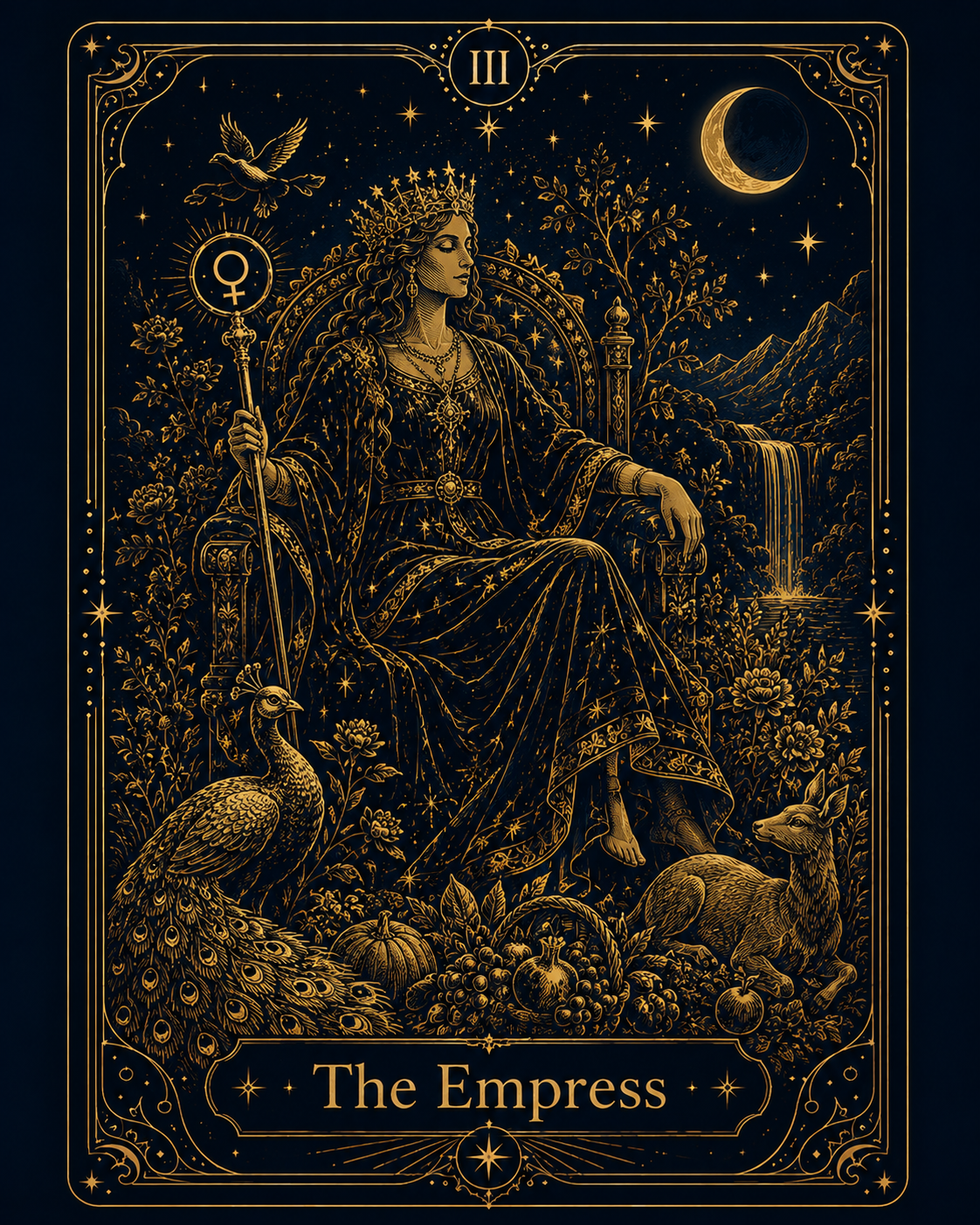
The Empress
The Quiet Knowing, Given a Body
Awoman reclines on a cushioned throne set outdoors in an overgrown wheat field, a crown of twelve stars resting in her hair, a river winding lazily behind her toward a distant forest. Where the High Priestess sat between two pillars guarding a threshold, the Empress sits in the open, past it, already surrounded by whatever that earlier card only hinted was on the other side. Nothing here is hidden. Everything is growing.
Numbered III, the Empress is widely read as the natural offspring of the two cards before her: the Magician's active will and the High Priestess's quiet knowing, brought together and given somewhere real to grow. She is not a continuation of either card alone. She is what becomes possible once will and intuition have both already done their work, and something new is finally, visibly, allowed to flourish because of it.
A Harvest Goddess in Everything But Name
The earliest Italian and French decks called this figure simply L'Imperatrice, "the Empress," paired formally with an Emperor as one half of a matched set of worldly rulers, exactly as the Pope and Papess this Archive's previous chapter traced represented spiritual authority in male and female form. Four cards, two pairs, standing for the two great powers medieval society actually recognised: the church, and the throne, each with a woman's face alongside a man's.
What the Rider-Waite-Smith deck's imagery adds, wheat, a flowing river, a crown of stars, a heart-shaped Venus shield tucked beside her, draws unmistakably on an older archetype no single myth owns outright: the Great Mother, worshipped in one form or another by nearly every agricultural society that ever depended on the land actually producing enough to survive the winter. Demeter and her Roman counterpart Ceres, goddesses of the harvest, sit closest to this specific image; Venus, goddess of love and beauty, lends the card its ruling planet; but the deeper root reaches further back than any one named goddess, into the plain, universal fact that abundance, in every culture, has always needed a face.
What the Card Actually Shows
The Crown of Twelve Stars — cosmic, not merely earthly, abundance
Twelve stars circle her head, widely read as the twelve months, or the twelve zodiac signs this Archive's own Sun Signs chapters have already explored, tying her fertility to a rhythm larger than any single season.
The Ripe Wheat Field — growth, already well underway
She sits inside a field already tall and golden rather than freshly planted, marking a card about harvest and result, not a card about the uncertain early work of planting something new.
The Venus Symbol — love made into a shield
A heart-shaped cushion beside her bears the astrological glyph for Venus, this card's ruling planet, love and beauty offered as genuine protection rather than mere decoration.
The Flowing River — feeling, given somewhere to go
Water moves freely behind her toward a distant forest, read as emotional abundance allowed to circulate rather than dammed up, the exact opposite of the High Priestess's still, guarded threshold.
The Pomegranates on Her Robe — an echo, deliberately repeated
The same fruit that decorated the High Priestess's veil reappears here, worn openly rather than hidden behind a curtain, fertility no longer concealed but fully, visibly claimed.
The Distant Forest — nature, still untamed
Wild woodland frames the cultivated wheat field, a reminder that even the most deliberate abundance still grows from something that was never fully tamed to begin with.
Upright and Reversed
Upright, the Empress favours creation in nearly any form: a literal pregnancy, a creative project finally bearing fruit, a body finally listened to and cared for rather than pushed past its limits. It rarely arrives to describe scarcity. It arrives to describe abundance already present, and asks only whether the person it is offered to is actually willing to receive it rather than deflect it.
Reversed, the card most often points to a creative block, an idea that will not grow no matter how much effort is poured into it, or the opposite extreme entirely: nurture curdled into smothering, a caretaker who has stopped asking whether their care is actually wanted. It can also describe simple self-neglect, someone who nurtures everyone else's field and has quietly stopped tending their own.
The Empress in Love
Drawn upright in a love reading, the Empress usually points to a relationship rich in warmth, sensuality, and genuine care, affection expressed rather than merely felt, a partnership that nourishes both people rather than depleting either one. It is one of the deck's most literal fertility cards, and can describe an actual pregnancy or the wish for one, alongside its broader meaning of love that has grown comfortable enough to be openly tender.
For someone single, this card often points toward a season of genuine self-love and self-care arriving before, or instead of, a partner, the field made ready regardless of who eventually walks through it. Reversed, it warns of exactly the imbalance this chapter's previous section already named: love turned smothering, a relationship where one person's constant giving has left no room for the other to actually want anything, or a self so busy nurturing everyone else that it has entirely stopped nurturing itself.
The Empress in Work and Money
In a career reading, the Empress frequently appears when patient, sustained effort is finally beginning to pay off, a creative project gaining real momentum, a business finding its natural audience, a slow-growing reputation finally bearing visible fruit. It favours steady, organic growth over sudden, forced expansion, and rewards work that has been allowed to develop on its own timeline rather than rushed toward an artificial deadline.
With money specifically, the card describes genuine abundance, resources flowing in rather than being anxiously guarded, and can point toward income drawn from something nurturing or creative by nature. Reversed, it warns of stalled growth, a project that refuses to take root no matter how much is invested in it, or overextension, resources poured out in every direction until nothing is actually left to sustain the person doing the giving.
Strengths, Weaknesses, and the Thin Line Between Them
The Light
- Abundance. Genuine plenty, freely offered and freely received.
- Nurture. Care that helps something else actually grow.
- Creativity. Ideas allowed to develop at their own pace.
- Sensuality. Real comfort in the body and the physical world.
- Connection to nature. A rhythm matched to natural cycles, not forced.
The Shadow
- Overindulgence. Abundance with no boundary left around it.
- Smothering. Nurture that leaves no room to grow independently.
- Stagnation. Creativity that never gets released into the world.
- Neglect of self. Sensuality and care given everywhere except inward.
- Dependency. A connection so close it forgets to let go.
The Empress Beside Other Cards
Beside the Emperor, card IV, the deck's other great worldly-power pairing plays out in full: her organic, natural growth meeting his deliberate, built structure, the same spiritual-and-temporal architecture the Pope and Papess established for the church, now repeated for the throne. Beside the Star, card XVII, two of the deck's gentlest, most abundant cards sit together and rarely conflict, hope and fertility doubled rather than contradicted, a spread that reads as unusually, almost suspiciously good news.
Her most meaningful pairing, though, is with the High Priestess herself: the quiet, seated knowing of card II, finally given the body, the garden, and the voice this Archive's previous chapter promised she would eventually receive. Where the Priestess guards a threshold, the Empress is already living on its far side.
Correspondences of the Empress
The Empress Across the Great Traditions
Tarot de Marseille — L'Imperatrice, formally crowned
Shown seated with a heraldic eagle-crested shield and a full royal crown, a considerably more formal, overtly political image than the wild, natural field the Rider-Waite-Smith deck would later surround her with.
Rider-Waite-Smith — the harvest goddess
The wheat-field, river, and star-crowned figure this chapter has already described in full, nature's own abundance standing in for any formal, political crown at all.
Thoth — the Empress, doves and Venus
Crowley and Harris drew the connection to Venus even more explicitly, surrounding her with doves and alchemical symbols of love and generative union, leaning further into the card's astrological identity than its agricultural one.
What Survives Every Version — abundance, freely given
Heraldic queen, harvest goddess, or Venusian figure among doves, every tradition keeps the same underlying promise: whatever crown this card wears, it never once withholds what it has grown.
What This Card Actually Asks of You
The question is not whether you are capable of growth. This card almost never appears to suggest a shortage of ability; the field is already tall and golden by the time the reader ever sees it. The real question is whether you are willing to actually receive what has already grown, to let it be enough, rather than immediately handing every bit of the harvest away to someone else before you have taken your own share of it.
Drawn in a reading, the Empress is rarely asking the querent to work harder. She is asking them to stop treating rest, pleasure, and receiving as things that must first be earned. This Archive's opening Tarot chapter called the whole deck a mirror rather than a fortune, and this card holds up one of its gentlest reflections: proof that something has already been allowed to grow, and a quiet question about whether its own gardener has remembered to eat from it too.
a river moves easily toward a distant forest,
and a crown of twelve stars rests on hair no one had to tell to grow.
A harvest goddess worshipped under a dozen different names, a queen paired formally with her king, a woman seated in a field she never had to force into blooming: every version of this card is describing the same plain, generous fact. Something has already grown. The only real question left is whether you will let yourself actually keep some of it.
FOR THE CURIOUS
The Empress and Emperor's paired role as temporal authority figures, alongside the Pope and Papess as spiritual ones, is documented across scholarship on the early Italian and French tarot traditions. Demeter and Ceres are recorded across classical Greek and Roman sources as harvest goddesses. The Rider-Waite-Smith imagery described in this chapter is Pamela Colman Smith's 1909 design. The Thoth deck's reinterpretation is Aleister Crowley and Lady Frieda Harris's, completed across the 1940s.
Next in Tarot: Chapter Six, The Emperor, the structure this card's own wild field has been quietly waiting for.
The rest of this is yours, not a type.
Reveal my chart