The Fool
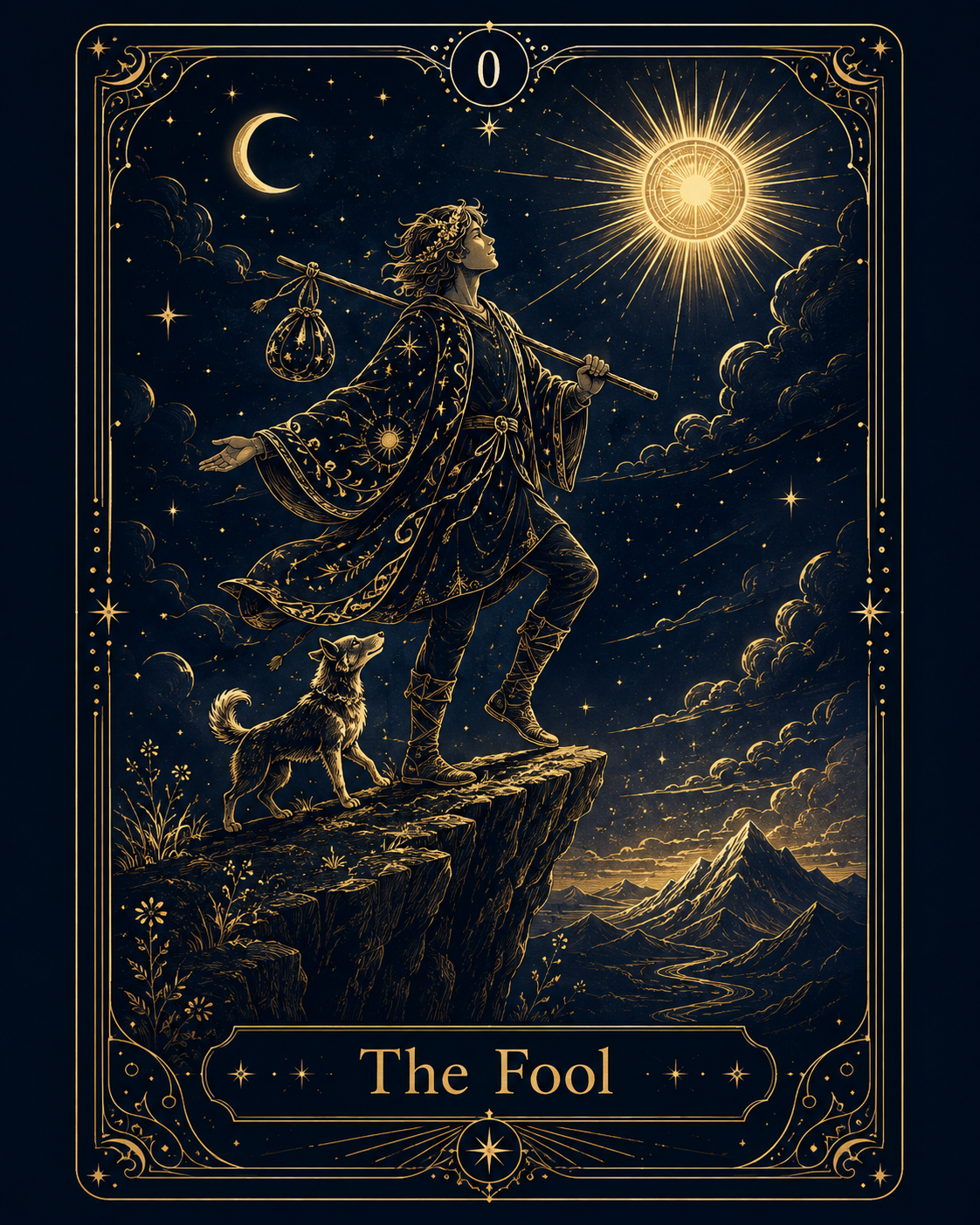
The Fool
The Card at the Edge
Ayoung traveller stands at the lip of a cliff, face tilted up toward the sun, one foot already lifted into empty air. A small white dog leaps at their heels, barking a warning that clearly has not landed. A white rose sits in one hand, a small bundle on a stick rests over one shoulder, and the whole scene is lit with the particular, careless brightness of someone who has not yet had a reason to look down.
This is the image nearly every modern deck uses to open its Major Arcana, and it is worth sitting with before any keyword or meaning is attached to it. The Fool is not falling. Read carefully, the traveller has not yet stepped off anything at all; the moment the card actually captures is the half-second before the leap, when the decision is already made and the consequence has not yet arrived. Numbered zero rather than one, the Fool is traditionally read as standing both before card I and after card XXI, the empty circle the whole Fool's Journey this Archive already opened in its first chapter, both departs from and quietly returns to.
The One Person Allowed to Say Anything
Medieval and Renaissance European courts kept licensed fools, jesters whose entire social function was to mock, tease, and occasionally correct the very monarchs they served, protected from punishment by the simple fact that no one held a fool responsible for what a fool said. The original Italian trionfi decks called this figure Il Matto, "the madman," and, tellingly, gave it no number at all in many early decks, exactly the same numberless, boundary-sitting position it still occupies at the very edge of the modern Major Arcana.
Beside the court jester sits an older, parallel figure: the "holy fool" of medieval Christian and Eastern Orthodox tradition, a person whose apparent madness was read not as a deficiency but as a kind of unfiltered closeness to God, saying plainly what wiser, more careful people were too calculating to say aloud. Both traditions agree: foolishness, looked at from the right angle, is not the opposite of wisdom. It is sometimes the only shape wisdom is allowed to take in a room too guarded for the plain truth.
What the Card Actually Shows
The Cliff Edge — the leap itself
The traveller's front foot is already lifted, weight already committed, the single clearest image of a decision made before its consequence is fully understood.
The Small White Dog — instinct, sounding an alarm
Leaping and barking at the traveller's heels, the dog is read as loyal instinct, or the small, sensible warning most people carry and, at this exact moment, are choosing not to hear.
The White Rose — purity of intention
Held loosely, without fear of the thorns, the rose marks the leap as innocent rather than reckless: not carelessness, but a genuine, undefended openness to what comes next.
The Bundle on a Stick — unexamined baggage
Light and barely secured, the bundle is read as everything the traveller is carrying without having unpacked it yet: past experience, unprocessed and untested, along for the ride regardless.
The Sun Behind — unseen support
A bright, undirected sun fills the whole sky behind the figure, read as the universe's own quiet backing for the leap, visible to the reader even though the traveller, mid-stride, is not looking at it.
The Distant Mountains — challenges not yet visible
Small, pale, and easy to miss in the background, the mountains represent the real difficulty still ahead, present in the scene, but genuinely invisible from where the traveller is currently standing.
Upright and Reversed
Upright, the Fool describes a genuine, healthy readiness to begin: a new relationship, a new city, a new idea, entered into with open eyes and very little fear, the specific kind of courage that only looks naive from a safe distance. It rarely appears in a reading to describe an ending. It appears to describe a threshold, a door already halfway open.
Reversed, the same energy curdles into something closer to its shadow: recklessness without any of the original innocence behind it, a leap taken not from trust but from a refusal to look, or, just as often, hesitation so complete that even the healthy, original leap never actually happens at all. Readers generally use context to decide which reversed meaning applies, too much risk, or not nearly enough.
The Fool in Love
Drawn upright in a love reading, the Fool usually points to a relationship, or a feeling, still young enough that its outcome genuinely cannot be predicted, and reads that uncertainty as exciting rather than threatening. It favours the early, unguarded stage of something: the first date entered without a script, the confession made before it has been rehearsed into something safer, the willingness to be a beginner again at something the heart has technically done before.
For someone already in a settled partnership, the card often points toward injecting exactly that same spontaneity back in, a spontaneous trip, an honest conversation avoided for too long, rather than announcing a new person entirely. Reversed, it warns against confusing genuine connection with the simple thrill of novelty, or points to a partner, or a version of yourself, entering a relationship without having thought even one step past the leap itself.
The Fool in Work and Money
In a career reading, the Fool commonly appears exactly when a person is weighing whether to leave something stable for something unproven: a new job with no guarantee, a business with no track record, a creative pursuit with no clear return. It rarely arrives to confirm the safe option. It tends to arrive to say that the unproven path is, at minimum, worth taking seriously, and that the fear attached to it is not, by itself, a reason to decline.
With money specifically, the card carries a genuine warning alongside its optimism: enthusiasm is not the same as a plan, and this is one of the few cards in the deck where most readers will actively encourage a little more caution than the card's own energy suggests, packing a few more supplies, in the language of its own image, before actually stepping off the ledge. Reversed, it points bluntly at a risk taken with insufficient thought, a resignation given without a plan, a bet placed on excitement alone.
Strengths, Weaknesses, and the Thin Line Between Them
The Light
- Openness. A genuine willingness to meet the unknown without armour.
- Courage. Moving forward before every variable is confirmed safe.
- Faith. A real, working trust that things tend to work out.
- Spontaneity. Choosing the moment over the plan when it matters.
- Innocence. Meeting people and ideas without pre-judging them.
The Shadow
- Recklessness. Openness becomes ignoring a warning worth hearing.
- Naivety. Courage becomes a refusal to see real risk at all.
- Carelessness. Faith becomes an excuse to skip the planning entirely.
- Impulsiveness. Spontaneity becomes a pattern of never finishing.
- Gullibility. Innocence becomes an easy target for anyone unkind.
The Fool Beside Other Cards
Beside the Magician, card I, the Fool reads as raw, unfocused potential finally meeting the will and skill to actually use it, the pairing most often read as the true beginning of the whole Fool's Journey this Archive already traced in Tarot's opening chapter. Beside Death, card XIII, it reads as a leap taken directly through an ending rather than around it, trusting a new beginning enough to walk straight past the loss that made room for it.
Its most striking pairing is with the World, card XXI, the final card of the Major Arcana: the two together are widely read as the entire journey folding back on itself, the beginner and the completed traveller occupying the same spread, the same question asked at its very first moment and its very last.
Correspondences of the Fool
The Fool Across the Great Traditions
Tarot de Marseille — Le Mat, the outsider
Often shown in torn, ragged clothing, sometimes harassed by a small animal biting at his leg rather than a loyal dog beside him, closer to the medieval vagrant or wandering beggar than to Smith's bright, hopeful traveller.
Rider-Waite-Smith — the standard image
The bright, sunlit cliff-edge scene this chapter has already described in full, the version now recognisable even to people who have never picked up a deck.
Thoth — the green man, reborn
Crowley and Harris reimagined the card through a considerably stranger lens: a green, spring-like figure sometimes read as a fusion of several mythological trickster and vegetation gods, emphasising rebirth and untamed natural force over the RWS deck's simple human innocence.
What Survives Every Version — the same core idea
Ragged beggar, sunlit traveller, or green spring god, every tradition keeps the same underlying figure: someone standing entirely outside the ordinary order of things, and free, because of that, to begin again.
What This Card Actually Asks of You
The question is not whether the leap is safe. Almost nothing worth doing in a life ever fully answers that question in advance, and the card is honest enough not to pretend otherwise. The real question is whether you are willing to move before every variable is settled, trusting the sun at your back even though, mid-stride, you cannot actually turn around to look at it.
Drawn at the start of a reading, the Fool is rarely describing the easy, safe choice. It is almost always describing the choice that requires trust precisely because certainty was never actually going to arrive first. This Archive's earlier chapter on how to read a spread put it plainly: the deck describes a shape, and what gets built inside that shape has always been left to the hand holding the cards. Nowhere is that more true than here, at card zero, before anything else has even begun.
a small dog is already barking a warning already too late to matter,
and the sun is already holding up a sky no one mid-stride can see.
The court jester who could say anything, the holy fool who saw further than the wise, the traveller stepping off a cliff with a white rose still in hand: every version of this card is describing the same single willingness. Not certainty. Just the leap, taken honestly, before certainty was ever going to arrive.
FOR THE CURIOUS
The court jester tradition and the "holy fool" of medieval Christian and Eastern Orthodox practice are documented across numerous historical and religious studies. Il Matto's unnumbered status in early Italian tarot decks is discussed in scholarship on the Visconti-Sforza and Marseille traditions. The Rider-Waite-Smith imagery described in this chapter is Pamela Colman Smith's 1909 design. The Thoth deck's reinterpretation is Aleister Crowley and Lady Frieda Harris's, completed across the 1940s.
Next in Tarot: Chapter Three, The Magician, the first stop on the road the Fool just stepped onto.
The rest of this is yours, not a type.
Reveal my chart