The Hanged Man
The Hanged Man
The Sword, Finally Met by a Refusal to Move
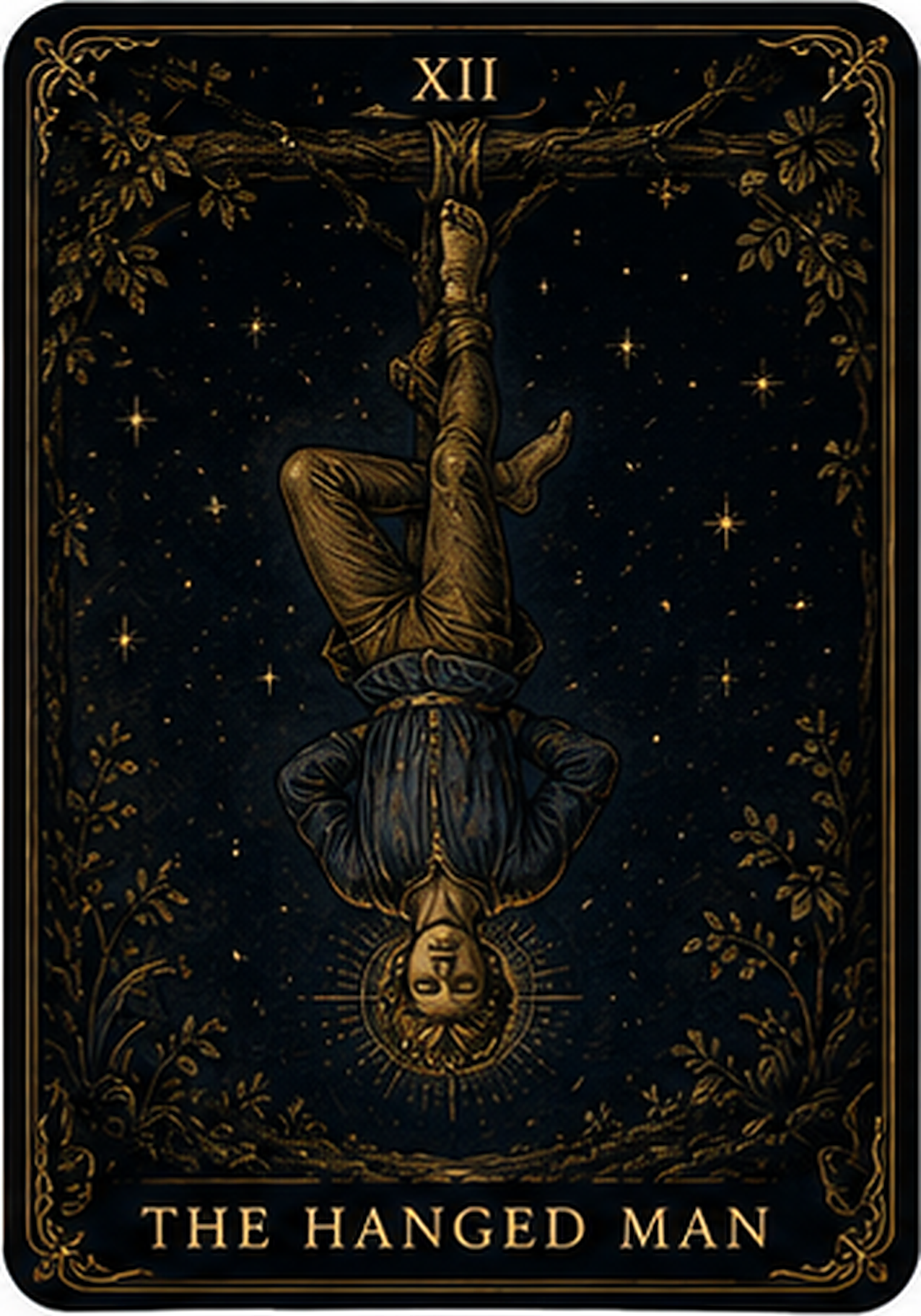
Ayoung man hangs upside down by one foot from a living, leafing tree, his other leg bent behind him, his hands held quietly behind his back. He is not struggling. A soft, golden light circles his head like a halo, and his face, upside down as it is, looks entirely at peace, closer to someone deep in thought than someone in any real danger.
Numbered XII, the Hanged Man is the deck's clearest picture of voluntary surrender, action deliberately withheld, not out of weakness, but because staying exactly still, upside down, is precisely what this particular moment actually requires. Where Justice weighed, decided, and cut, this card simply hangs, patiently, and waits to see what the world looks like from an angle no one standing upright could ever actually notice.
A Punishment That Became a Sacrifice
Some tarot historians trace the earliest Italian and French version of this card, hung upside down by one foot, hands bound, to a real medieval Italian practice called pittura infamante, "shame painting," in which convicted traitors and debtors were publicly depicted hanging in exactly this inverted, humiliating pose as a form of civic punishment. Read this way, the card's original meaning had nothing to do with enlightenment at all. It meant disgrace, betrayal, and a punishment meant to be seen by an entire city.
The occult revival this Archive has already traced across its earlier Tarot chapters reached for a very different, far more sympathetic story: Odin's self-sacrifice on Yggdrasil, the Norse World Tree, where the god hung himself, pierced by his own spear, for nine days and nights, sacrificing himself to himself, in order to earn the wisdom of the runes. Voluntary, purposeful, and rewarded with genuine insight, Odin's ordeal gave the old shame-painting image an entirely new meaning: not punishment endured, but wisdom deliberately paid for.
What the Card Actually Shows
His Calm, Untroubled Face — peace, not distress
Despite hanging fully inverted, his expression shows no strain at all, the single clearest sign that whatever kept him here was never really punishment.
The Golden Halo — insight, arriving upside down
A soft ring of light circles his head, borrowed straight from religious iconography of enlightenment, illumination arriving precisely because of his inverted view, not despite it.
His Bent Leg, Forming a Four — structure, even in surrender
His free leg crosses behind the other in a shape resembling the numeral four, foundation and stability quietly present even in a pose that looks, at first glance, entirely out of control.
His Hands, Held Behind His Back — restraint, without visible struggle
His hands are bound, or simply held, out of sight behind him, yet nothing in his posture suggests he is straining against them.
The Living, Leafing Tree — life, continuing regardless
Green leaves still grow along the beam suspending him, proof that the whole world around this pause has not stopped growing simply because he has stopped moving.
The T-Shaped Wooden Beam — a cross, quietly echoed
The gallows takes the shape of a Tau cross, an ancient symbol of sacrifice this card shares, deliberately or not, with a much older tradition of willing suffering for a greater purpose.
Upright and Reversed
Upright, the Hanged Man favours a deliberate pause: stepping back from forward motion entirely, not to give up, but to actually see a fixed situation from an angle constant forward pressure was never going to reveal. It rarely appears to describe genuine defeat; it appears when the most useful thing a person can do is stop pushing, and let a new perspective arrive on its own.
Reversed, the card points either to stalling that has lost its purpose, a pause that never actually earns anything because it was never really chosen in the first place, or to needless self-sacrifice, suffering endured for a cause that no longer deserves it. Some readers use the reversed card to describe someone who has confused staying stuck with genuine surrender, resenting the position rather than actually learning from it.
The Hanged Man in Love
Drawn upright in a love reading, the Hanged Man often points to a necessary pause, a decision genuinely better left unmade for now, a fixed idea about how the relationship "should" look that finally needs to be let go of in favour of seeing the actual people involved more clearly. It favours patience over any forced resolution, a willingness to sit with real uncertainty rather than rushing to end it.
It can also describe a healthy, chosen sacrifice, putting a partner's need ahead of one's own for a genuine reason, or a single person willingly staying unattached a while longer to actually understand what they want first. Reversed, it can point to an unhealthy limbo, staying in a relationship purely out of inertia or martyrdom, or resentment building underneath a sacrifice that was never actually agreed to freely.
The Hanged Man in Work and Money
In a career reading, the Hanged Man frequently appears when a stalled project or a paused decision is not actually a failure, a launch deliberately delayed until the timing is right, a promotion turned down on purpose to protect something more valuable, a period of genuine limbo that will eventually reveal exactly what a stuck situation actually needed. It favours patience over forcing an outcome the moment simply is not ready to deliver.
With money specifically, the card can describe a deliberate financial sacrifice made for a longer-term gain, or a spending freeze entered into on purpose rather than out of panic. Reversed, it warns of stalling that has stopped serving any real purpose, a project kept alive out of stubbornness alone, or martyring one's own finances for a job or a person that has stopped actually deserving the sacrifice.
Strengths, Weaknesses, and the Thin Line Between Them
The Light
- Surrender. Letting go of control that was never truly yours.
- New perspective. Seeing a fixed situation from an angle worth waiting for.
- Patience. Genuine willingness to sit with real uncertainty.
- Sacrifice. Giving something up for a reason that still holds.
- Stillness. Peace with not moving, chosen rather than forced.
The Shadow
- Stagnation. A pause that has quietly stopped teaching anything.
- Avoidance. Stillness used to dodge a decision worth making.
- Martyrdom. Suffering kept up for its own sake alone.
- Resentment. Sacrifice that was never actually freely chosen.
- Helplessness. Waiting mistaken for the only option left.
The Hanged Man Beside Other Cards
Beside Justice, card XI, the contrast this Archive named plays out exactly as promised: a decisive, weighed cut, met immediately by a figure who chooses, just as deliberately, to do nothing at all. Beside the very next card in the sequence, Death, card XIII, this card's willing, small suspension reads as direct preparation, a little death chosen freely, just before this Archive's next chapter opens the door to a much larger one.
His most reflective pairing loops all the way back to the very beginning of this sequence: the Fool, card 0, who leapt off a cliff without ever once looking down. The Hanged Man hangs from the same implied fall, upside down, finally looking, calmly, at exactly the ground the Fool never checked.
Correspondences of the Hanged Man
The Hanged Man Across the Great Traditions
Tarot de Marseille — Le Pendu, closer to the punishment
Shown in the same inverted, bound pose this chapter has already described, but with less of the Rider-Waite-Smith deck's serene halo, closer in feeling to the darker pittura infamante tradition this card most likely first descended from.
Rider-Waite-Smith — the willing, enlightened sacrifice
The haloed, calm-faced figure this chapter has already described in full, punishment reframed entirely as a chosen, illuminating pause.
Thoth — the dying god, reborn
Crowley and Harris leaned further into dying-and-rising god mythology, Osiris among them, framing the card explicitly around willing sacrifice as the necessary precondition for genuine spiritual rebirth.
What Survives Every Version — the pose no one is fighting
Shamed traitor, willing sage, or dying god, every tradition keeps the same core image: a figure hung upside down, and, crucially, never once shown struggling against it.
What This Card Actually Asks of You
The question is not how to get down faster. This card rarely appears to suggest an escape route; the rope, the tree, and the stillness are all, for now, simply the correct place to be. The real question is whether you are willing to actually stop struggling long enough to notice what the world looks like from an angle you would never have chosen voluntarily, and whether that new view might be worth exactly as long as it actually takes.
Drawn in a reading, the Hanged Man is rarely asking the querent to accept suffering for its own sake. He is asking them to trust that a chosen pause, however uncomfortable, is doing real work precisely because it has stopped fighting its own position. This Archive's opening Tarot chapter called the whole deck a mirror rather than a fortune, and this card holds up one of its most patient reflections: proof that sometimes the bravest, most productive thing a person can do is simply stop moving, and let the view change on its own.
a soft halo still circles a face that shows no strain at all,
and a fall the Fool never once looked down at is finally, calmly, being seen.
A medieval traitor once painted upside down for an entire city to see as punishment, a god who hung himself from his own tree for nine days to earn the wisdom of the runes: the same pose has carried both shame and enlightenment, sometimes within the very same century. Every version of this card has always been asking the same plain question. Not how to get down, but whether you are willing to actually stay a while longer, and let the view change you first.
FOR THE CURIOUS
The medieval Italian tradition of pittura infamante is documented across art historical scholarship on civic punishment imagery. Odin's self-sacrifice on Yggdrasil for the runes is recorded in the Old Norse poem Hávamál. The Rider-Waite-Smith imagery described in this chapter is Pamela Colman Smith's 1909 design. The Thoth deck's reinterpretation is Aleister Crowley and Lady Frieda Harris's, completed across the 1940s.
Next in Tarot: Chapter Fifteen, Death, the small, willing pause of this card meeting an ending it cannot simply wait out.
The rest of this is yours, not a type.
Reveal my chart