The Hermit
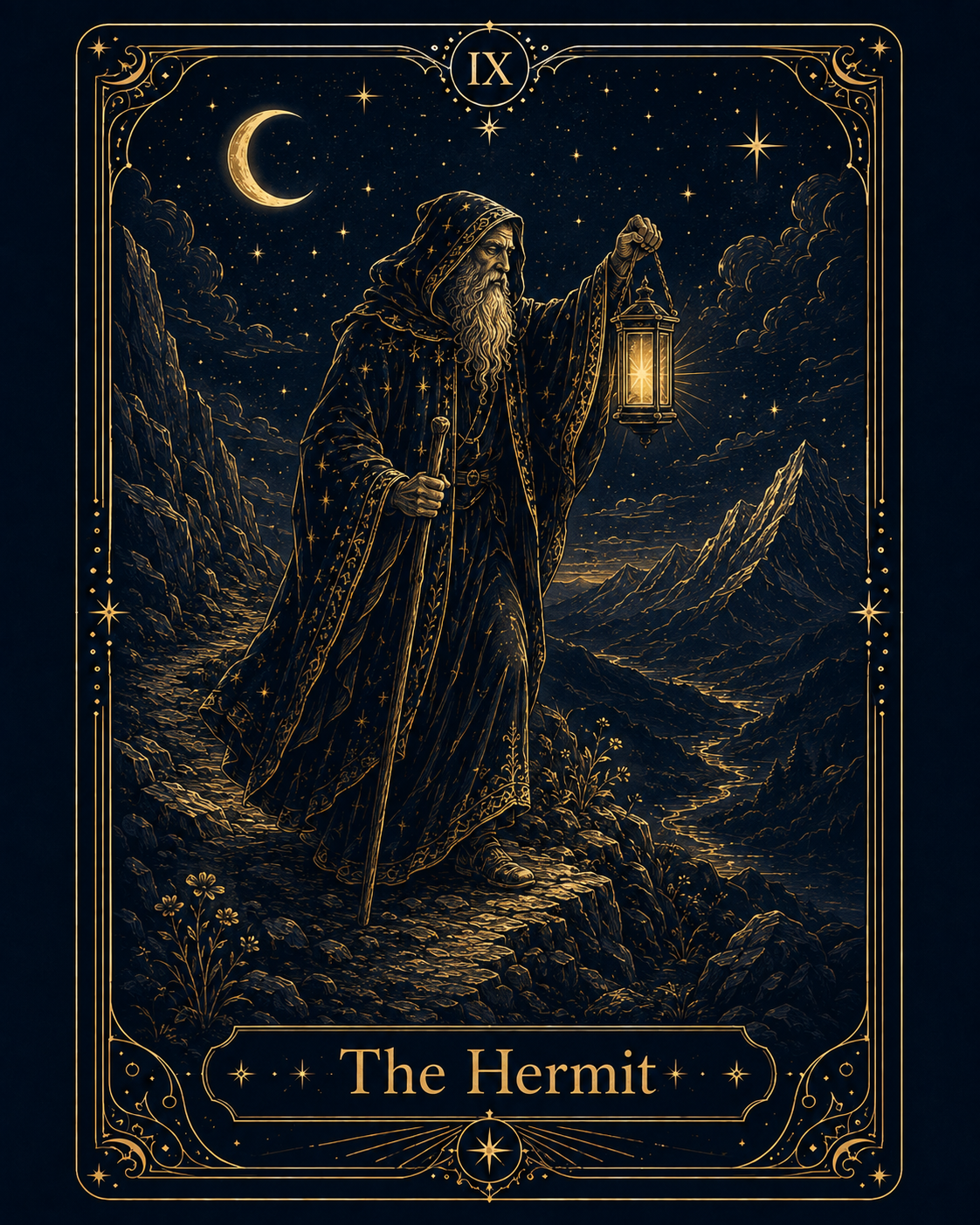
The Hermit
The Same Calm, Finally Alone With Itself
An old man in a plain grey cloak stands alone on a barren, snow-covered peak, high enough above the world that clouds obscure whatever is happening below him. In one hand he holds a tall staff for support. In the other, raised at shoulder height, he carries a lantern, its light shaped like a six-pointed star, small, steady, and entirely his own. He is not performing calm for anyone. There is, as far as the card shows, no one left up here to perform it for.
Numbered IX, the Hermit marks the point where this Archive's whole sequence turns fully inward for the first time since the deck began. The Fool leapt outward into the world. The Magician built on a table in front of others. The Hierophant taught a room of kneeling students. This card climbs, alone, past all of them, to a place high enough that the only voice left worth consulting is finally its own.
The Philosopher Who Searched by Daylight
Diogenes of Sinope, the fourth-century-BCE Greek philosopher known for rejecting nearly every social convention of his time, was said to wander Athens in full sunlight with a lamp held aloft, a deliberately absurd gesture meant to suggest that genuine honesty was so rare it might as well require searching for in broad daylight, the way anyone else would search for something in the dark. The image of a wise, solitary figure carrying a small, steady light in search of a larger truth predates the tarot deck itself by well over a thousand years.
The Hermit also draws on the far older figure of the wandering ascetic, present across nearly every tradition this Archive has traced: Hindu and Buddhist renunciates who leave society entirely to seek liberation in solitude, Christian desert fathers who withdrew into the wilderness for decades of contemplation, Taoist hermit-sages who left the imperial court behind for a mountain hut. Beneath all of them sits the same archetype later writers would call the wise old man, the same figure who eventually became Merlin, and later still, Gandalf: an elder too far outside ordinary society to be corrupted by it, and precisely because of that, worth actually listening to.
What the Card Actually Shows
The Lantern's Six-Pointed Star — the Seal of Solomon
The light inside his lantern is shaped like a six-pointed star, traditionally associated with Solomon's own legendary wisdom, a small, self-contained source rather than anything borrowed from the sun or another person.
The Tall Wooden Staff — support, chosen deliberately
He leans on a plain staff for balance, a reminder that solitude is not the same as total self-sufficiency; even a hermit accepts the help a simple, honest tool can offer.
His Grey Cloak — neither light nor dark
Unlike the Empress's warm colours or the Magician's confident red, his cloak sits in a plain, unremarkable grey, wisdom that has stopped needing to announce itself visually.
The Snow-Covered Peak — above what obscures clear sight
He stands high enough that clouds cover the world below him entirely, a vantage point only solitude and real effort could actually earn.
His Long White Beard — time, already spent
Unmistakably aged, he marks this card's wisdom as something accumulated slowly, over real years, rather than arrived at all at once.
His Raised, Outward Lantern — a light meant to be seen
Though entirely alone, he still holds the lantern up and outward rather than close to his own chest, quiet proof that even solitary wisdom is not necessarily meant to be kept from view forever.
Upright and Reversed
Upright, the Hermit favours deliberate withdrawal: time alone chosen on purpose, in order to actually hear an answer that noise and other people's opinions were drowning out. It rarely appears to suggest loneliness; it appears when quiet, sustained reflection is precisely what a decision or a question genuinely requires before it can be answered honestly.
Reversed, the card points either to isolation that has stopped being useful, withdrawal grown out of fear rather than genuine need, or the opposite failure entirely: refusing the solitude a moment clearly called for, staying surrounded by noise specifically to avoid whatever the silence might have revealed. Some readers use the reversed card to describe someone who has climbed the mountain and then refused to ever come back down.
The Hermit in Love
Drawn upright in a love reading, the Hermit often points to a genuine, healthy need for space, time single and unattached to actually understand what a person wants before pursuing anyone else, or a partner who needs real solitude to process something rather than constant closeness. It favours the relationship, or the single stretch of life, that gets stronger precisely because someone was brave enough to step back and think clearly first.
It can also describe a mentor-like connection, someone offering hard-won wisdom to a partner or friend from a place of genuine, lived experience rather than easy reassurance. Reversed, it can point to isolation that has curdled into avoidance, someone hiding from intimacy rather than genuinely needing space, or a withdrawal so complete that a relationship worth saving quietly starves from the distance.
The Hermit in Work and Money
In a career reading, the Hermit frequently appears when the wisest next step is research, quiet reflection, or simply working alone for a while, a big decision that genuinely should not be rushed, a period of study or independent work that will pay off precisely because it happened away from other people's opinions. It favours depth over visibility, real understanding over the appearance of constant activity.
With money specifically, the card can point toward the value of quiet, independent research before a major financial decision, or toward simply pulling back from external pressure and noise long enough to actually think clearly about a budget or a plan. Reversed, it warns of decision paralysis brought on by too much withdrawal, isolating oneself from advice that was genuinely needed, or avoiding a hard financial reckoning by staying too busy to ever actually sit with it.
Strengths, Weaknesses, and the Thin Line Between Them
The Light
- Introspection. Real, honest reflection, given actual time.
- Wisdom. Insight earned slowly, through genuine experience.
- Guidance. A steady light others can eventually find their way by.
- Independence. Comfort standing apart from the crowd's noise.
- Patience. Willingness to search without a guaranteed answer.
The Shadow
- Isolation. Reflection that has quietly become avoidance.
- Detachment. Wisdom kept so private it helps no one at all.
- Aloofness. Guidance withheld from people who actually need it.
- Loneliness. Independence that has curdled into real disconnection.
- Stagnation. A search so long it has stopped expecting an answer.
The Hermit Beside Other Cards
Beside Strength, card VIII, the pairing this Archive named plays out exactly as promised: calm mastery shown once in the open, beside a very real lion, now turned entirely inward, alone, with no audience left to prove anything to. Beside the High Priestess, card II, a quieter contrast surfaces: her quiet knowing is seated, guarding a fixed threshold others might eventually approach; his is standing, still climbing, carrying its own light rather than waiting behind a veil for someone patient enough to arrive.
His most forward-looking pairing sits with the very next card in the sequence, the Wheel of Fortune, card X: hard-won personal clarity, found alone on a mountain through real effort, about to meet the one force in the entire deck that no amount of solitude, will, or preparation can actually steer.
Correspondences of the Hermit
The Hermit Across the Great Traditions
Tarot de Marseille — Le Vieillard, and an hourglass
Called simply "the old man" in early decks, sometimes shown holding an hourglass rather than a lantern, tied more directly to Father Time and the slow wisdom of old age than to any active, ongoing search.
Rider-Waite-Smith — the lantern on the peak
The star-lit lantern and snowy mountain this chapter has already described in full, wisdom pictured as something actively searching rather than merely accumulated with age.
Thoth — the Hermit, and the seed
Crowley and Harris added imagery of a serpent and an egg, or a seed, tied to Virgo's own harvest symbolism, framing the card around spiritual initiation and the deliberate cultivation of wisdom rather than its simple possession.
What Survives Every Version — an old figure, and one small light
Hourglass, lantern, or seed, every tradition keeps the same essential structure: an elder standing apart from the crowd, holding something small, patient, and entirely their own.
What This Card Actually Asks of You
The question is not whether you are lonely. This card rarely appears to describe an absence of people; it appears to describe an absence of noise, the specific, deliberate quiet a person needs in order to finally hear something that a crowd, however well-meaning, was always going to talk over. The real question is whether you are willing to climb high enough, and stay there long enough, to actually let that quiet say something true.
Drawn in a reading, the Hermit is rarely asking the querent to disappear from the world forever. He is asking them to step away from it for exactly as long as an honest answer actually takes to arrive, no longer, no shorter. This Archive's opening Tarot chapter called the whole deck a mirror rather than a fortune, and this card holds up one of its quietest reflections: proof that some answers were never going to be found anywhere but alone, and a plain reminder to eventually come back down the mountain once you have found them.
a small lantern still burns in an outstretched hand,
and a search that never promised an answer keeps going anyway, one quiet step at a time.
A philosopher once carried a lamp through daylight, searching for a single honest man he was never recorded as finding. Desert fathers, forest sages, and hermits across an entire world of traditions climbed away from the noise for exactly the same reason. Every version of this card has always been asking the same plain question. Not whether you are alone, but whether you are finally quiet enough to hear what the noise was always drowning out.
FOR THE CURIOUS
Diogenes of Sinope's lamp is recorded across classical sources on the Cynic philosophers. Ascetic and hermetic traditions across Hindu, Buddhist, Christian, and Taoist practice are documented across comparative religious scholarship. The Rider-Waite-Smith imagery described in this chapter is Pamela Colman Smith's 1909 design. The Thoth deck's reinterpretation is Aleister Crowley and Lady Frieda Harris's, completed across the 1940s.
Next in Tarot: Chapter Twelve, The Wheel of Fortune, the hard-won clarity of this card, now meeting a force no lantern can steer.
The rest of this is yours, not a type.
Reveal my chart