The Hierophant
The Hierophant
The Private Knowing, Made Public Doctrine
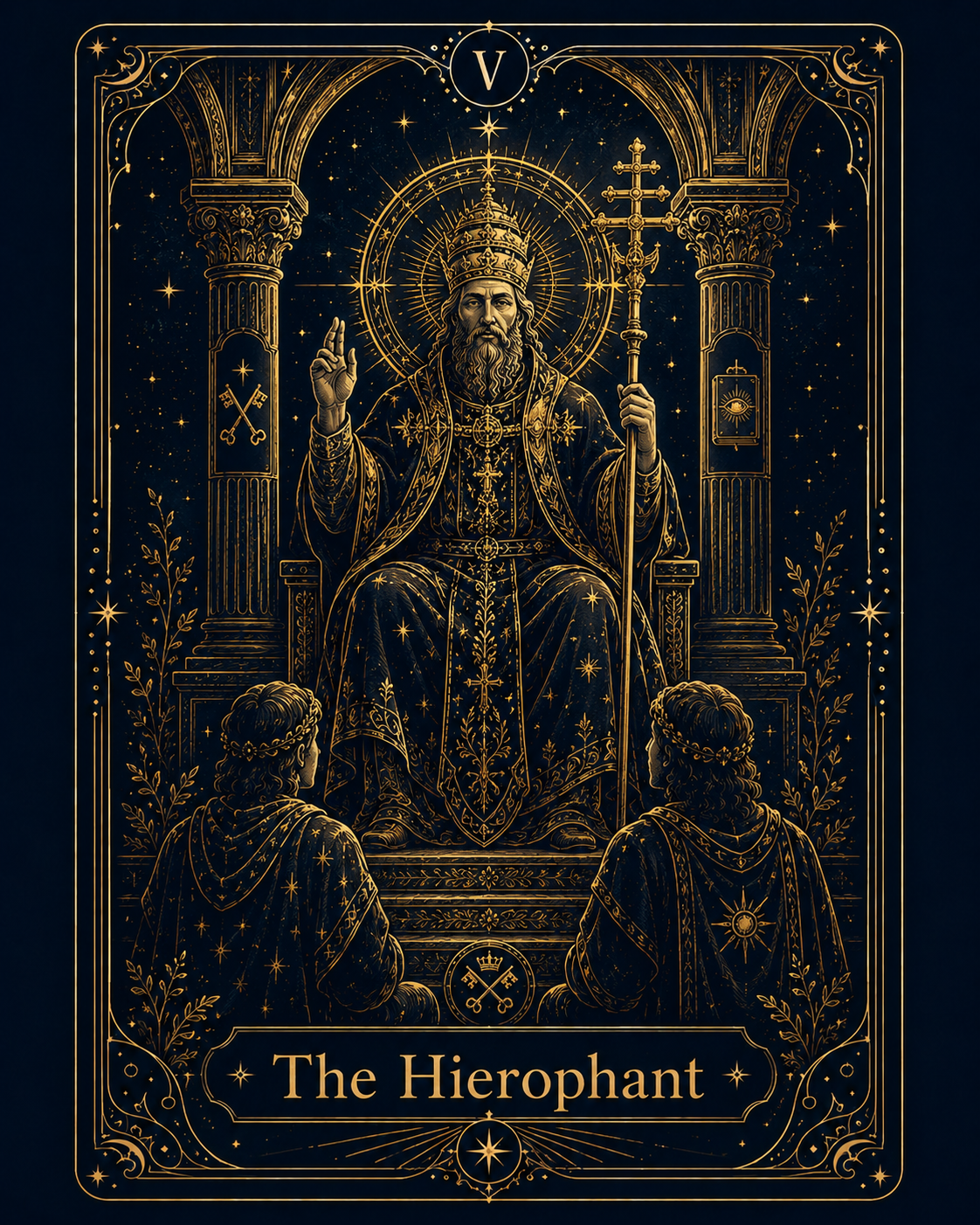
Arobed figure sits enthroned between two grey pillars, a triple-tiered crown on his head, a triple-barred cross held upright in one hand, the other raised in a formal gesture of blessing. Two crossed keys rest at his feet. Two acolytes kneel before him, their robes patterned with the same roses and lilies this Archive has already traced through the Magician's garden and the Empress's own field, the same symbols, now worn by students rather than grown in open air.
Numbered V, the Hierophant sits directly across the deck's opening sequence from the High Priestess, and the contrast is deliberate down to the smallest detail: her pillars were black and white, stark opposites guarding a threshold; his are a single, muted grey, the sharp edges of private mystery worn smooth by tradition, repetition, and an institution built specifically to make one person's truth everyone's inheritance.
The Card That Kept Changing Its Own Name
The earliest Italian decks called this card simply Il Papa, the Pope, paired formally with La Papessa, the female Pope this Archive's own High Priestess chapter already traced, exactly the spiritual half of the same four-card authority set that gave the world the Emperor and Empress. For centuries this was an unremarkable pairing. But as religious tensions sharpened across parts of Reformation-era Europe, a card openly depicting the Pope, robed and enthroned, inside an ordinary game of cards became, in some regions, a genuinely uncomfortable thing to keep selling.
Several card-makers quietly renamed the figure, Jupiter in some decks, a generic bishop or high priest in others, softening a specific, potentially controversial office into something broader and safer to print. The Rider-Waite-Smith deck's chosen title, Hierophant, reaches further back still, to ancient Greece: the word named the specific priest who alone was permitted to reveal the secret rites of the Eleusinian Mysteries, one of antiquity's most closely guarded religious traditions. The card kept its throne, its crown, and its two kneeling students. It simply stopped insisting on any one religion's claim to them.
What the Card Actually Shows
The Triple Crown — authority over three realms
A tiered crown, echoing the papal tiara, is traditionally read as authority spanning three domains at once: the physical, the mental, and the spiritual, teaching claimed to cover the whole of a person, not just their soul.
The Triple-Barred Cross — the same three realms, held upright
His sceptre repeats the crown's threefold structure, doctrine held not as an abstraction but as something actively, physically carried and displayed.
The Raised Hand of Blessing — sanction, formally given
Two fingers raised, two folded, the traditional gesture of benediction marks this card's core function: not merely holding wisdom, but formally, publicly approving what others bring before it.
The Crossed Keys — access, granted or withheld
Resting at his feet, the crossed keys reference the keys of Saint Peter, read here as the power to open, or close, the door to a body of shared, guarded knowledge.
The Two Kneeling Acolytes — the tradition, actively received
Two students in floral-patterned robes kneel before him, marking this card as fundamentally about transmission, wisdom that only means something once it is actually passed to someone else.
The Grey Pillars — duality, softened by tradition
Unlike the High Priestess's stark black and white columns, his pillars share a single, muted grey, sharp opposites gradually worn smooth by repetition and institutional consensus.
Upright and Reversed
Upright, the Hierophant favours structured learning, formal commitment, and the genuine comfort of belonging to something larger than one person's private opinion, a wedding, a degree, a mentorship, a faith community actually chosen rather than merely inherited. It rarely appears to suggest tradition is worthless; it appears when an established path is, for this particular question, the right one to actually walk.
Reversed, the card points either to rebellion against convention for its own sake, or, just as often, to convention followed long past the point it still made sense, dogma obeyed out of habit or fear rather than genuine belief. Some readers use the reversed card to describe institutions that have stopped serving the people kneeling in front of them, more interested in preserving their own authority than in actually teaching anything worth learning.
The Hierophant in Love
Drawn upright in a love reading, the Hierophant commonly points toward marriage, engagement, or a relationship following a fairly traditional shape, one that a wider community can recognise and openly celebrate, rather than a connection kept private or undefined. It favours commitment made formal and public, a relationship built on shared values, sometimes literally a shared faith or cultural tradition both partners were raised inside.
Its shadow surfaces whenever that same formality starts to feel like obligation rather than genuine choice: a relationship pursued mainly to satisfy family or social expectation, love measured by how well it performs convention rather than how it actually feels. Reversed, the card can describe a couple deliberately building a relationship outside traditional structure, or a person quietly realising the shape they were taught to want no longer fits what they actually feel.
The Hierophant in Work and Money
In a career reading, the Hierophant commonly appears when the sensible path runs through an established institution rather than around it: further education, a formal qualification, a respected mentor whose guidance is worth the time it takes to actually absorb it. It favours working within a system long enough to understand why its rules exist before deciding which of them are actually worth challenging.
With money specifically, the card describes conventional, well-tested financial wisdom, saving steadily, following advice from someone experienced, trusting a process that has already worked for a great many people before you. Reversed, it warns against blindly following outdated financial advice simply because it is familiar, or against staying inside an institution or career path purely out of habit, long after it has stopped actually teaching or rewarding you.
Strengths, Weaknesses, and the Thin Line Between Them
The Light
- Tradition. Inherited wisdom, actually tested by time.
- Community. Belonging to something larger than one opinion.
- Guidance. A mentor willing to teach what took years to learn.
- Structure. A formal path that spares each generation reinventing it.
- Reverence. Genuine respect for what has actually earned it.
The Shadow
- Dogma. Tradition followed without ever asking why.
- Conformity. Belonging bought at the cost of honest disagreement.
- Rigidity. Guidance that refuses to update when it should.
- Bureaucracy. Structure that exists mainly to preserve itself.
- Blind obedience. Reverence for authority that has stopped earning it.
The Hierophant Beside Other Cards
Beside the High Priestess, card II, the deck's clearest staged contrast plays out exactly as promised across this Archive's earlier chapters: a truth kept quietly private, now made formally public, each one incomplete without the other, mystery with no teaching to eventually become, teaching with no genuine mystery underneath it to actually transmit. Beside the Emperor, card IV, the Hierophant completes the deck's full picture of authority, worldly law and spiritual law, standing shoulder to shoulder, each legitimising the other.
His most forward-looking pairing sits with the very next card in the sequence, the Lovers, card VI: the blessing formally given, immediately followed by the moment two people actually have to choose each other for themselves, tradition handing the reader directly into the deck's first real card about personal choice.
Correspondences of the Hierophant
The Hierophant Across the Great Traditions
Tarot de Marseille — Le Pape, plainly named
Shown in full papal dress with a raised hand of blessing before two kneeling clerics, the most direct and unapologetically religious version of this card across all three traditions.
Rider-Waite-Smith — the Hierophant, softened
The triple crown and crossed-keys figure this chapter has already described in full, borrowing the name of an ancient Greek office to deliberately soften any single religion's claim on the image.
Thoth — the Hierophant, universalised further
Crowley and Harris pushed the de-Christianising even further, drawing on Eastern and esoteric imagery to frame the card as a teacher of universal spiritual law rather than any one specific tradition's doctrine.
What Survives Every Version — the kneeling students
Named Pope, Hierophant, or universal teacher, every tradition keeps the same core structure: a seated authority, a body of guarded wisdom, and at least one student kneeling close enough to actually receive it.
What This Card Actually Asks of You
The question is not whether tradition has value. This card rarely appears to argue against structure, community, or inherited wisdom; two kneeling students would not be there at all if none of it were worth learning. The real question is whether you are kneeling because the teaching in front of you still genuinely earns it, or because kneeling is simply the only posture you have ever been shown.
Drawn in a reading, the Hierophant is rarely asking the querent to abandon every inherited belief. He is asking them to actually examine which ones still hold up under an honest look, and which ones have simply never been questioned. This Archive's opening Tarot chapter called the whole deck a mirror rather than a fortune, and this card holds up one of its more uncomfortable reflections: not a verdict on tradition itself, but a plain invitation to check whether yours is still serving the person actually living inside it.
a hand stays raised in blessing,
and two students kneel close enough to actually hear what is being taught.
A Pope once too recognisable to print safely, a Greek priest sworn to reveal only the most guarded rites, a teacher whose name has changed every few centuries without his crown ever once coming off: every version of this card has always been asking the same plain question. Not whether the tradition is real, but whether it is still true for the person currently kneeling in front of it.
FOR THE CURIOUS
Il Papa's political sensitivity in some regions and periods, and its subsequent renaming across various decks, is discussed across tarot historical scholarship. The Hierophant's origin as the title of the presiding priest of the ancient Greek Eleusinian Mysteries is documented in classical scholarship. The Rider-Waite-Smith imagery described in this chapter is Pamela Colman Smith's 1909 design. The Thoth deck's reinterpretation is Aleister Crowley and Lady Frieda Harris's, completed across the 1940s.
Next in Tarot: Chapter Eight, The Lovers, the blessing this card gave, now met with an actual choice.
The rest of this is yours, not a type.
Reveal my chart