The High Priestess
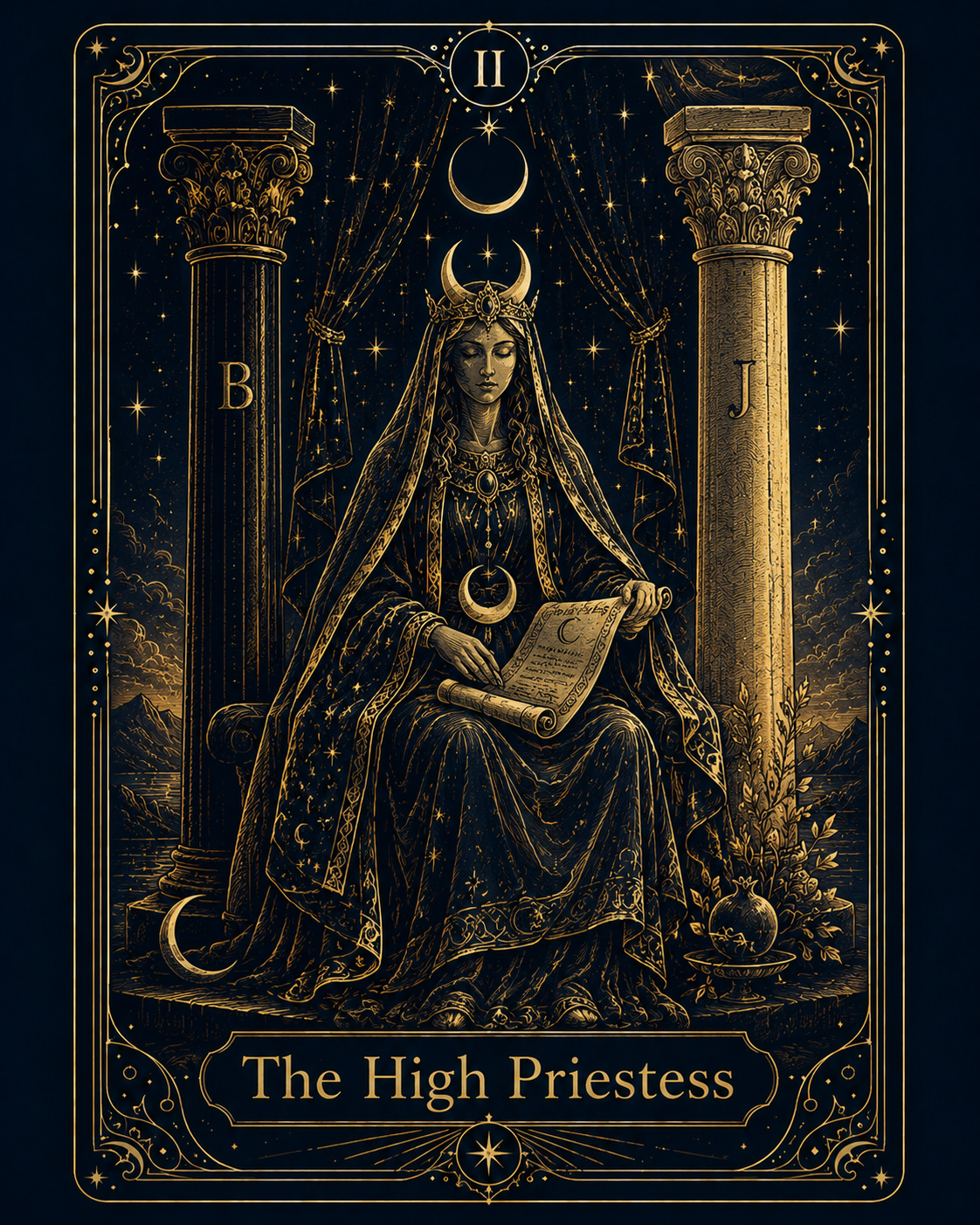
The High Priestess
The Woman Between Two Pillars
Aseated figure rests between two towering pillars, one black, one white, a veil patterned with pomegranates hanging behind her, concealing whatever lies past the threshold she is quietly guarding. A crescent moon sits at her feet. A scroll, marked with only a few visible letters, rests half hidden beneath her robe, more of it concealed than shown. She is not performing anything. She is simply present, and that presence is, on its own, the entire content of the card.
Numbered II, directly following the Magician's active, outward-facing will, the High Priestess describes the opposite instinct entirely: knowledge that is not demonstrated, power that is not exercised, a truth that is deliberately kept just out of reach because some things, this card insists, are only ever real once they are found rather than handed over. Where the Magician's whole table was in plain sight, this card's entire meaning sits behind a curtain the reader is not invited to lift.
The Female Pope the Church Never Named
Early Italian and French decks called this card La Papesse, "the female Pope," and pictured her with a book open on her lap, dressed almost identically to the era's Popes and cardinals, a startling image for a Europe where the Catholic Church held enormous, unquestioned authority. Some historians connect the image to the medieval legend of Pope Joan, a woman said to have disguised herself as a man, risen through the Church's ranks, and been discovered only when she unexpectedly gave birth during a public procession, a story almost certainly more folklore than fact, but persistent enough to shape centuries of imagination regardless.
The occult revival this Archive has already traced across its earlier Tarot chapters reworked the figure considerably, drawing her toward Isis, the Egyptian goddess of hidden wisdom, and toward the Kabbalistic concept of the Shekinah, the divine feminine presence said to dwell quietly alongside, rather than above, the material world. The Rider-Waite-Smith deck's title, High Priestess, kept the seated, book-holding authority of the old Papesse while removing every trace of an actual, named office, leaving behind pure, unaffiliated, uninstitutional knowledge instead.
What the Card Actually Shows
The Black and White Pillars — Boaz and Jachin
Named for the two pillars said to stand at the entrance of Solomon's Temple, one dark, one light, marking the threshold between the visible world and whatever mystery the High Priestess is seated in front of.
The Veil of Pomegranates — fertility, and what it hides
Hanging behind her between the two pillars, the pomegranate-patterned veil references old symbols of fertility and the underworld alike, concealing a mystery the card never actually shows the reader.
The Crescent Moon — intuition underfoot
Resting at her feet rather than above her head, the crescent moon marks intuition as a foundation she stands on, not a distant symbol she merely gestures toward.
The Horned, Crowned Headdress — Isis and Hathor
A horned crown cradling a full lunar disc directly references the Egyptian goddesses Isis and Hathor, both keepers of concealed, sacred knowledge in their own mythologies.
The Half-Hidden Scroll — knowledge, partially revealed
Marked with only a few visible letters and tucked mostly beneath her robe, the scroll insists that some knowledge is only ever partly given, the rest left for the reader to actually go and find.
Her Blue Robes — water, turned inward
Flowing, water-toned robes tie her directly to this card's ruling element, feeling and intuition held calm and still rather than expressed outward.
Upright and Reversed
Upright, the High Priestess favours patience over action, listening over speaking, and trusting a feeling that cannot yet be fully explained in words. It frequently appears when the sensible next move is to gather more, wait a little longer, and let understanding arrive on its own timeline rather than forcing a conclusion before the picture is complete.
Reversed, the card points to disconnection from that same inner voice, intuition ignored in favour of noise, or, just as often, secrecy that has curdled from healthy discretion into an unhealthy withholding, information kept back not out of genuine wisdom but out of simple mistrust. Some readers use the reversed card to describe a truth someone else is actively hiding, rather than a truth the querent has simply not yet found.
The High Priestess in Love
Drawn upright in a love reading, the High Priestess often points to an attraction still living entirely in the private, unspoken register: a feeling neither person has named yet, a connection sensed rather than confirmed, a gut instinct about someone that has not yet been tested against a single real conversation. It can also describe a relationship's genuinely private layer, the parts of real intimacy that were never meant to be explained to anyone standing outside it.
For someone actively deciding whether to trust a partner, or a situation, this card is frequently read as direct advice: consult the instinct before the evidence, since the feeling usually arrived first for a reason worth taking seriously. Reversed, it can point to intuition being actively overridden, ignored warnings, a partner who withholds far past the point of reasonable privacy, or a person quietly lying to themselves about what their own gut has already told them.
The High Priestess in Work and Money
In a career reading, the High Priestess commonly appears when the wisest available move is research, patience, and observation, gathering information quietly before making any move the rest of the room can see. It favours the negotiation not yet entered, the offer not yet accepted, the plan still being quietly assembled behind the scenes rather than announced before it is ready. Where the Magician rewards visible action, this card rewards the discipline of waiting until the timing is actually right.
With money specifically, the card often points toward instinct about a deal that has not yet been fully explained in numbers, a hesitation worth honouring rather than rationalising away. Reversed, it can describe a decision made from fear rather than genuine insight, secrecy from a colleague or partner that is no longer protective but simply evasive, or a person ignoring their own well-founded instinct about a financial situation.
Strengths, Weaknesses, and the Thin Line Between Them
The Light
- Intuition. A trustworthy inner voice, listened to seriously.
- Patience. Waiting for the full picture before acting on it.
- Wisdom. Knowledge held quietly, without needing to perform it.
- Mystery. Comfort with not everything being explainable.
- Discretion. Keeping a confidence because it is genuinely owed.
The Shadow
- Disconnection. Intuition ignored until it goes quiet entirely.
- Passivity. Patience curdled into never actually acting at all.
- Secrecy. Wisdom withheld for advantage rather than good reason.
- Aloofness. Mystery used to avoid genuine closeness.
- Withholding. Discretion turned into evasion or quiet dishonesty.
The High Priestess Beside Other Cards
Beside the Magician, card I, the pairing this Archive already promised plays out exactly as expected: conscious will meeting quiet, unconscious knowing, each one correcting the other's blind spot, action tempered by patience, patience nudged toward actually doing something with what it has learned. Beside the Moon, card XVIII, two water-and-intuition cards sit together and rarely cancel each other's uncertainty out; readers generally treat the pairing as a doubled mystery rather than a doubled clarity, a spread genuinely asking the querent to sit with not knowing for a while longer.
Her most pointed pairing is with the very next card in the sequence, the Hierophant, card III: private, unaffiliated inner knowing placed directly beside public, institutional doctrine, the deck's clearest staged contrast between a truth found quietly within and a truth handed down formally from without.
Correspondences of the High Priestess
The High Priestess Across the Great Traditions
Tarot de Marseille — La Papesse, the female Pope
Shown in full papal-style robes and a triple crown, an open book resting on her lap, the boldest and most overtly institutional version of this card across all three traditions.
Rider-Waite-Smith — the threshold guardian
The veiled, pillar-flanked figure this chapter has already described in full, stripped of any named religious office, replaced with pure, unaffiliated inner knowledge.
Thoth — the Priestess, crossing the desert
Crowley and Harris leaned further into lunar and Isis-linked imagery, at times including a camel crossing a desert threshold, a direct visual echo of the card's Hebrew letter and its meaning of a crossing made possible.
What Survives Every Version — the veil itself
Papal crown, plain veil, or desert crossing, every tradition keeps the same core structure: a seated woman, a concealed truth behind her, and a reader left to decide whether to ask what lies past it.
What This Card Actually Asks of You
The question is not what you already know. It is whether you are willing to sit still long enough, and quietly enough, to actually hear the answer you already, somewhere, have. This card almost never appears to hand over new information; it appears to point at a feeling the querent has been talking over, rushing past, or simply too busy to notice was already there.
Drawn in a reading, the High Priestess is rarely asking for more research or more evidence. She is asking for less noise. This Archive's opening Tarot chapter described the whole deck as a mirror rather than a fortune, a tool for hearing what the reader, underneath, already suspected. No card in the entire Major Arcana takes that idea more literally than this one, seated calmly at the exact threshold where an answer either gets heard, or gets talked over one more time.
a crescent moon rests quietly underfoot,
and a scroll stays half-hidden, waiting for someone patient enough to actually ask.
A female Pope hidden inside a medieval card game, a goddess of concealed wisdom, a seated woman guarding a threshold: every version of this card has always been asking the same quiet question. Not what do you not yet know, but what have you already sensed, and simply not yet been still enough to hear.
FOR THE CURIOUS
La Papesse's appearance in early Italian and French tarot decks, and its possible connection to the Pope Joan legend, is discussed across tarot historical scholarship. The pillars Boaz and Jachin are described in the biblical account of Solomon's Temple (1 Kings 7). The Rider-Waite-Smith imagery described in this chapter is Pamela Colman Smith's 1909 design. The Thoth deck's reinterpretation is Aleister Crowley and Lady Frieda Harris's, completed across the 1940s.
Next in Tarot: Chapter Five, The Empress, the quiet knowing of this card given a body, a garden, and a voice.
The rest of this is yours, not a type.
Reveal my chart