The Lovers
The Lovers
The Blessing, Met With an Actual Choice
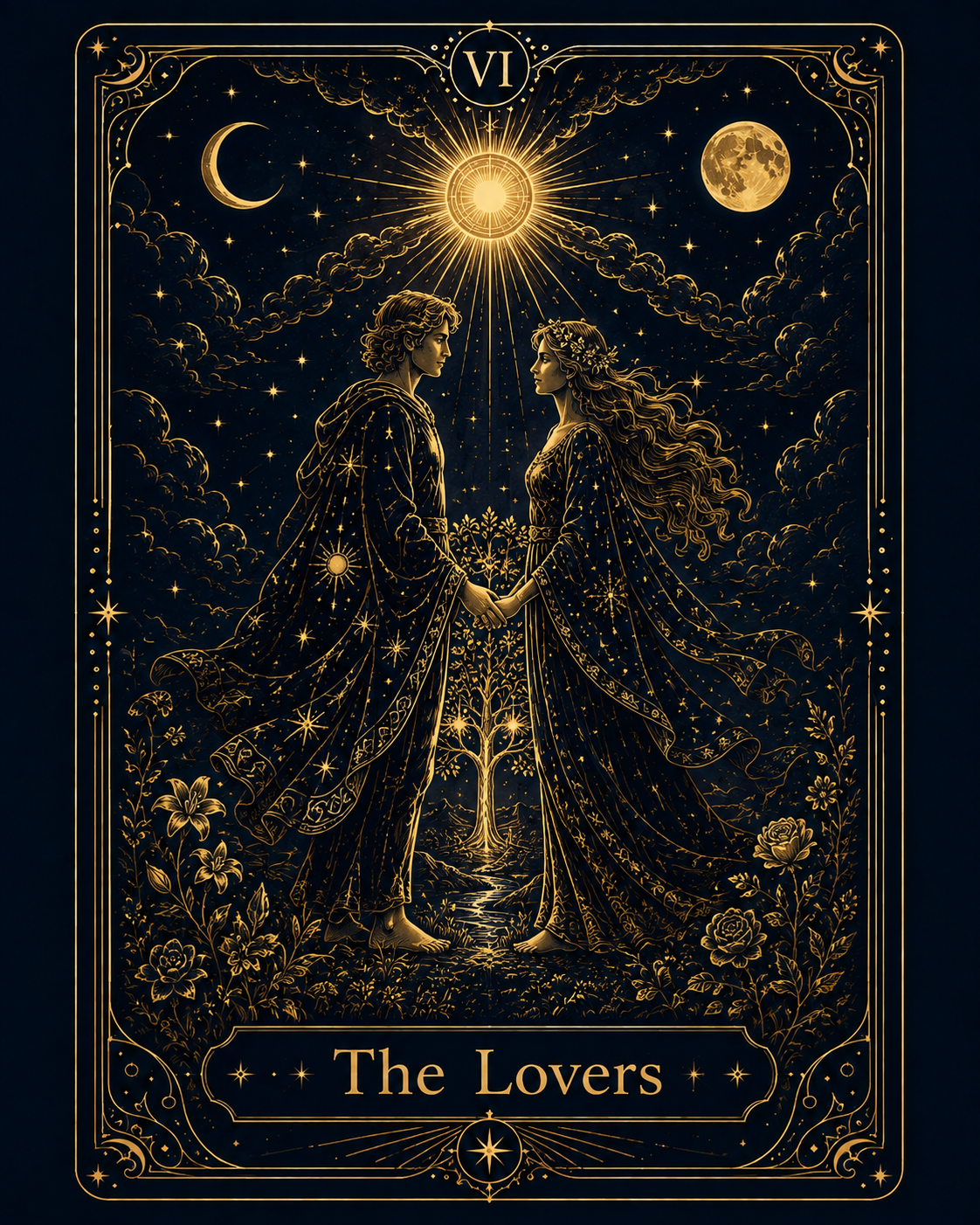
Aman and a woman stand unclothed beneath a great winged figure, arms spread wide in blessing, sunlight blazing directly overhead. Behind the woman rises a tree heavy with fruit, a serpent coiled through its branches. Behind the man rises a second tree, wreathed in small flames. Between them, far in the distance, a single mountain climbs toward the sky. Nothing in the scene is rushed. Everything in it is waiting on a decision only the two of them can actually make.
Numbered VI, the Lovers is popularly assumed to be a card purely about romance, and it certainly can describe that. But its older, deeper meaning runs through choice itself, the exact moment a person stops simply receiving guidance from above and starts deciding, consciously, which path is actually theirs to walk. The angel blesses. The trees offer their fruit either way. Only the two people standing between them can choose which one to reach for.
The Card That Used to Show a Choice, Not a Couple
The earliest Italian and French decks show a very different scene: a young man standing between two women, often read as a choice between virtue and vice, or between a familiar past and an uncertain future, with a small figure of Cupid hovering above, bow already drawn, an arrow aimed squarely down at the man's head. The composition echoes an old classical story, the Judgement of Paris, or Hercules famously forced to choose between two paths at a crossroads, both stories about a young man's character being tested by exactly one irreversible decision.
The Rider-Waite-Smith deck replaced that entire triangle with Adam and Eve standing beneath a benevolent angel, trading a story about romantic temptation for the foundational Western story about the very first real choice: whether to reach for the fruit of the Tree of Knowledge, and to accept everything that choosing it would cost. The composition changed completely. The card's actual subject, an irreversible decision that reveals exactly who is making it, never moved at all.
What the Card Actually Shows
The Winged Figure Above — blessing, not instruction
Widely identified with the archangel Raphael, healer among archangels, the figure blesses the scene with open arms but gives no visible command, presence offered without ever removing the actual choice from the two people below.
The Tree of Knowledge, and Its Serpent — the price of choosing
Behind the woman stands the biblical tree whose fruit brings awareness of good and evil, a serpent coiled through its branches, marking one path as costly, complicated, and irreversible once taken.
The Tree of Life, in Flame — the price of the other path
Behind the man stands a second tree, its twelve fruits rendered as small flames, an older, simpler vitality that asks nothing difficult of whoever stays close to it.
The Distant Mountain — what the choice eventually leads to
A single peak rises between the two figures in the far background, the long climb either path will eventually demand, small enough now to be easy to overlook entirely.
The Chain of Gazes — attention, not simply romance
The woman looks up toward the angel; the man looks toward the woman. Read carefully, the scene traces a line of guidance passed down and along, rather than two people already gazing only at each other.
Their Bare Bodies — nothing yet decided is hidden
Both figures stand entirely unclothed, marking a moment before any choice has been made and, with it, before either one has anything left to conceal.
Upright and Reversed
Upright, the Lovers favours genuine harmony, whether romantic, professional, or entirely internal, a decision that lines up cleanly with a person's actual values rather than simply the easiest or most flattering option available. It frequently marks a real fork in the road: a relationship, a job, a belief, finally chosen consciously rather than drifted into by default.
Reversed, the card points to disharmony, values pulling in two directions at once, a choice avoided so long it eventually gets made by circumstance instead of intention. It can describe a relationship where two people have quietly stopped wanting the same things, or a decision made from fear, convenience, or simple pressure rather than from anything the chooser can genuinely stand behind.
The Lovers in Love
Drawn upright in a love reading, the Lovers commonly describes a relationship built on genuine alignment: shared values, mutual attraction, a real and mutual choosing of one another rather than a connection either person simply fell into. It favours the deliberate decision over the passive drift, the relationship both people would still choose today, not only the one either of them happened to end up in.
For someone facing an actual romantic crossroads, the card is frequently read almost literally: two paths, two people, two futures, and a decision only the querent can genuinely make on their own behalf. Reversed, it can describe a relationship in real disharmony, a values mismatch neither partner has been willing to name aloud, or, in its oldest sense, a literal choice between two people that has been quietly avoided for far too long.
The Lovers in Work and Money
In a career reading, the Lovers often appears at a genuine decision point, two job offers, two directions for a business, a partnership worth entering or worth finally ending, and favours the option that actually aligns with a person's deeper values over the one that simply looks best on paper. It can also describe a business partnership or collaboration built on real, mutual respect, two parties whose goals genuinely point the same direction.
With money specifically, the card can point to a financial decision that needs to reflect what someone actually values, not merely what appears most profitable in the short term. Reversed, it warns of a partnership built on mismatched incentives, a decision postponed until it is effectively made by default, or a choice pursued purely for status rather than because it was ever genuinely wanted.
Strengths, Weaknesses, and the Thin Line Between Them
The Light
- Harmony. Values that genuinely, mutually align.
- Connection. A bond chosen freely, not simply fallen into.
- Integrity. A decision the chooser can actually stand behind.
- Intimacy. Openness with nothing important left concealed.
- Courage. The willingness to actually choose one path over another.
The Shadow
- Disharmony. Values quietly pulling in two directions at once.
- Codependency. A bond kept from fear rather than genuine choosing.
- Self-betrayal. A decision made against one's own better judgment.
- Temptation. Wanting what looks easy over what is actually right.
- Avoidance. A choice endlessly postponed until it makes itself.
The Lovers Beside Other Cards
Beside the Hierophant, card V, the pairing this Archive named plays out exactly as promised: a blessing formally given, immediately met by the one thing no institution can actually do for someone else, choosing. In the Minor Arcana, the Two of Cups carries a closely related meaning, mutual attraction and genuine connection, told in the deck's everyday register rather than its mythic one; this Archive's own future chapter on the suit of Cups will open that card in full.
The Lovers' most pointed pairing, though, sits much later in the deck, beside the Devil, card XV: two human figures again, standing again beneath a larger presence, but where the angel here blesses a free choice, the horned figure there binds two people in loose, self-accepted chains. The Rider-Waite-Smith deck drew both scenes to be read against each other on purpose.
Correspondences of the Lovers
The Lovers Across the Great Traditions
Tarot de Marseille — L'Amoureux, the crossroads
The young man flanked by two women and a bow-drawn Cupid this chapter has already described in full, a scene explicitly about temptation and consequence rather than a couple already in harmony.
Rider-Waite-Smith — Eden, and the first real choice
Adam and Eve beneath the blessing angel, the two trees, and the distant mountain, replacing romantic temptation with the foundational Western story of choice and consequence.
Thoth — the alchemical marriage
Crowley and Harris took a third path entirely, drawing on alchemical imagery of a royal marriage between opposites, leaning fully into Gemini's own duality made visually explicit through twinned figures.
What Survives Every Version — the irreversible fork
Crossroads, garden, or alchemical union, every tradition keeps the same core structure underneath its very different costumes: two paths, and a chooser who cannot walk both of them at once.
What This Card Actually Asks of You
The question is not which path looks better. Both trees in this card bear real fruit; neither one is drawn as an obvious mistake. The real question is which path is actually, honestly yours, chosen because it reflects what you value, not because it was blessed by someone else, not because it looked easiest, not because choosing nothing felt safer than choosing wrong.
Drawn in a reading, the Lovers is rarely asking the querent to fall in love. It is asking them to choose, consciously and completely, something they have perhaps been drifting toward or away from without ever quite naming the decision out loud. This Archive's opening Tarot chapter called the whole deck a mirror rather than a fortune, and this card holds up one of its oldest reflections: proof that the moment for an honest choice has arrived, and a plain reminder that avoiding it is, itself, already a choice.
a winged figure keeps its arms spread in blessing,
and a mountain waits quietly in the distance for whichever path finally gets chosen.
A young man once caught between two women and a drawn bow, the first man and woman reaching for a fruit that would cost them everything and give them everything in the same instant: every version of this card has always been asking the same plain question. Not what would be easiest to choose, but what is actually, honestly yours.
FOR THE CURIOUS
The Tarot de Marseille's original composition, a young man between two women beneath a bow-drawn Cupid, is documented across tarot historical scholarship and echoes the classical Judgement of Paris and Hercules-at-the-crossroads motifs. The Genesis account of Adam and Eve appears in Genesis 2–3. The Rider-Waite-Smith imagery described in this chapter is Pamela Colman Smith's 1909 design. The Thoth deck's reinterpretation is Aleister Crowley and Lady Frieda Harris's, completed across the 1940s.
Next in Tarot: Chapter Nine, The Chariot, the choice this card made, now carried forward by force of will.
The rest of this is yours, not a type.
Reveal my chart