The Magician
The Magician
The Card at the Table
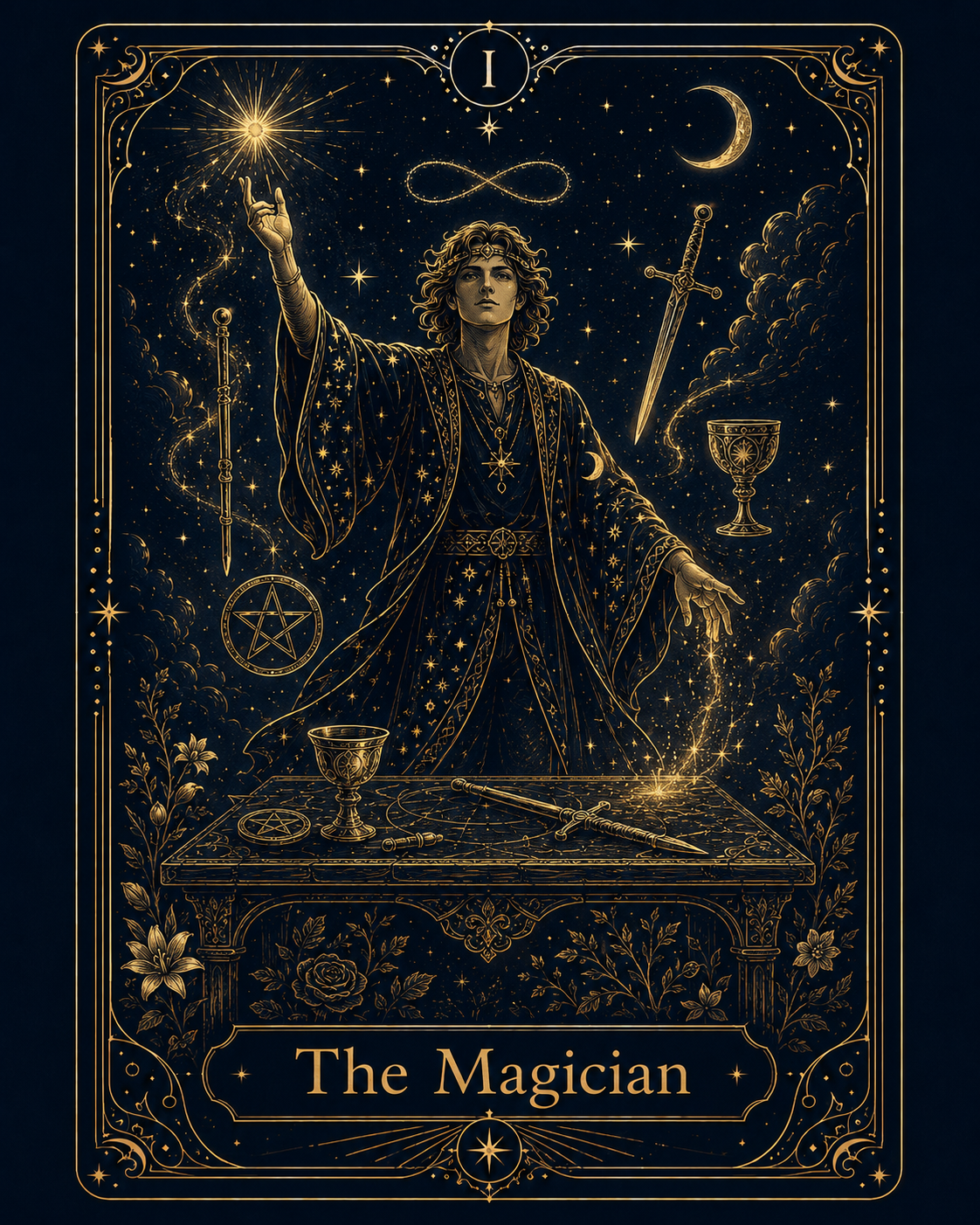
Afigure stands behind a small table, one arm raised toward the heavens holding a wand, the other pointed straight down at the earth, a single, deliberate gesture connecting the two. Laid out on the table before them, plainly visible, are a cup, a sword, a pentacle, and a second wand: the wand of Fire, the cup of Water, the sword of Air, and the pentacle of Earth, the four suits of the Minor Arcana this Archive's own opening chapter already mapped onto the four classical elements.
Numbered I, the very first counted card after the Fool's uncounted zero, the Magician marks the exact point where raw, undirected potential becomes a decision. The Fool had everything ahead of it and nothing chosen yet. The Magician has chosen: reached out, picked up a tool, and begun. Every one of this card's classical meanings, willpower, manifestation, skill, traces back to that single image of a hand already closed around something.
The Street Performer Behind the Sorcerer
The earliest Italian decks called this card Il Bagatto, roughly "the juggler" or "the trickster," and pictured exactly that: a street performer at a market stall table, running the shell game or sleight-of-hand tricks travelling entertainers have used to separate a crowd from its coins since long before playing cards existed. It was a modest, faintly disreputable image, closer to a con artist than a wizard, and for centuries that is precisely what the card was understood to mean.
The card's elevation into a genuine ceremonial magician, robed, deliberate, channelling divine power through a raised hand, arrived much later, through the same nineteenth and twentieth century occult revival this Archive's opening Tarot chapter already traced. Writers steeped in Hermeticism folded in the legendary sage Hermes Trismegistus and his famous axiom, "as above, so below," the exact gesture the Rider-Waite-Smith Magician now makes with his two raised and lowered hands, turning a market-square trickster into a figure capable of channelling the heavens into the earth.
What the Card Actually Shows
The Raised Wand — will reaching upward
Held toward the sky in one hand, the wand marks the moment intention is deliberately aimed at something larger than the self, a channel opened rather than a power invented from nothing.
The Pointing Hand — "as above, so below"
The other hand points straight down at the earth, completing the Hermetic axiom this chapter's history already named: whatever is drawn from above must still be delivered, concretely, into the material world.
The Infinity Symbol — unlimited resource
A lemniscate floats above the Magician's head like a halo, read as proof that the power being channelled here has no fixed limit, only a limit on how skilfully it is currently being used.
The Four Tools on the Table — every element, already available
Wand, cup, sword, and pentacle sit within easy reach, read as confirmation that this card is never short of resources; the only real question is which tool gets picked up first.
The Serpent Belt — eternity, worn at the waist
An ouroboros, a serpent eating its own tail, encircles the Magician's waist, a small, constant reminder that mastery is a cycle practised continuously, not a single trick performed once.
Roses and Lilies — desire and clarity, growing together
The garden framing the scene mixes red roses, passion, with white lilies, purity of purpose, suggesting genuine mastery needs both the wanting and the discipline, not one without the other.
Upright and Reversed
Upright, the Magician describes real manifestation: an idea deliberately turned into action, a skill actually applied rather than merely possessed, confidence backed by genuine competence. It is one of the most active cards in the entire deck, rarely describing something happening to a person, almost always describing something a person is actively doing.
Reversed, the same raised hand starts to look like a sleight-of-hand trick again: manipulation instead of genuine influence, all talk with no real follow-through, potential left sitting untouched on the table while its owner keeps promising, convincingly, that it will be picked up eventually. Some readers use the reversed card specifically to warn against being fooled by someone else's Magician-energy performance, a confidence that has not yet been tested against results.
The Magician in Love
Drawn upright in a love reading, the Magician often points to confident, intentional courtship: the message actually sent instead of drafted and deleted, the feeling stated plainly rather than left to be guessed at, real charisma used to close a distance rather than simply admired from across a room. In an existing relationship, it can point to actively applying effort where the relationship has been coasting, picking a tool up off the table rather than waiting for the spark to reignite itself.
Its shadow side arrives quickly, though, whenever charm tips into performance: someone saying exactly the right thing without meaning quite enough of it, a seduction that is technically skilful and quietly hollow. Reversed, the card frequently describes manipulation dressed as romance, or a partner, or a version of yourself, using considerable charisma to get what is wanted rather than to build what was actually promised.
The Magician in Work and Money
In a career reading, the Magician tends to appear exactly when a person has every skill and resource a project genuinely requires, and the only remaining question is whether they will actually pick them up. It favours the entrepreneur assembling scattered talents into one coherent pitch, the professional finally applying a skill they have quietly had all along, the negotiation won by someone who came prepared with every tool on the table rather than just one.
With money specifically, the card describes resourcefulness: turning a skill into income, spotting an opportunity and moving on it immediately, making more out of what is already available rather than waiting for more to arrive. Reversed, it warns of exactly the same resourcefulness aimed the wrong way, financial cleverness curdled into manipulation, a deal that looks masterful and is actually a trick.
Strengths, Weaknesses, and the Thin Line Between Them
The Light
- Resourcefulness. Using every tool actually on the table.
- Willpower. Turning a clear intention into a real result.
- Skill. Competence earned, then genuinely applied.
- Confidence. Belief in ability that has actually been tested.
- Focus. One clear channel, deliberately aimed.
The Shadow
- Manipulation. Resourcefulness turned against someone else's interest.
- Trickery. Willpower dressed up as a result that was never real.
- Arrogance. Skill mistaken for a right to skip the work next time.
- Overconfidence. Belief that outruns what has actually been tested.
- Scattered energy. Focus lost across too many tools at once.
The Magician Beside Other Cards
Beside the Fool, card 0, the Magician reads exactly as this Archive's previous chapter predicted: raw, undirected potential finally given a shape and a first deliberate move. Beside the High Priestess, card II, it forms one of the Major Arcana's clearest pairs of opposites, conscious will meeting quiet, unconscious knowing, action paired with the patience to wait and listen, each correcting the other's blind spot.
Beside the Wheel of Fortune, card X, the pairing raises the deck's oldest open question: how much of an outcome was actually earned through deliberate skill, and how much simply arrived. Readers generally treat the two together as a reminder that even the most capable hands on the table are still, eventually, dealt a card they did not choose.
Correspondences of the Magician
The Magician Across the Great Traditions
Tarot de Marseille — Le Bateleur, the juggler
Shown at a simple market table with a wand and a handful of small objects, wearing a wide hat some later readers noticed resembled an infinity symbol from certain angles, closer to a street entertainer than any kind of sorcerer.
Rider-Waite-Smith — the ceremonial magus
The robed, deliberate figure this chapter has already described in full, hand raised to the sky, hand pointed at the earth, the image now inseparable from the card's modern name.
Thoth — the winged Magus
Crowley and Harris depicted a more explicitly Mercury-linked, winged figure surrounded by the tools of active creation, leaning further into the card's Hermetic, scholarly associations than the RWS deck's simpler ceremonial staging.
What Survives Every Version — the table itself
Street juggler, ceremonial magus, or winged Hermetic scholar, every tradition keeps the same core object in frame: a table, and a set of tools already within reach, waiting on a decision.
What This Card Actually Asks of You
The question is not whether you have what you need. This card almost never appears to announce a missing tool; the wand, the cup, the sword, and the pentacle are, more often than the person drawing this card wants to admit, already sitting on the table in front of them. The real question is which one you are actually going to pick up, and whether you are willing to let the result prove whether the confidence behind the gesture was ever real.
Drawn in a reading, the Magician is rarely describing a problem of resources. It is almost always describing a moment of decision, the exact hinge this Archive's opening Tarot chapter described as a mirror rather than a fortune: the deck shows the shape, and the hand holding the cards decides what actually gets built from it. Nowhere in the whole Major Arcana is that hand more visibly, deliberately in motion than here, at card one.
a second hand already pointed back down at the earth,
and a table of tools is waiting to find out which one gets used first.
The market-square trickster and the ceremonial magus were always the same figure wearing two different coats. Every version of this card is asking the same plain question: given everything already within reach, what will actually be built with it, and how much of the confidence behind the gesture can the results actually back up.
FOR THE CURIOUS
Il Bagatto's origins as a street-performer figure are documented across scholarship on the early Italian tarocchi decks, including the Visconti-Sforza tradition. The Hermetic axiom "as above, so below" is traditionally attributed to the Emerald Tablet associated with Hermes Trismegistus. The Rider-Waite-Smith imagery described in this chapter is Pamela Colman Smith's 1909 design. The Thoth deck's reinterpretation is Aleister Crowley and Lady Frieda Harris's, completed across the 1940s.
Next in Tarot: Chapter Four, The High Priestess, the quiet knowing this card's raised hand has not yet learned to hear.
The rest of this is yours, not a type.
Reveal my chart