The Moon
The Moon
The Clear Sky, Meeting Something Harder to See Through
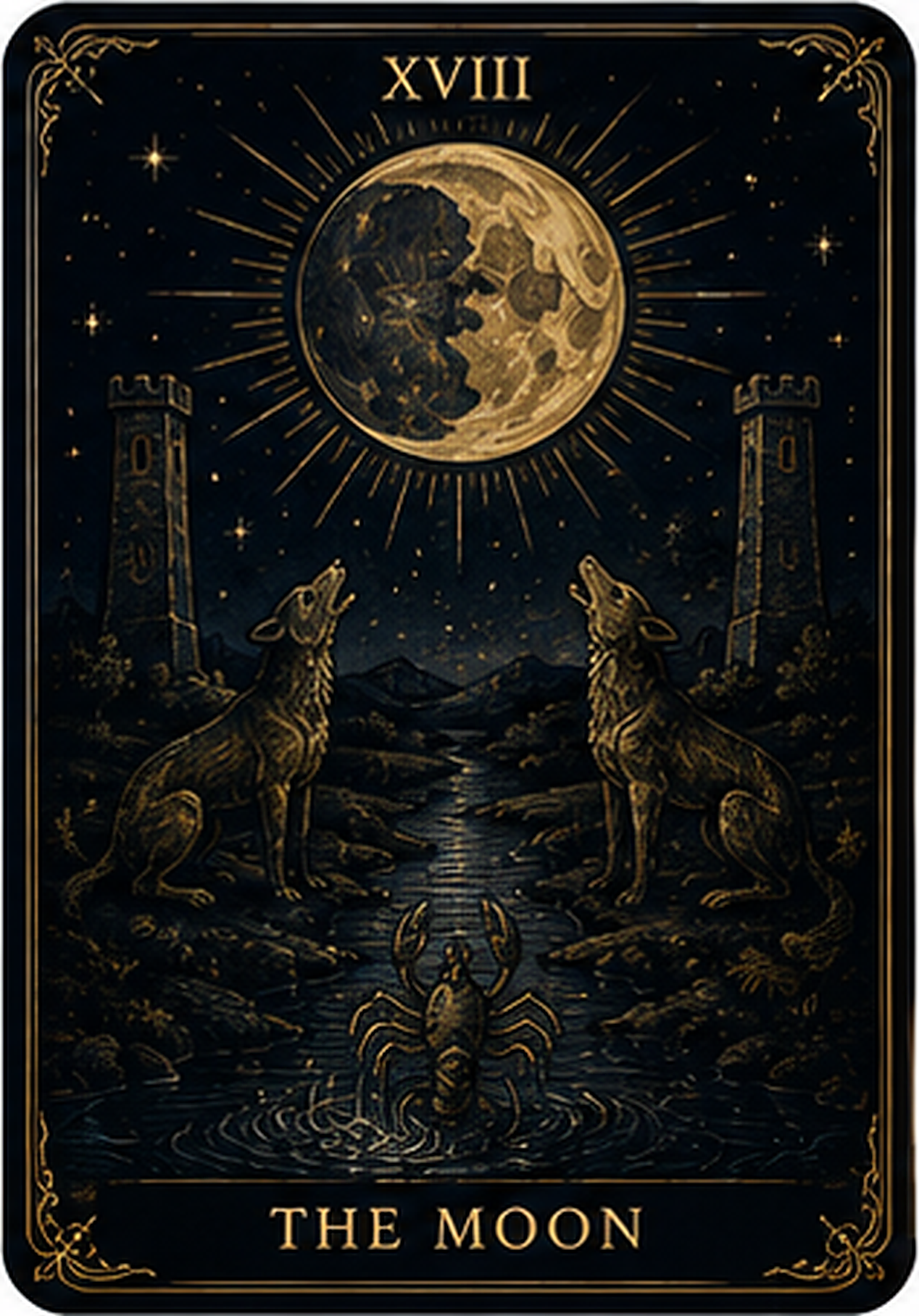
Alarge moon dominates a night sky, drops of light falling from it like quiet, uncertain rain. Two towers stand in the distance on either side of a winding path, a domesticated dog and a wild wolf both howling up toward the same uncertain light from opposite sides of that path, and, in the foreground, a small crayfish claws its way up out of a still, dark pool, something primal surfacing before it has fully decided what shape it wants to take.
Numbered XVIII, the Moon owes this Archive two separate debts at once. This Archive's own High Priestess chapter, all the way back in its fourth chapter, already named this exact pairing, a doubled mystery rather than a doubled clarity. And the Star, just one chapter ago, promised exactly this arrival: hope, however genuine, was never going to make every shadow ahead fully explainable.
The Light That Gave Us a Word for Madness
The English word lunatic descends directly from luna, the Latin word for moon, reflecting a widely held folk belief, persisting for centuries, that the full moon's changing light could influence mental instability, sleeplessness, and even the transformation of werewolves in older folklore. Long before any tarot deck existed, the moon had already earned a reputation as the light under which things stopped being reliably themselves.
Moon goddesses appear across an unusually wide range of mythologies, Selene and Hecate in Greek tradition, Luna in Roman religion, Chandra in the Vedic tradition this Archive has already traced in its own dedicated chapter. Hecate in particular sits close to this card's own composition: a goddess associated with magic, the night, and crossroads specifically, a fitting patron for a card whose entire scene is built around a single winding path, flanked by two very different kinds of howling.
What the Card Actually Shows
The Moon's Human Face — a light with its own mood
Given a distinctly human expression rather than left as a bare disc, the moon here feels less like a neutral source of light and more like a presence with its own uncertain temperament.
The Two Distant Towers — an echo of Death's own skyline
The same twin towers this Archive already traced glowing at dawn in the Death chapter reappear here at night, familiar structure made considerably harder to read clearly in moonlight.
The Dog and the Wolf — the tame and the wild, both uncertain
A domesticated dog and an untamed wolf howl up at the same moon from opposite sides of the path, both instincts, familiar and unfamiliar alike, equally unsettled by what they see.
The Winding Path — a crossroads, without a clear signpost
The road curves out of sight toward the distant towers, offering no clear view of where it actually leads, a genuine crossroads in the spirit of Hecate's own old domain.
The Crayfish, Emerging — something primal, still forming
A small crustacean claws its way out of a still pool in the foreground, an old, primal instinct surfacing before it has fully decided what shape it wants to take.
The Falling Drops of Light — illumination, offered in pieces
Small droplets fall steadily from the moon itself, light given out gradually rather than all at once, exactly the pace this whole card insists understanding actually arrives at.
Upright and Reversed
Upright, the Moon favours honest engagement with genuine uncertainty: intuition trusted even without full proof, dreams and the subconscious taken seriously rather than dismissed, a situation acknowledged as genuinely unclear rather than forced into a false, premature clarity. It rarely appears to promise deception is definitely occurring; it appears when the honest answer is simply, for now, that not everything can be confirmed yet.
Reversed, the card most often describes confusion finally beginning to lift, repressed fears or feelings surfacing enough to finally be addressed directly, or a deception that has finally, clearly, been exposed. Some readers reserve a harder reading for reversed Moon, anxiety spiralling well past what the actual situation justifies, paranoia mistaken for insight. Both readings share the same underlying question: has the fog actually lifted, or simply gotten louder.
The Moon in Love
Drawn upright in a love reading, the Moon often points to genuine uncertainty about a relationship's true nature, feelings that run deep without yet being fully understood, or a partner whose intentions remain honestly unclear rather than deliberately hidden. It favours trusting a real, intuitive sense that something matters, even before every question about it can actually be answered.
It can also describe unspoken fears finally surfacing, an old insecurity resurfacing in a new relationship without an obvious immediate cause. Reversed, it can point to clarity finally cutting through a confusing dynamic, a truth about a partner's intentions finally becoming clear, or, less happily, anxiety about a relationship spiralling well past anything the actual situation currently justifies.
The Moon in Work and Money
In a career reading, the Moon frequently appears around incomplete information, office politics that are genuinely hard to read, or a gut feeling that something is off even without hard evidence yet to confirm it. It favours patient intuition over forced, premature certainty, trusting a real instinct while still, honestly, gathering more to actually confirm it.
With money specifically, the card can describe a financial situation that is not fully transparent yet, worth investigating further before any major decision. Reversed, it warns either of a hidden truth finally being revealed, clarity cutting through what was genuinely confusing, or of anxiety about money spiralling well past what the actual numbers currently justify.
Strengths, Weaknesses, and the Thin Line Between Them
The Light
- Intuition. Trusting a real instinct before it can be proven.
- Acceptance. Sitting honestly with genuine uncertainty.
- Depth. Taking dreams and the subconscious seriously.
- Patience. Waiting for real clarity instead of forcing it.
- Imagination. Following a feeling before all the facts arrive.
The Shadow
- Paranoia. Fear that has stopped checking itself for evidence.
- Denial. Refusing to name a discomfort that is actually there.
- Self-deception. Believing a story that does not really hold up.
- Anxiety. Uncertainty spiralling past what the situation warrants.
- Confusion. Mistaking a feeling for something already confirmed.
The Moon Beside Other Cards
Beside the Star, card XVII, last chapter's promise plays out exactly as expected: clear-eyed hope, meeting genuine, honest uncertainty. A much older promise closes here too. This Archive's own High Priestess chapter, all the way back in Chapter Four, already named this exact pairing word for word: a doubled mystery, rarely a doubled clarity, two water-and-intuition cards that were never actually going to cancel each other's fog out.
Her forward-looking pairing sits with the very next card in the sequence, the Sun, card XIX: this card's careful half-light, immediately followed by the single most unambiguous, cloudless card in the entire Major Arcana.
Correspondences of the Moon
The Moon Across the Great Traditions
Tarot de Marseille — La Lune, remarkably stable
Shown with the same dog, wolf, crayfish, and twin towers this chapter has already described, one of the more consistent compositions across the entire history of the deck, changed relatively little from its earliest printings.
Rider-Waite-Smith — a face, given to the light
The human-featured moon and winding path this chapter has already described in full, uncertainty given an unmistakably personal, watchful presence.
Thoth — the Moon, and Anubis at the threshold
Crowley and Harris added explicit Anubis imagery, jackal-headed guardians flanking the path, and a scarab beetle pushing the lunar disc, tying the card more directly to Egyptian imagery of thresholds between the living and the dead.
What Survives Every Version — a path, still only half lit
Consistent composition, watchful face, or Egyptian threshold guardians, every tradition keeps the same essential image: a winding road, and just enough light to see that the destination is not yet fully visible.
What This Card Actually Asks of You
The question is not whether you can see the whole path clearly. This card rarely appears to promise that kind of clarity is even currently available; the towers stay distant, the road stays winding, and the light stays partial for a reason. The real question is whether you are willing to keep walking anyway, trusting an honest instinct even while significant parts of the picture are still, genuinely, in shadow.
Drawn in a reading, the Moon is rarely asking the querent to eliminate every uncertainty before moving forward. It is asking them to stop mistaking uncertainty itself for danger. This Archive's opening Tarot chapter called the whole deck a mirror rather than a fortune, and this card holds up one of its most honest reflections: proof that not everything worth trusting arrives fully explained, and a plain reminder that both the dog and the wolf are, this whole time, howling at exactly the same real light.
a small crayfish is still climbing out of a pool it has not yet fully left behind,
and a winding road still leads off toward two distant towers, neither one quite close enough to make out clearly yet.
A word for madness borrowed directly from the moon's own Latin name, a goddess of crossroads and uncertain magic, a road that has never once, in any printing of this card, actually reached its destination: every version of this image has always been asking the same plain, patient question. Not whether you can see everything clearly yet, but whether you can trust the road enough to keep walking anyway.
FOR THE CURIOUS
The etymology of "lunatic" from the Latin luna is documented across historical linguistics. Hecate's association with magic, the night, and crossroads is recorded across Greek mythological sources. The Rider-Waite-Smith imagery described in this chapter is Pamela Colman Smith's 1909 design. The Thoth deck's reinterpretation is Aleister Crowley and Lady Frieda Harris's, completed across the 1940s.
Next in Tarot: Chapter Twenty-One, The Sun, this card's careful half-light finally, completely, clearing.
The rest of this is yours, not a type.
Reveal my chart