The Star
The Star
The Quietest Hope in the Whole Deck
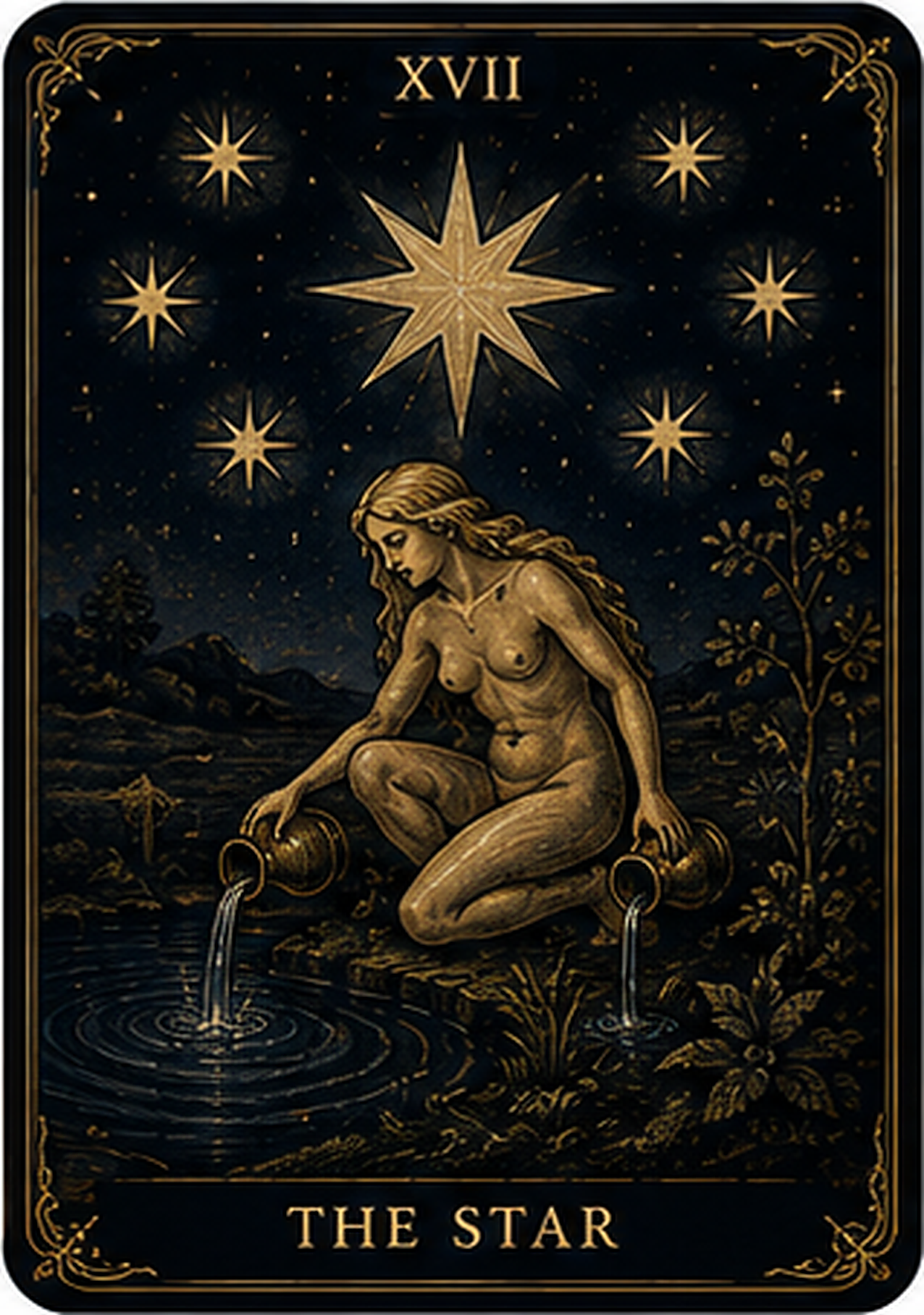
Anaked woman kneels beside a calm, still pool, one knee resting on the land, one foot submerged in the water. In one hand she holds a jug she pours back into the pool itself, returning what already belonged there. In the other, she pours a second stream out across the land, five small rivulets spreading gently into the soil around her. Above her, a single large star blazes at the centre of seven smaller ones, all of it lit beneath a sky finally, completely clear of the previous card's storm.
Numbered XVII, the Star arrives directly after the Tower's total collapse, and nothing in this card rushes to explain that collapse away or pretend it never happened. It simply, quietly, continues. Where the Tower struck without warning, this card does not strike at all. It kneels, and pours, and waits, patiently proving that something worth trusting can survive even the worst night this whole Archive has traced.
The One Thing That Never Escaped
According to Greek myth, Pandora opened a jar she had been warned never to touch, releasing every hardship, illness, and sorrow into the world at once. Only one thing remained trapped at the very bottom once the jar was finally closed again: Elpis, hope itself, sometimes read as a mercy left behind to help humanity endure everything that had just escaped, and sometimes read, more unsettlingly, as hope trapped rather than freed. Either reading keeps the same essential shape this card has carried ever since: catastrophe unleashed, and one small, steady thing that refused to leave.
A second, broader tradition runs underneath the myth: the ancient practice of reading the night sky itself for guidance, shared by Egyptian, Babylonian, and Greek astronomers alike, the entire ancestral root this Archive's whole astrology sections have already traced in depth. This card is, in some sense, tarot's most direct nod to that older tradition: a sky worth trusting, studied calmly, long after the storm that made trusting anything feel impossible.
What the Card Actually Shows
One Knee on Land, One Foot in Water — an echo of Temperance
Her posture directly recalls the angel this Archive's own Temperance chapter already traced, balance between two different states, deliberately repeated here at a much gentler pace.
The Jug Poured Back Into the Pool — honouring the source
One stream returns to the water it came from, a quiet acknowledgement that healing depends on maintaining, not merely taking from, whatever originally sustained you.
The Jug Poured Onto the Land — nourishment, freely given
Five rivulets spread outward across the ground, generosity extended outward even while the figure herself is still, visibly, in the middle of her own healing.
The Eight-Pointed Stars — a whole sky, finally visible
One large star blazes above seven smaller ones, the storm that closed the previous chapter entirely cleared away, nothing left overhead now but calm, steady light.
The Ibis in the Tree — wisdom, quietly watching
A bird, often identified with the ibis and its associations with Thoth, keeper of wisdom, watches calmly from a nearby branch, insight simply present rather than urgently demanded.
Her Unclothed, Unguarded Body — vulnerability, no longer hidden
She kneels entirely exposed, without the armour or robes this Archive's earlier authority figures relied on, healing pictured as something that happens in the open, not behind a wall.
Upright and Reversed
Upright, the Star favours quiet, patient optimism, faith in the future that does not need loud proof to justify itself, healing well underway after real hardship, inspiration returning gently rather than arriving all at once. It rarely appears to promise instant transformation; it appears when calm, steady renewal is genuinely, finally, possible.
Reversed, the card most often points to despair persisting even as circumstances actually improve, a hope that has gone quiet from exhaustion rather than from any real absence of reason to feel it. Some readers use the reversed card to describe disconnection from faith itself, a numbness that arrives after enough disappointment that even genuine good news struggles to actually land.
The Star in Love
Drawn upright in a love reading, the Star commonly points to healing after real heartbreak, faith slowly returning after a painful ending, or a new connection approached with calm, grounded hope rather than desperate need. It favours patience over rushing back toward certainty, a willingness to stay open even while still visibly, honestly, in the middle of recovering.
For someone already partnered, it can describe a relationship entering a genuinely calmer season after real difficulty, both people finally able to breathe. Reversed, it can point to a lingering inability to trust again despite clear evidence that things have actually gotten better, or hope so worn down by past disappointment that it struggles to recognise a genuinely good thing when it finally arrives.
The Star in Work and Money
In a career reading, the Star frequently appears after a real setback, a job loss, a failed venture, a period of real professional doubt, and favours patient, grounded rebuilding over any rushed attempt to prove the difficulty never happened. It can describe inspiration returning gently, a long-term vision worth trusting again even without immediate, dramatic proof it is working.
With money specifically, the card can describe financial recovery after real hardship, slow and steady rather than sudden, or renewed faith in a long-term plan that is, quietly, finally starting to show real results. Reversed, it warns of discouragement that persists even once the actual numbers have started improving, or a long-term plan abandoned too early, right before it was finally about to pay off.
Strengths, Weaknesses, and the Thin Line Between Them
The Light
- Hope. Genuine faith in the future, quietly held.
- Healing. Real recovery, given the calm it actually needs.
- Renewal. Inspiration returning gently after real hardship.
- Generosity. Pouring outward even while still recovering.
- Calm. Steadiness that does not need proof to feel real.
The Shadow
- Despair. Hope gone quiet even as things improve.
- Disconnection. Faith in the future that no longer feels believable.
- Numbness. Good news that struggles to actually land.
- Self-neglect. Pouring outward with nothing left for oneself.
- Restlessness. Impatience with a calm that feels undeserved.
The Star Beside Other Cards
Beside the Tower, card XVI, the promise this Archive named plays out exactly as expected: total devastation, immediately followed by the gentlest, most patient card the whole deck has to offer. A much older promise lands here too. This Archive's own Empress chapter, all the way back in Chapter Five, already named this exact pairing: abundance flowing freely, doubled rather than contradicted, two women, two sets of water, both genuinely generous.
Her forward-looking pairing sits with the very next card in the sequence, the Moon, card XVIII: this card's calm, clear-eyed hope, followed immediately by something considerably murkier, uncertainty and illusion arriving right after clarity felt, for one chapter, finally secure.
Correspondences of the Star
The Star Across the Great Traditions
Tarot de Marseille — L'Étoile, a simpler sky
Shown with the same water-pouring woman and cluster of stars this chapter has already described, though sometimes accompanied by a butterfly rather than a bird, and with varying numbers of stars across different historic printings.
Rider-Waite-Smith — hope, kneeling in the open
The unclothed, calmly kneeling figure this chapter has already described in full, vulnerability and healing pictured as something that happens without armour of any kind.
Thoth — the Star, and Nuit
Crowley and Harris tied the card explicitly to Nuit, the Egyptian sky goddess, reframing the kneeling figure less as a worshipper beneath the stars and more as an embodiment of the night sky itself.
What Survives Every Version — water, poured without hurry
Butterfly, bird, or sky goddess, every tradition keeps the same essential image: someone pouring water calmly, unhurried, beneath a sky that has finally, completely, cleared.
What This Card Actually Asks of You
The question is not whether the damage was real. This card never once pretends the Tower's collapse did not happen; the woman kneeling here is still, visibly, in the middle of her own recovery. The real question is whether you are willing to actually let yourself feel some hope again, calmly, without needing proof it will be rewarded before you allow yourself to feel it at all.
Drawn in a reading, the Star is rarely asking the querent to pretend everything is already fixed. It is asking them to notice that the sky has, in fact, cleared, and that something worth trusting is still, quietly, pouring. This Archive's opening Tarot chapter called the whole deck a mirror rather than a fortune, and this card holds up one of its gentlest reflections: proof that hope was never naive simply because the damage before it was real, and a plain, patient reminder that healing rarely announces itself loudly.
two jugs still pour without any hurry at all,
and a whole sky, finally cleared of every trace of the previous night's storm, keeps quietly shining down on all of it.
A jar that released every hardship into the world and kept only one small thing behind; an ancient sky that civilizations across the world once studied for guidance long before anyone thought to draw a single card: every version of this image has always been asking the same plain, gentle question. Not whether the damage was real, but whether you are finally willing to let yourself hope again, calmly, before you have any proof at all that the hope will be rewarded.
FOR THE CURIOUS
The myth of Pandora's jar and the hope left inside it is recorded in Hesiod's Works and Days. Ancient astronomical and astrological traditions across Egyptian, Babylonian, and Greek civilisations are documented across the history of astronomy. The Rider-Waite-Smith imagery described in this chapter is Pamela Colman Smith's 1909 design. The Thoth deck's reinterpretation is Aleister Crowley and Lady Frieda Harris's, completed across the 1940s.
Next in Tarot: Chapter Twenty, The Moon, this card's clear sky meeting something considerably harder to see through.
The rest of this is yours, not a type.
Reveal my chart