The Suit of Cups
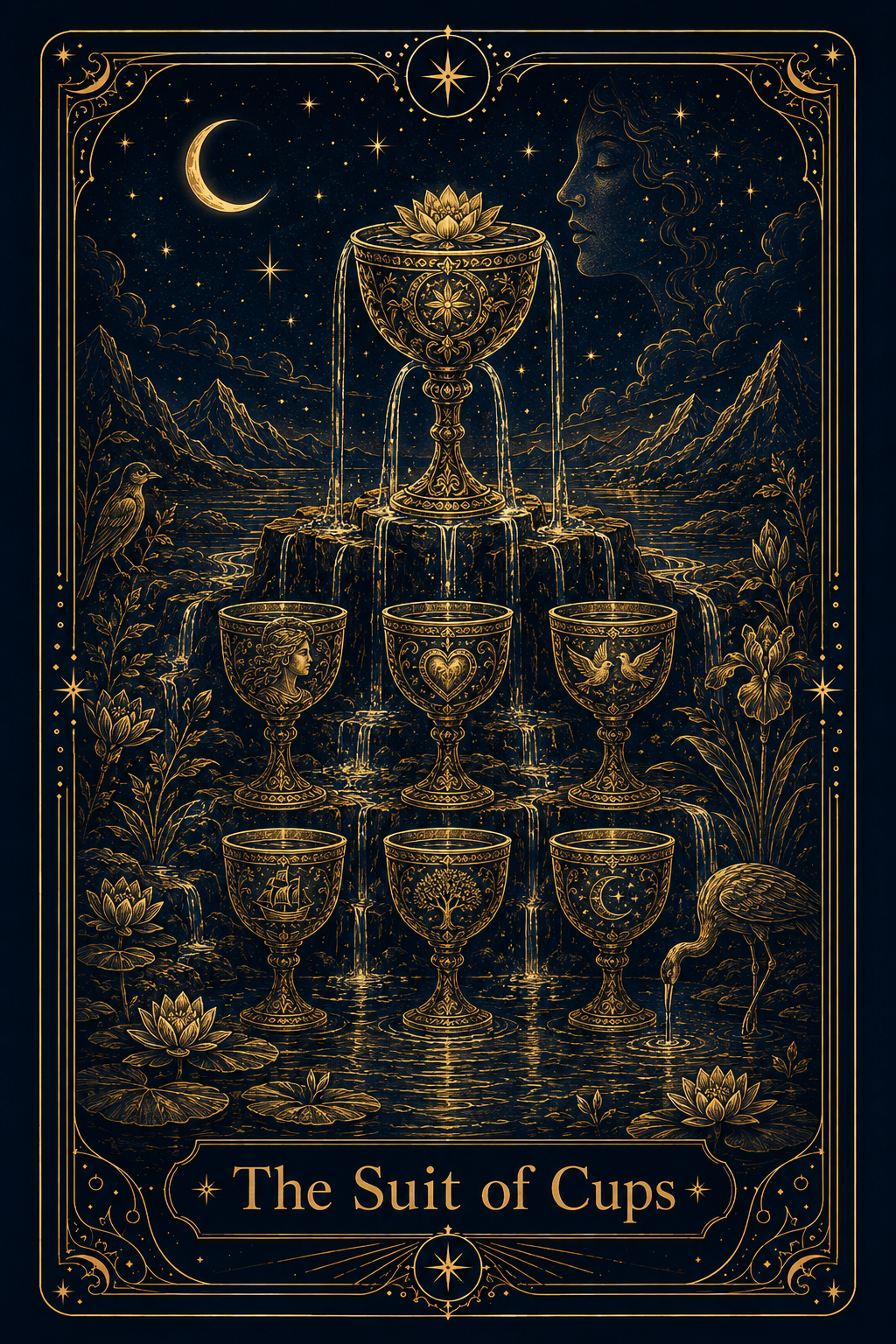
The Suit of Cups
The Suit of Water
Wands burned with the urge to act. Cups do the opposite of act. They receive. Where fire pushes outward, water pools, reflects, and takes the shape of whatever holds it, and the whole of this second suit lives in that inward turn. It is the suit of emotion, of love and grief and longing, of intuition, of the bonds between people and the quiet weather of the inner life.
When a spread fills with Cups, it has stopped asking about projects and ambitions altogether. It is asking about the heart: who the querent loves and how, what they are mourning, what they secretly hope for, which feeling they have been carefully not looking at. These are rarely the loudest cards in a reading, but they are almost always the ones a querent remembers, because they name the thing the rest of the deck was only circling.
Where the Suit Comes From
Among the four suits of the medieval Mamluk cards that seeded the European deck, one was already, unmistakably, cups. Where the polo-stick of the Wands chapter had to be reinterpreted by card-makers who had never seen the game, the cup needed no translation at all. It passed into the Italian coppe almost unchanged, and from there into the small red heart of the French deck the world now shuffles, the softened silhouette of a vessel that once held wine.
What the occult revival added was not a new shape but a deeper reading of the old one. To the Hermetic Order of the Golden Dawn this Archive has traced before, the cup was the natural vessel of Water, assigned the letter Heh and the whole realm of feeling, dream, and reflection. And to Arthur Waite in particular, who commissioned the deck this chapter describes and who spent much of his life writing about the legend of the Holy Grail, the cup was never entirely separable from that most famous vessel of all.
It is why the Ace of Cups, when Pamela Colman Smith drew it, arrived looking less like a wine-cup and more like a sacrament: a dove, a descending host, water spilling in streams. The suit of everyday feeling had quietly borrowed the imagery of the most sacred cup in the Western imagination, and has carried a faint trace of it ever since.
The Cup as a Vessel
A cup is defined entirely by two things: that it is open, and that it is shaped to receive. Turn it over and it holds nothing; it must be upright, and empty, before it can be filled. That is the whole emotional logic of the suit written into its object. Feeling is not something the querent manufactures by force, the way fire manufactures action. It is something that arrives, and the only real question is whether the querent is open enough to let it in, and steady enough to hold it once it comes.
This is why the shadow of this suit is so rarely about too little feeling and so often about the mishandling of it: a cup held too tight, spilling; a cup kept turned down so nothing can enter; a cup so full it overflows and floods everything around it. The numbered cards, which the next pages trace in order, are best read as a single vessel filling and emptying and filling again, rather than as a fire climbing and falling.
The Anatomy of the Suit
The Ace is water at its source, the full and overflowing heart before it has been given to anyone in particular. The numbered cards, Two through Ten, then move through the whole emotional weather of a life: union and celebration, a slump into apathy and then real grief, a slow recovery through memory, and at last a rising to overflow. The four court cards are people rather than stages, four temperaments who each carry water at a different depth.
The Ace of Cups
The Ace is the suit distilled to its source: not a relationship, not a particular love, but the capacity for feeling itself, brimming and ready to be poured. Drawn upright, it is the arrival of new emotion, an opening of the heart, a wave of love or compassion or spiritual tenderness that has not yet attached itself to a single person or thing. The overflowing water is the traditional sign that this feeling is abundant, more than the cup can even contain.
What makes the Ace so tender is exactly what makes it fragile. An open cup can be filled, but it can also be knocked, ignored, or turned away. Reversed, that same overflowing heart closes: emotion blocked or repressed, love offered and not received, a numbness where feeling should be, a cup turned quietly upside down so that nothing, good or bad, can get in.
Two Through Five — Union and Loss
Two figures exchange cups beneath a winged emblem of healing. The Two is connection at its purest: mutual love, partnership, a meeting of equals, the moment two separate hearts agree to pour something into one another. It is the Ace's overflowing feeling, finally given a direction and a name.
Three figures raise their cups together in a circle. The Three widens the bond of the Two into community: friendship, reunion, shared joy, the particular happiness of being among people who are glad you exist. It is the warmest of the suit's early numbers, feeling made social.
A figure sits with arms crossed, ignoring a fresh cup offered from a cloud. The Four is emotional apathy: boredom, discontent, a heart so turned inward it cannot see what is being held out to it. Nothing is wrong, exactly, which is precisely the problem the card is naming.
A cloaked figure grieves over three cups spilled on the ground, and does not turn to see two still standing behind. The Five is the suit's lowest point: loss, mourning, regret. Yet the two upright cups are the card's quiet mercy, all that remains is still more than nothing.
Six Through Ten — From Memory to Overflow
Children in a walled garden, one offering the other a cup of flowers. The Six is nostalgia and innocence: the sweetness of the past, a kindness remembered, sometimes a figure returning from it. After the grief of the Five, it is the heart's first warmth again, gentle and backward-looking.
Seven cups float in cloud, each holding a different vision, some treasure, some monstrous. The Seven is fantasy and choice: wishful thinking, too many tempting options, dreams not yet tested against reality. It asks the querent to notice which cups are real and which are only wanted.
A figure turns from eight stacked cups and walks toward the mountains under a moon. The Eight is the brave, sad decision to leave something that no longer nourishes the heart, even when it looks complete from outside, in order to go looking for something deeper.
A satisfied figure sits before an arc of nine cups, arms folded, content. Long called the wish card, the Nine is emotional satisfaction, comfort, a desire fulfilled. Its only shadow is smugness, contentment that tips over into merely having enough and wanting no one else near it.
A couple stand with their children beneath a rainbow of ten cups. The Ten is the suit's fulfilment: lasting harmony, love that has become a shared life, the emotional happy ending. Where fire's Ten was a crushing burden, water's Ten is the cup finally running over with more than enough.
The Court of Cups
The Page — the dreamer
The youngest water, gazing at a cup from which a fish has improbably appeared. The Page is intuition and imagination before experience: a tender new feeling, a creative stirring, a message that arrives through the heart rather than the head. Its shadow is a dreaminess that never quite touches the ground.
The Knight — the romantic
Mounted on a white horse, moving at a walk, offering his cup like a proposal. The Knight is the idealist who follows his heart: charming, poetic, the bringer of love and beautiful gestures. Pushed too far he becomes moody, unrealistic, in love with the feeling more than the person.
The Queen — the deep well
Seated at the water's edge, absorbed in an ornate covered cup only she can see into. The Queen is emotional depth itself: compassion, intuition, the one who feels others' feelings as her own. Her shadow is a heart with no edges, giving until she is overwhelmed, or lost in her own moods.
The King — calm over deep water
Throned on a stone slab adrift on a rolling sea, cup in hand, entirely unshaken. The King is emotional mastery: feeling held steady, compassion that governs rather than floods, the wise and diplomatic counsellor. His shadow is water gone still and cold, feeling withheld or quietly turned to control.
The Water That Nourishes and the Water That Drowns
Water Well Held
- Empathy. Feeling another's state as if it were weather you share.
- Intuition. Knowing something true before you can explain it.
- Love. Attachment given freely and received without grasping.
- Depth. A willingness to feel a thing all the way down.
- Compassion. Softness that does not curdle into pity.
Water Gone Wrong
- Overwhelm. Feeling so much you can no longer act at all.
- Moodiness. Emotion running the whole show, ungoverned.
- Escapism. Retreating into dream to avoid what is real.
- Manipulation. Feeling used as a lever on other people.
- Stagnation. Old emotion held so long it goes still and sour.
Reversed Cups rarely mean a heart has gone cold; far more often they mean the water has been mismanaged, dammed, spilled, or allowed to rise past the point of safety. A reversed suit card asks the querent to look at how their feeling is actually moving, and whether it is nourishing the ground it touches or quietly washing it away.
Correspondences of the Suit
The Suit Beside the Others
Beside the suit of Wands, water meets fire, and the deck's oldest opposition plays out from the other side: feeling against drive, the pull to stay and feel against the urge to act. A reading heavy with both is usually about a heart and an ambition pulling in different directions, and about which one the querent will finally let win. Beside Swords, water meets air, and this is the sharpest pairing of all: the eternal quarrel between the heart and the head, feeling weighed against cold judgement, and the question of which the querent trusts when the two disagree.
Beside Pentacles, water meets earth, and the two settle each other. Earth gives feeling a form to live in, a home, a shared life, a love made steady and daily rather than merely felt. This is the pairing of emotional security, of romance that has quietly become a household, of a heart that has found somewhere solid to pour itself.
What the Water Is Really Asking
The question sounds simple and almost never is. Not what you think you should feel, not what would be reasonable or convenient to feel, but what is actually moving in you underneath all of that, the grief you have been too busy to sit with, the love you have not admitted, the contentment you keep deferring until conditions are perfect. Cups are gentle cards, but the honesty they ask for is not gentle at all. A cup can only be filled once it is turned right way up and looked into.
This Archive's opening Tarot chapter called the whole deck a mirror rather than a fortune, a way of hearing what the reader already half-knew. In the suit of Water that half-knowing is almost always an emotion the querent has been holding at arm's length. The cards do not deliver new feeling. They simply ask the querent to stop looking away from the feeling that was already there.
filling and emptying and filling again with the whole weather of a heart,
waiting for someone honest enough to look into it.
A Mamluk cup, an Italian chalice, a small red heart, a borrowed trace of the Grail: this suit has worn many vessels, and poured the same thing through all of them. Not what you do, not what you know, not what you own, but what you feel, and the harder question of whether you will let yourself feel it all the way down.
FOR THE CURIOUS
Cups appear as one of the four suits of the medieval Mamluk cards from which the European deck descends. The assignment of Cups to Water and to the letter Heh follows the Hermetic Order of the Golden Dawn. Arthur Waite, who commissioned this deck, wrote extensively on the legend of the Holy Grail; the Ace of Cups' sacramental imagery is Pamela Colman Smith's 1909 design.
Next in Tarot: Chapter Twenty-Six, the Suit of Swords, water's counterweight, the cold clarity of air and the mind that weighs what the heart only feels.
The rest of this is yours, not a type.
Reveal my chart