The Suit of Pentacles
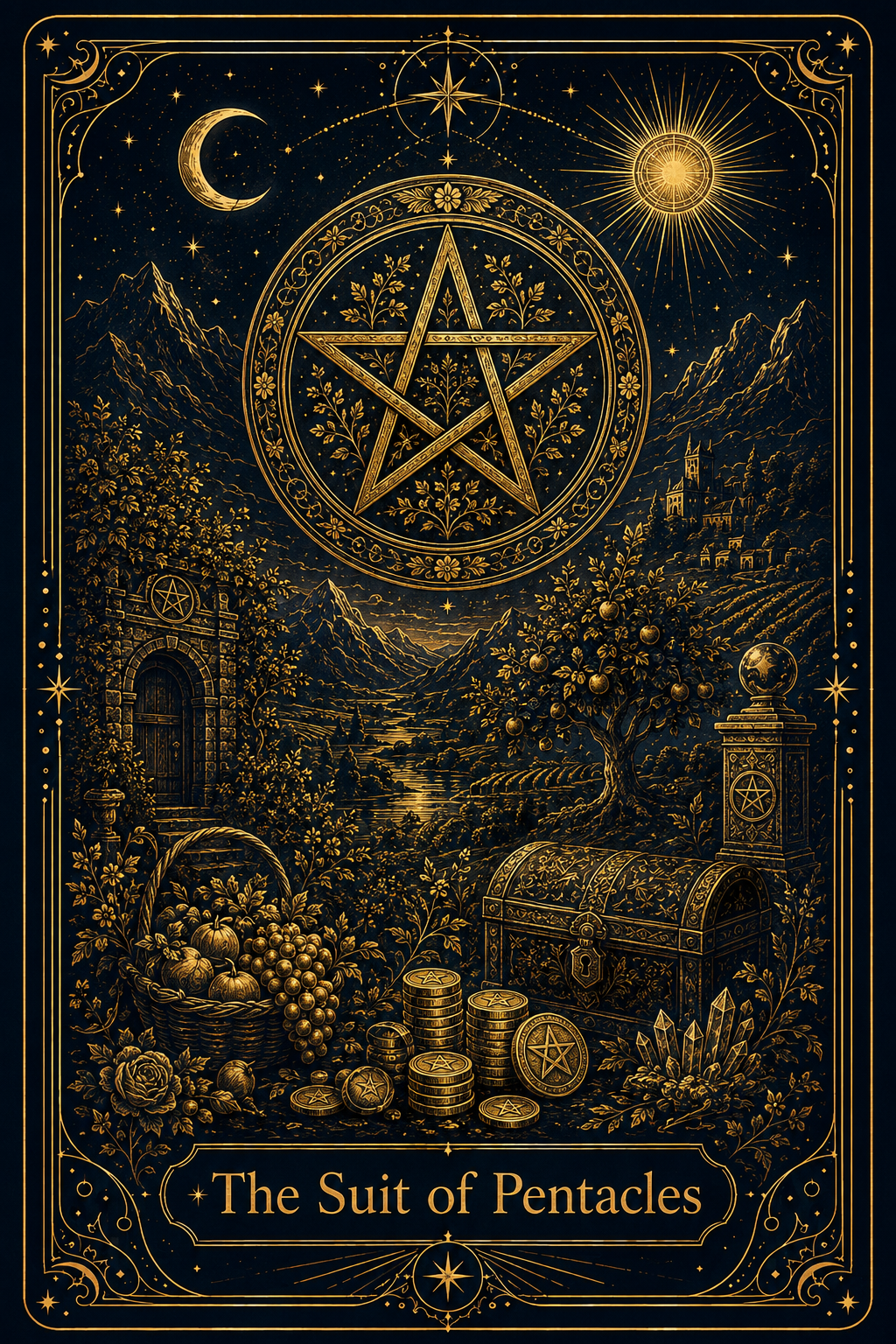
The Suit of Pentacles
The Suit of Earth
Pentacles are the suit of matter. Money belongs here, but money is only the easiest symbol. So do the body and its health, the house, the job, the meal, the skill learned by repetition, the garden that grows because someone watered it, the years saved into a pension, the tools on a bench, the inheritance passed from one set of hands to another. Earth is everything that has weight, cost, texture, maintenance, and consequence.
When a spread fills with Pentacles, the reading has come down out of fire, water, and air and entered the part of life that must be lived on a Tuesday morning. The question is practical: what is this worth, what does it require, what can be afforded, what needs care, what will still be standing after the mood and the idea have passed. This suit is slower than the others because matter is slow. That slowness is not a weakness. It is how anything becomes real.
Where the Suit Comes From
Coins were one of the four suits of the medieval Mamluk cards from which the European deck descends. In the Latin-suited decks of Italy and Spain they remained literal coins, denari and oros, small discs repeated across the pip cards. In the modern French-suited correspondence, their nearest relative is Diamonds: value reduced from a round coin to a red geometric sign.
The occult deck changed the name more than the object. Nineteenth-century esoteric writers increasingly called the suit Pentacles or Disks, and in the Rider-Waite-Smith deck each golden disc carries a five-pointed star. The ordinary coin had become a pentacle: material value marked with a symbol, the world of money and work opened outward into the whole problem of embodiment.
That distinction matters. A coin asks how much something costs. A pentacle asks what gives a thing value at all: labour, time, skill, care, land, health, continuity, the body that must do the work and the world that must hold the result. The suit never stops being practical. It simply becomes larger than finance.
The Coin Becomes a Pentacle
Money is the obvious language of Pentacles because it turns effort into something visible and transferable. But the cards repeatedly refuse to let wealth stand alone. The Three shows people building together. The Eight shows a craftsperson at a bench. The Nine places abundance inside a cultivated garden. The Ten turns money into family, shelter, age, dogs at an elder's feet, a life whose value is measured by what continues after one person is gone.
This is why the suit can speak as clearly about health as salary, about a home as an investment account, about discipline as possession. Earth is the body because the body is where every abstract thing eventually sends its bill. Ambition costs sleep. Love needs time. An idea needs labour. Even spiritual practice needs a place to sit and a nervous system capable of staying there. Pentacles are where the invisible elements acquire weight.
The Anatomy of the Suit
The Ace is earth in potential: one clean opportunity, a seed placed in the hand. The numbered cards, Two through Ten, test whether that potential can survive real life. It must be balanced, built, protected, lost, shared, waited for, practised, enjoyed, and finally passed on. The four court cards are people at different relationships to the material world, from the student studying one coin to the sovereign responsible for an entire estate.
The Ace of Pentacles
The Ace is material possibility in its purest form: a job offer, a useful skill, a financial opening, a new home, an improvement in health, a chance to build something that can endure. Unlike the flash of the Ace of Wands or the revelation of the Ace of Swords, this card rarely shouts. It puts something solid in the hand and asks whether the reader will plant it.
The garden matters as much as the coin. An opportunity becomes abundance only through tending, and the path through the hedge reminds the reader that the gift is an entrance, not a destination. Reversed, the seed can be missed, mishandled, or pursued only for its price: a bad investment, poor planning, a body ignored, a chance to build security lost because the groundwork was never done.
Two Through Five — Balance to Winter
A young figure loops two pentacles through an infinity ribbon while ships rise and fall on rough water behind. The Two is balance in motion: money, work, time, obligations, the art of keeping several real demands alive at once. It is flexibility rather than perfect control.
A craftsperson stands beneath a stone arch while two others consult the plan. The Three is skilled work made social: apprenticeship, collaboration, competence recognised by others, the moment talent becomes something that can be built into a structure larger than one person.
A crowned figure grips one coin to the chest, balances another on the head, and pins two beneath the feet. The Four is security and its shadow: saving, protecting, holding what has been earned, but also possession tightened until nothing can circulate and safety becomes a cage.
Two exhausted figures pass through snow beneath a bright stained-glass window marked by five pentacles. The Five is material hardship: poverty, illness, exclusion, unemployment, the body's cold fact that sometimes resources fail. It also asks whether help is nearer than despair allows the reader to see.
Six Through Ten — Exchange to Legacy
A wealthy figure holds a balance and gives coins to two kneeling people. The Six is exchange, generosity, support, and the power hidden inside giving. It asks both sides of the transaction: can you receive without shame, and can you give without turning help into control.
A worker leans on a tool and studies pentacles growing on a vine. The Seven is patience and assessment: effort already invested, results not yet ready, the long middle in which a person must decide whether to keep tending, change method, or accept that growth has its own pace.
An artisan hammers one pentacle while completed discs hang in a careful row. The Eight is apprenticeship matured into practice: repetition, attention, craft, learning by doing the same necessary thing well enough that skill becomes almost physical memory.
A richly dressed figure stands alone among vines and nine pentacles, a hooded falcon on one hand. The Nine is self-sufficiency, earned comfort, refinement, the pleasure of standing inside a life one has cultivated deliberately and no longer needing permission to enjoy it.
An elder sits with dogs as a younger family moves beneath an arch, ten pentacles arranged across the scene. The Ten is legacy: family wealth, continuity, property, tradition, long-term security, the moment private success becomes a structure other people can live inside.
The Court of Pentacles
The Page — the student of matter
A young figure holds a pentacle at eye level as though the rest of the landscape has disappeared. The Page is practical curiosity: study, a new skill, financial learning, the first serious attention paid to what could be built. Its shadow is endless preparation, dreaming about competence instead of practising it.
The Knight — the steady hand
The Knight's horse stands almost still before a ploughed field while he holds the pentacle level. This is duty, reliability, routine, patient labour, the person who finishes because they return tomorrow. His shadow is stagnation: discipline hardened into habit long after the habit has stopped serving anything alive.
The Queen — the living garden
Seated amid roses and greenery, a rabbit near her feet, the Queen cradles the pentacle rather than displaying it. She is practical care: home, health, hospitality, resourcefulness, abundance that feels warm because it is used to sustain life. Her shadow is giving so much care to the world that her own body becomes the neglected ground.
The King — the steward
Vines and grapes cover the King's throne, a castle behind him, the pentacle held with complete ease. He is material mastery: wealth, competence, stewardship, long-range security, the authority that knows value must be maintained. His shadow is ownership mistaken for worth, success hardened into control or greed.
The Garden Tended and the Ground Gone Hard
The Ground Well Tended
- Stewardship. Caring for resources rather than merely owning them.
- Patience. Giving slow work the time slow work requires.
- Craft. Skill built through repetition, feedback, and attention.
- Security. Enough structure that the body can finally unclench.
- Embodiment. Letting values appear in habits, choices, and real conditions.
The Ground Compacted
- Greed. Confusing accumulation with safety or worth.
- Scarcity. Acting from not-enough even when enough is present.
- Stagnation. Stability becoming a reason never to change.
- Workaholism. Treating the body as a machine that owes endless output.
- Materialism. Measuring every value by what can be priced.
Reversed Pentacles rarely mean the material world has vanished. More often they show the relationship to it out of balance: money leaking or clutched, effort without reward, health neglected, a job that has become identity, a fear of loss so strong it prevents use and enjoyment. The remedy is almost always practical before it is mystical.
Correspondences of the Suit
The Suit Beside the Others
Beside Wands, earth meets fire and gives ambition a workshop: inspiration becomes a business, a performance becomes practice, a desire becomes a project with dates, costs, and consequences. Too much earth smothers the flame in caution; too much fire scorches the ground before roots can take hold. At their best, this is the pairing that actually ships the thing.
Beside Cups, earth meets water and gives feeling a container: affection becomes a home, care becomes food, grief is held by ritual, love is measured in time given and tasks quietly done. Beside Swords, earth meets air and gives the idea structure: a plan becomes a system, a judgement becomes policy, an insight becomes a repeatable method. What the mind can describe, earth asks someone to maintain.
What the Pentacle Is Really Asking
Earth does not care much about intensity. A person can want something fiercely, feel it deeply, understand it perfectly, and still never build a life around it. Pentacles ask for the quieter evidence: the appointment kept, the money set aside, the meal cooked, the body rested, the skill repeated, the difficult maintenance nobody applauds. The suit's wisdom is that reality is made mostly from what happens again.
This is why its highest cards feel so calm. The Nine does not announce success; she walks inside it. The Ten does not show a hero at a summit; it shows people living beneath what previous effort has made possible. Earth asks the reader to stop measuring a life only by moments of revelation and begin noticing the structures that make those moments survivable.
and for a long time nothing visible happens,
until one morning the world has weight where there was only hope.
Tarot began in this Archive with the Fool stepping toward open air. It closes here, in the most ordinary suit: a coin in a hand, a craft learned, a winter survived, a garden tended, a family beneath an arch. The Major Arcana named the great turning points. The Minor Arcana named the days that make those turning points possible.
FOR THE CURIOUS
Coins belong to the oldest known family of the four suits and remained literal coins in the Latin decks. The occult title Pentacles, the assignment to Earth and final Heh, and the elemental framework used here follow the Western esoteric tradition associated with the Golden Dawn. The illustrated scenes described throughout the chapter are Pamela Colman Smith's 1909 designs for the Rider-Waite-Smith deck.
TAROT COMPLETE · 27 CHAPTERS · 78 CARDS
The rest of this is yours, not a type.
Reveal my chart