The Suit of Swords
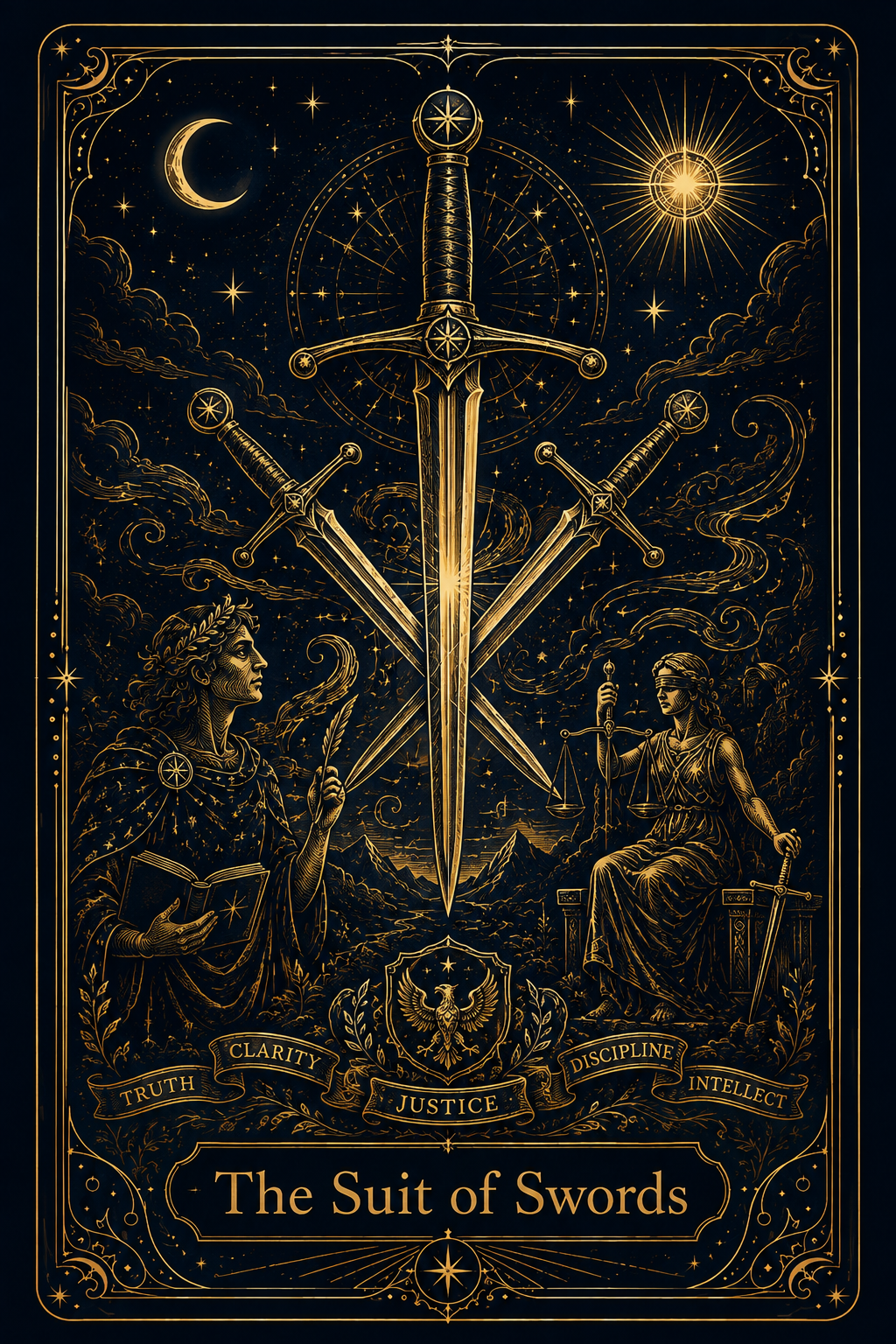
The Suit of Swords
The Suit of Air
Swords are the suit of the mind. Thought, logic, truth, judgement, the words we choose and the decisions we reach, all of it belongs to this element of air. And of the four suits it has by far the darkest reputation, because the mind is not only where clarity lives. It is also where we worry, where we cut ourselves and others, where grief is turned over at three in the morning long after the event that caused it has passed. This suit does not flinch from any of that.
When a spread fills with Swords, it has left both the workshop and the heart and entered the head. It is asking about a conflict, a hard truth, a decision that must be made with the eyes open, a mind that has perhaps been running too fast in the dark. These are rarely comfortable cards. They are, however, honest ones, and the discomfort is usually the point.
Where the Suit Comes From
Swords were one of the four suits of the medieval Mamluk cards from which the whole European deck descends, and they crossed into the Italian and Spanish decks as literal, curved blades, drawn crossing one another across the card. The French deck abstracted them, as it abstracted everything, into a single black shape, and it is a small curiosity of language that the English word for that shape, spades, comes not from any digging tool but from the Italian spade, meaning swords.
The occult tradition then made the assignment this Archive has traced before. To the Hermetic Order of the Golden Dawn, the sword belonged to Air, given the letter Vav and the entire realm of thought, speech, and judgement. This is the suit's central paradox, and worth sitting with: the most violent, most concrete of the four suit-objects, a weapon that draws blood, was made the emblem of the least visible of the elements, the invisible air we cannot see and cannot hold.
The logic underneath is exact. The mind's characteristic act is division: to think is to cut, to separate this from that, true from false, one option from another. And a blade is the perfect image of division, a thing whose entire purpose is to cleave one thing cleanly into two. Air was given a sword because the intellect, more than anything else a person owns, is a cutting instrument.
The Double-Edged Blade
Every sword has two edges, and it does not choose which one it lands on. The same faculty that lets a person see a situation clearly lets them see, with equal sharpness, everything wrong with themselves. The same honesty that cuts through another's excuses can cut through their dignity. The same restless intelligence that solves a problem by daylight will, by night, invent a dozen problems that do not exist and lie awake defending against them. Nothing in the deck helps more, or harms more, than a mind.
This is why the suit of Swords carries so much visible pain, and why several of its cards are among the hardest images in the whole deck. It is not that air is a crueller element than the others. It is that the intellect is the one instrument a person can turn fully against themselves, and this suit refuses to pretend otherwise. Read well, it is not a suit of doom. It is a suit about learning which edge of the blade is facing you.
The Anatomy of the Suit
The Ace is air at its purest and most powerful: a single, clean, decisive stroke of clarity. The numbered cards, Two through Ten, then follow the mind down its harder road, through stalemate and heartbreak, brief rest and hollow defeat, deception and self-made imprisonment, into the suit's long night of dread, and at last to a rock bottom over which the sky is already lightening. The four court cards are people, four temperaments who each carry the blade with a different hand.
The Ace of Swords
The Ace is the suit distilled to its cleanest expression: not an argument, not a decision already made, but the raw power of the mind to cut through confusion and see. Drawn upright, it is breakthrough, a sudden clarity, a truth arriving all at once, the mental force to name a thing exactly as it is and act on it. The crown at the sword's tip marks this as a victory of the mind, clarity achieved, cleanly and completely.
But it is still a sword, and its crown sits at the point of a blade. The very clarity the Ace offers can wound whoever it is turned toward, including the one who wields it. Reversed, that clean edge clouds or curdles: confusion where there should be insight, judgement clouded by noise, or worse, a sharp truth used deliberately as a weapon, clarity weaponised into cruelty.
Two Through Five — Stalemate to Sorrow
A blindfolded figure sits with two crossed swords held tight to her chest, a moon rising over dark water. The Two is stalemate: a decision avoided, a truce that solves nothing, a mind so unwilling to see the choice in front of it that it has bound its own eyes rather than look.
Three swords driven clean through a single red heart, under grey rain. The Three is the deck's plainest image of heartbreak: sorrow, grief, painful truth, the specific wound the mind inflicts when it finally understands something the heart wishes it had not. It hides nothing, and asks the reader not to either.
A figure lies still as a tomb effigy, three swords on the wall above, one beneath. The Four is the suit's mercy: rest, retreat, recovery, a deliberate stillness after the pain of the Three. It is not defeat but recuperation, the mind laying its blade down long enough to heal.
A smirking figure gathers fallen swords as two others walk away beaten. The Five is conflict won at too high a cost: a hollow victory, discord, the sour triumph of being right in a way that costs every relationship in the room. It asks whether this was a fight worth winning at all.
Six Through Ten — Passage to Rock Bottom
A ferryman poles a boat carrying a cloaked figure and child toward a far, calmer shore, six swords upright in the hull. The Six is transition: moving on, leaving trouble behind, a sad and necessary journey away from turbulent water toward something quieter. Grief carried, but carried forward.
A figure slips away from a camp carrying an armful of swords, glancing back. The Seven is cunning and deception: stealth, strategy, getting away with something, acting alone. Turned inward, it is self-deception, the clever story a mind tells itself to avoid a truth it already half-knows.
A bound, blindfolded figure stands hemmed by eight swords, though none of them actually touch her and the cage is open on one side. The Eight is restriction that is largely self-imposed: feeling trapped, powerless, unable to see that the way out was never barred at all.
A figure sits up in bed, face in hands, nine swords hung on the wall behind. The Nine is anxiety, nightmares, despair, the mind at its cruellest hour, magnifying every fear in the dark. Its swords are on the wall, not in the body: this is suffering imagined, which makes it no lighter to bear.
A figure lies face down beneath ten swords, and on the horizon the black sky is already turning gold. The Ten is a painful ending, ruin, the absolute floor, and the one consolation the whole deck offers here: it cannot get worse than this, and the dawn behind it is not decoration but promise.
The Court of Swords
The Page — the restless watcher
The youngest air, standing braced against the wind, sword raised, alert to everything. The Page is mental energy and curiosity: a hunger for truth, sharp new ideas, vigilance, a talent for questions. Its shadow is the mind used badly, gossip, suspicion, cleverness spent on watching others rather than learning.
The Knight — the charge of the mind
Galloping headlong into the wind, sword high, all forward motion. The Knight is the intellect turned to action: driven, direct, brilliant in a hurry, carried by the force of an idea. Pushed too far he is reckless and tactless, so certain he is right that he runs straight over everyone in his way.
The Queen — the clear eye
Seated in profile, sword upright, one hand extended as if to say only what is true. The Queen is unclouded perception: honesty, independence, a mind that sees through sentiment to the fact beneath. Her shadow is clarity gone cold, wit sharpened into cruelty, a truth-telling that has forgotten to be kind.
The King — the judge
Throned, sword upright and unwavering, gaze level. The King is the intellect matured into authority: judgement, ethics, truth held in service of principle, the fair and clear-sighted arbiter. His shadow is reason turned tyrant, logic used to dominate, a mind so cold it mistakes its own hardness for justice.
The Mind That Frees and the Mind That Torments
The Blade Well Held
- Clarity. Seeing a situation exactly as it is.
- Honesty. Naming the true thing, even when it stings.
- Judgement. Deciding fairly, on the merits, eyes open.
- Insight. Cutting through a knot others only tighten.
- Courage. The nerve to think a thought all the way through.
The Blade Turned Inward
- Anxiety. A mind inventing dangers to defend against.
- Cruelty. Truth aimed to wound rather than to free.
- Overthinking. Analysis that circles and never lands.
- Cynicism. Clarity soured into seeing only the worst.
- Coldness. Reason used to wall off every feeling.
Reversed Swords rarely mean a person has stopped thinking; far more often they mean the thinking has turned against them. A reversed suit card asks the querent to notice which way their own blade is pointed, and whether the sharpest mind in the room has quietly begun using its edge on the one person it should be protecting.
Correspondences of the Suit
The Suit Beside the Others
Beside the suit of Wands, air meets fire, and the two can either steer or consume one another: intellect giving raw drive a direction and a plan, or a cool idea fanned by too much thinking into something that burns down more than it meant to. Beside the suit of Cups, air meets water, and this is the oldest and most human quarrel in the deck, the head against the heart, cold judgement weighed against warm feeling, and the querent forced to decide which they will trust when the two flatly disagree.
Beside Pentacles, air meets earth, and the mind is at last given something solid to work on: a thought becomes a plan, a strategy, a design carried out in the material world. This is the pairing of the architect and the analyst, of clear thinking made to serve a concrete end, the point where the sword stops merely cutting and starts to build.
What the Blade Is Really Asking
The question has two edges, exactly as the suit does. Outwardly it asks the querent to see a situation as it really is, past the story they would prefer, past the comfort of not-quite-looking, and to have the nerve to act on what they find. But it turns inward just as sharply, and there it asks something harder: is your own mind, right now, working for you or against you. Is the blade cutting you free, or simply cutting you. Most of the suffering in this suit comes not from the truth itself but from a mind mishandling it in the dark.
This Archive's opening Tarot chapter called the whole deck a mirror rather than a fortune, a way of hearing what the reader already half-knew. In the suit of Swords that half-knowing is almost always a truth the querent has been avoiding, or a mental habit that has quietly turned cruel. The cards do not sharpen the blade. They only ask the querent to notice, at last, which way it has been pointing.
as ready to cut a captive free as to wound the hand that holds it,
waiting for someone steady enough to choose which.
A Mamluk blade, an Italian sword, a small black spade: this suit has worn many edges and asked the same thing through all of them. Not what you do, not what you feel, but what is true, and the harder question of whether your own sharp mind is, tonight, working for you or against you.
FOR THE CURIOUS
Swords appear as one of the four suits of the medieval Mamluk cards from which the European deck descends; the English word spades derives from the Italian spade, meaning swords. The assignment of Swords to Air and to the letter Vav follows the Hermetic Order of the Golden Dawn. The card scenes described throughout, including the dawn behind the Ten, are Pamela Colman Smith's 1909 designs for the Rider-Waite-Smith deck.
Next in Tarot: Chapter Twenty-Seven, the Suit of Pentacles, the last of the four, where fire, water, and air must finally take solid form in the world of earth, body, and work.
The rest of this is yours, not a type.
Reveal my chart