The Suit of Wands
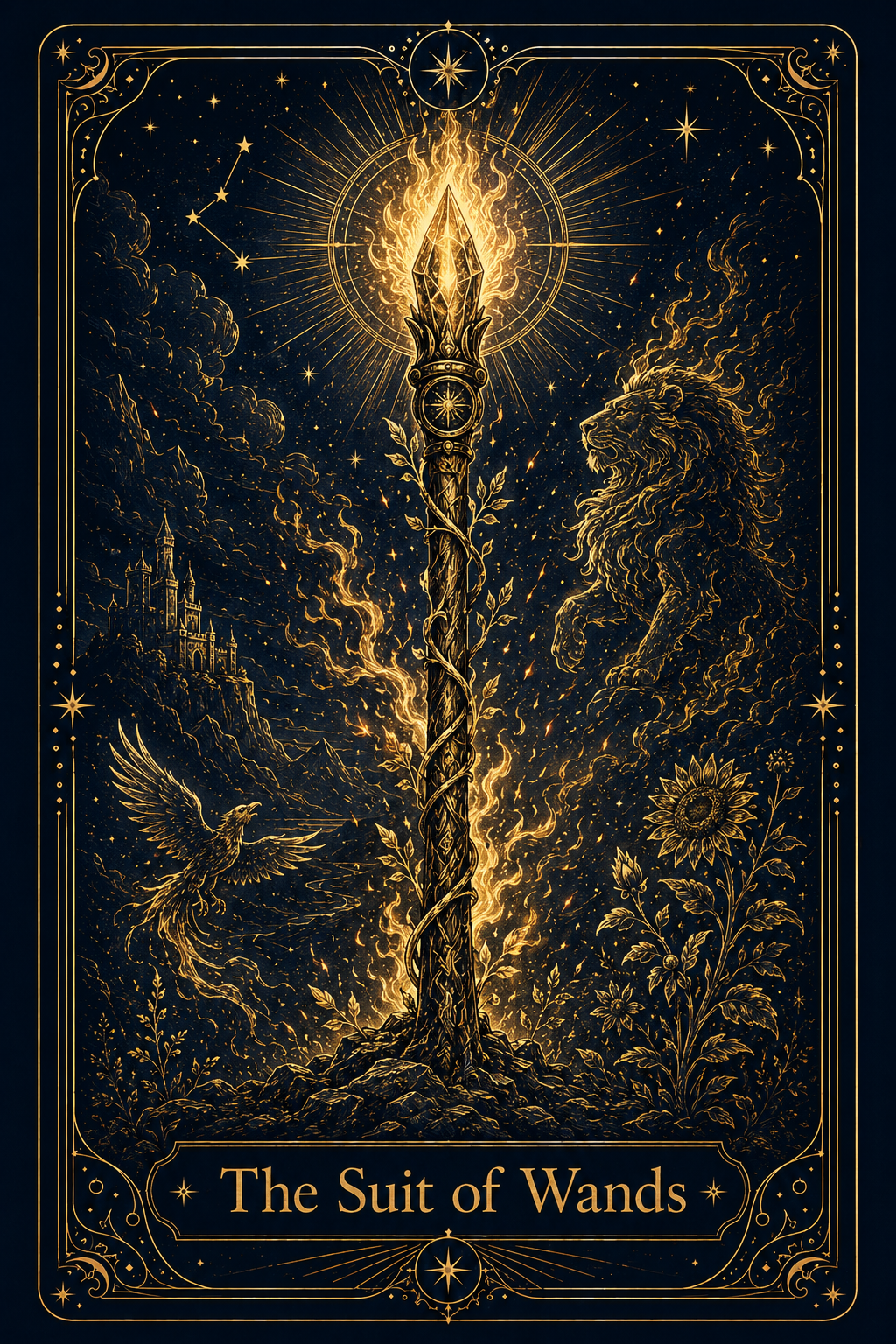
The Suit of Wands
The Suit of Fire
With the World, the Major Arcana ended, and with it the deck's grandest register: destiny, fate, the shape of the sky itself. What opens now is the other family of cards, the fifty-six the opening Tarot chapter called the weather rather than the sky, the cards of the week rather than the decade. They are divided into four suits, and the deck's oldest convention hands the first of them to Fire.
Wands are the suit of drive. Where the coming suits will govern feeling, thought, and the material world, this one governs the raw forward push underneath all three: creativity, ambition, will, passion, the spark of a new idea and the nerve to actually chase it. When a reading fills with Wands, it is almost never asking how the querent feels or what they own. It is asking what they are moved to do, and whether they have the energy to do it.
Where the Suit Comes From
The four suits of the modern deck descend, by the best surviving evidence, from the Mamluk playing cards of medieval Egypt and Syria, which reached Europe in the late fourteenth century. One of those Mamluk suits was the polo-stick. Europe did not play polo, and so its card-makers quietly reinterpreted the unfamiliar object as something they did recognise: a plain wooden baton, a staff, a cudgel. That baton is the direct ancestor of this suit.
From there the lineage splits. In the older Italian and Spanish decks the suit stayed literal, drawn as rough-hewn staves or clubs, and in the French deck that eventually conquered the card table it was abstracted one final step into the small black trefoil the world now calls clubs. The tarot kept the staff, refined it into a leaf-sprouting wand, and, under the influence of the nineteenth-century occult revival this Archive has already traced, assigned it to the first of the four classical elements.
The Hermetic Order of the Golden Dawn made that assignment fixed doctrine. In their system the four suits map onto the four letters of the divine name and the four elements beneath them, and the wand was given to Fire, and to the letter Yod, the small flame-shaped mark from which, in that tradition, every other letter is said to be built. A baton mistaken for a polo stick had become, by a very long road, the deck's element of pure ignition.
The Card That Learned to Show a Scene
Before the Rider-Waite-Smith deck, the Minor Arcana were what a modern deck of playing cards still is: the Five of a suit was five identical symbols in a tidy pattern, with no picture, no figure, and no scene to interpret. Readers who wanted meaning from those cards had to memorise it from a book, because the card itself gave them nothing to look at. The pip cards were, quite literally, just counting.
When Arthur Edward Waite commissioned a new deck, the artist Pamela Colman Smith did something no widely circulated deck had done before: she gave every single one of the fifty-six Minor Arcana cards a full illustrated scene. Suddenly the Three of Wands was a figure on a headland watching ships, the Ten was a man bent double under a load, the Five was a scramble of youths with staves. The meaning moved out of the book and into the picture, where a reader could simply see it.
Nearly every scene this chapter is about to describe is hers. It is difficult to overstate how completely that one decision shaped modern tarot: the reason the Minor Arcana can be read intuitively at all, the reason this suit tells a continuous story from Ace to Ten, is that Smith drew it that way a little over a century ago.
The Anatomy of the Suit
The Ace is the pure root of the element, the seed from which the rest of the suit grows: fire itself, before it has been put to any particular use. The numbered cards, Two through Ten, then trace that fire through a full arc, from its first deliberate spark, up through a blaze of effort and triumph, and finally down under the weight of everything it set alight. The four court cards are not stages at all but people: four human temperaments, each embodying the suit's fire at a different pitch.
The Ace of Wands
The Ace is the suit distilled to its essence: not a project, not a plan, but the spark that comes before either. Drawn upright, it is the arrival of raw creative energy, a sudden idea, a rush of enthusiasm, an invitation to begin something the querent does not yet have words for. The leaves falling from the wand are the traditional sign that this fire is alive and already growing, not a dead stick but a living branch.
What the Ace deliberately withholds is any guarantee that the fire will be used. A match struck is not yet a bonfire, and this card marks only the strike: the moment of pure potential, thrilling precisely because nothing has been committed to yet. Reversed, that same spark stalls, an idea that never quite catches, motivation that flares and dies, a beginning postponed so long the heat goes out of it entirely.
Two Through Five — The Fire Takes Hold
A figure stands between his own walls holding a small globe, the wider world literally in his hand. The Two is the first act of will after the Ace's spark: a plan formed, a direction chosen, the quiet, powerful moment of deciding to expand rather than stay where it is safe.
The same figure, now on a headland, watches his ships move out across open water. The Three is enterprise already underway: the plan launched, the first returns awaited, a card of foresight, expansion, and the particular patience of having committed and now watching to see what comes back.
Four wands stand garlanded like a gateway, figures celebrating beneath them. The Four is a genuine milestone: a homecoming, a wedding, a foundation laid and worth marking. Rare among the middle numbers, it is simply, uncomplicatedly good, a pause to enjoy what the fire has built so far.
Five youths brandish their staves in what could be a brawl or a rough game. The Five is the suit's first friction: competition, clashing ambitions, the chaos of everyone wanting to act at once. It is rarely serious harm, more the heat of a crowded field, but it is the point at which fire stops being purely the querent's own.
Six Through Ten — The Fire at Full Height
A rider crowned with laurel moves through a cheering crowd. The Six is public success and well-earned recognition, the moment effort is seen and acclaimed. Its only shadow is how much it depends on that crowd: a triumph that still needs an audience to feel real.
One figure on higher ground fends off six wands rising from below. The Seven is the defence of a hard-won position: perseverance under pressure, the challenge that arrives precisely because the querent has something now worth attacking.
Eight wands fly through open air toward the ground, the only card in the suit with no human figure at all. The Eight is pure velocity: rapid movement, sudden news, events speeding up, a plan finally in motion and moving faster than expected.
A bandaged figure leans on one wand, eight more fenced behind him, watching warily for one more assault. The Nine is resilience worn thin: exhausted but still standing, guarded by hard experience, finding the nerve for one final push.
A figure struggles forward under all ten wands at once, the load so wide he can barely see past it. The Ten is the suit's final weight: success curdled into overload, responsibility taken on past the point of balance, the fire that built everything now almost too heavy to carry.
The Court of Wands
The Page — the spark of curiosity
The youngest fire, gazing up at a sprouting wand as if at a new toy. The Page is enthusiasm before experience: a fresh interest, a message that stirs excitement, the free-spirited beginner willing to chase a thing simply because it lit them up. Its shadow is a spark that never settles on anything long enough to grow.
The Knight — fire in motion
Mounted on a rearing horse, armour scaled with salamanders, already halfway to somewhere. The Knight is charisma and headlong action, passion, adventure, and the nerve to leap first. Upright he is magnetic and brave; pushed too far he becomes reckless, impatient, all departure and no arrival.
The Queen — radiant confidence
Seated with a sunflower in hand and a black cat at her feet, wholly at ease. The Queen is warmth that draws others in: self-assured, sociable, creatively commanding, generous with her energy without ever losing herself in the room. Her shadow is heat turned sharp, warmth withdrawn or curdled into jealousy.
The King — the visionary
Throned, salamander and lion at his side, gaze fixed on a far horizon. The King is fire matured into leadership: bold long-range vision, natural authority, the entrepreneur who inspires others to build. Overreaching, he becomes domineering, impatient with anyone slower than his own ambition.
The Fire That Warms and the Fire That Burns
Fire Well Kept
- Drive. Energy pointed at something worth doing.
- Courage. The nerve to begin before it is safe.
- Inspiration. Ideas arriving faster than doubt can catch them.
- Momentum. Progress that feeds on its own heat.
- Passion. Caring enough about something to act on it.
Fire Gone Wrong
- Burnout. Energy spent faster than it can be replaced.
- Recklessness. Courage untethered from any thought.
- Scattering. A dozen sparks, no single fire kept alight.
- Frustration. Momentum stalled, heat with nowhere to go.
- Domination. Passion turned into forcing one's will on others.
Reversed Wands rarely mean the fire is gone; far more often they mean the fire is mismanaged. A reversed suit card asks the querent to look at where their energy is actually going, and whether the answer is a blaze that warms or one that has simply started consuming the person tending it.
Correspondences of the Suit
The Suit Beside the Others
Beside the coming suit of Cups, fire meets water, and the deck's oldest opposition plays out: drive against feeling, the urge to act against the pull to stay and feel. Water can douse fire or fire can boil water dry, and a reading heavy with both is usually about a conflict between what the querent wants to do and what they cannot stop feeling. Beside Swords, fire meets air, and the two feed each other: air is what a flame breathes, intellect giving will its direction, though too much air can also fan a small spark into something destructive.
Beside Pentacles, fire meets earth, and this is the pairing the suit most needs. Earth is what fire lacks entirely: patience, substance, follow-through. Wands supply the spark and the nerve; Pentacles supply the ground to build on. A reading that balances the two describes inspiration that actually becomes something, the rarest and most useful marriage in the whole Minor Arcana.
What the Fire Is Really Asking
The question is not what the querent could do, since fire always has a hundred answers to that. It is what they are actually willing to burn for: which of all these possible fires is worth the energy a real one costs, and which are only the pleasant heat of imagining. Wands are thrilling precisely because starting is easy and cheap. What the suit keeps asking, card after card, is whether the querent will feed one fire long enough to matter, or simply keep striking new matches.
This Archive's opening Tarot chapter described the whole deck as a mirror rather than a fortune, a way of hearing what the reader already suspected. In the suit of Wands that suspicion is almost always about energy: where it has been going, where it has been wasted, and the one direction the querent already knows, underneath, their fire actually wants to move.
and a fire begins its long climb from spark to blaze to burden,
waiting for someone with the nerve to keep it lit.
A polo stick mistaken for a baton, a baton refined into a wand, a wand assigned to the first of the elements: this suit has always been about the same thing under all its disguises. Not what you feel, not what you know, not what you own, but the raw, restless push to act, and the harder question of what you will actually spend it on.
FOR THE CURIOUS
The descent of the European suits from the Mamluk cards, including the polo-stick suit reinterpreted as batons, is documented across playing-card scholarship. The assignment of Wands to Fire and to the letter Yod follows the Hermetic Order of the Golden Dawn. The fully illustrated Minor Arcana scenes described throughout this chapter are Pamela Colman Smith's 1909 designs for the Rider-Waite-Smith deck.
Next in Tarot: Chapter Twenty-Five, the Suit of Cups, fire's opposite, the water that feels where this suit acts.
The rest of this is yours, not a type.
Reveal my chart