The Sun
The Sun
The Half-Light, Finally Clearing Completely
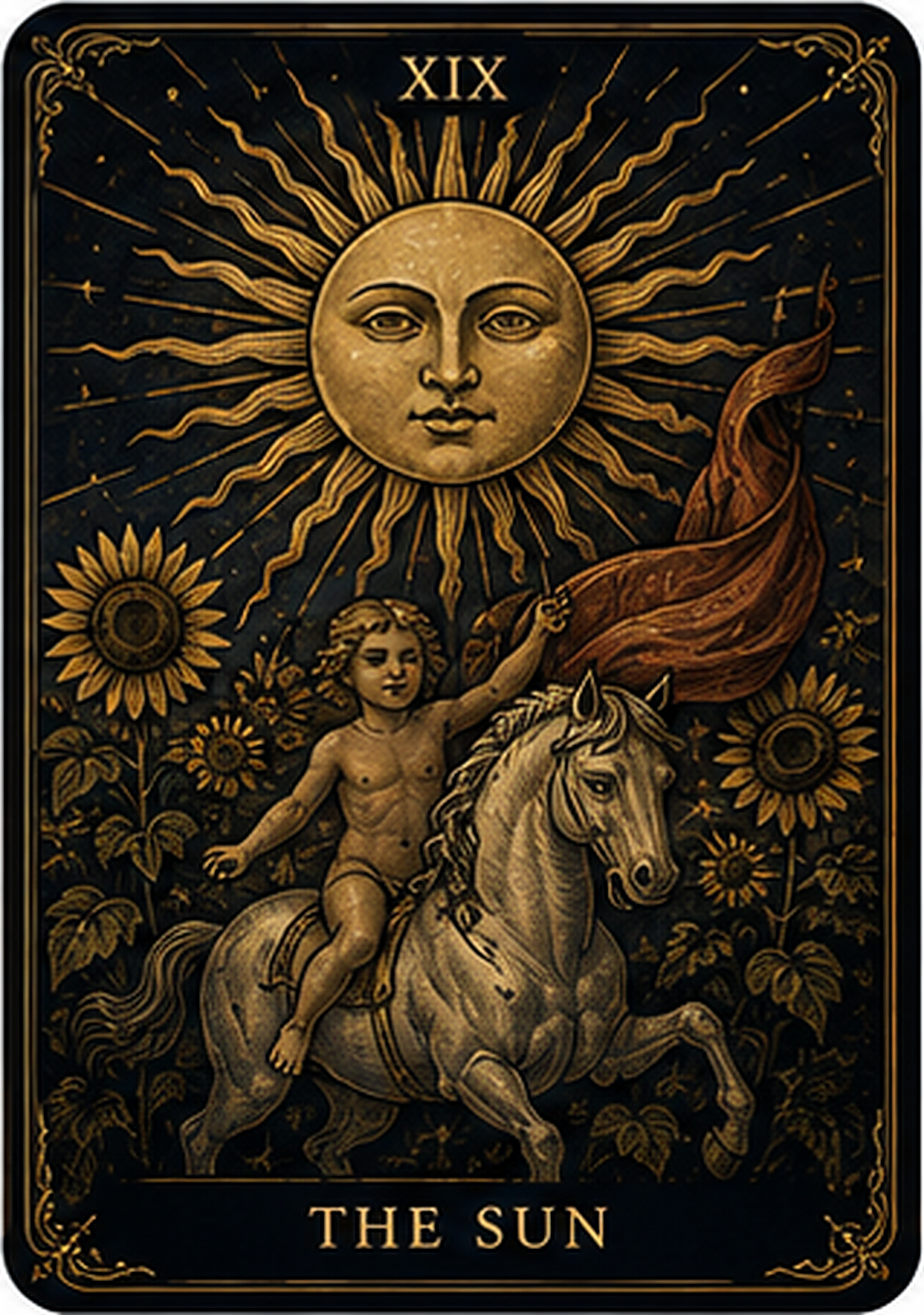
Abright, wide sun with a plain, warm face fills the upper half of the card, its rays alternating between straight lines and gentle waves. Beneath it, a naked child rides a white horse bareback, no saddle, no reins held tightly, holding a large red banner that streams out openly behind. Four sunflowers grow behind a low garden wall, and the whole scene sits under a clear, cloudless sky. Nothing here is hidden. Nothing here needs to be.
Numbered XIX, the Sun answers the Moon's own careful half-light with total, unguarded clarity. Where that card's dog and wolf both howled at an uncertain glow, unsure exactly what they were seeing, this card leaves nothing at all to interpret. The child rides in full view, the banner is fully unfurled, and the wall behind them is deliberately built low enough to see clearly straight over.
The Light Every Ancient Civilisation Worshipped
Sun worship spans an unusually wide range of unrelated cultures: Ra, chief solar deity of ancient Egypt, Helios and Apollo in Greek tradition, and Surya, the Vedic sun god this Archive's own Chariot chapter already introduced, driving a chariot across the sky each day. Rome kept a related cult of Sol Invictus, "the Unconquered Sun," whose major festival fell on the twenty-fifth of December, a date later adopted for Christmas itself, one of history's more surprising, well-documented calendar overlaps.
The child riding openly beneath this card's sun draws on a related, gentler idea found across several mythologies: the sun reborn each morning as something young and new. Horus, in Egyptian myth, was frequently identified with the rising sun, a child-god renewed with each dawn rather than a single, unchanging elder deity. This card's own rider carries the same quiet suggestion, joy that renews itself completely, rather than simply persisting, worn down, from one day into the next.
What the Card Actually Shows
The Alternating Rays — warmth and clarity, together
Straight rays and gentle wavy ones alternate around the sun's face, often read as intellectual illumination paired with genuine, felt vitality, two kinds of light offered at once.
The Bareback Child — trust with nothing to hold onto
Riding without a saddle or tightly gripped reins, the child shows complete ease and trust, nothing gripped defensively, nothing braced against a fall that clearly is not coming.
The Fully Unfurled Red Banner — nothing folded away
A bright red flag streams entirely open behind the rider, victory and joy displayed without a single fold or corner kept hidden from view.
The Four Sunflowers — always turning toward the light
Sunflowers famously track the sun's path across the sky; here they grow openly behind a low wall, plants built entirely around following exactly the light this card provides.
The Low Garden Wall — a boundary you can see straight over
Unlike the Emperor's fortress or the Devil's pedestal, this wall is built low, a boundary that marks space without ever once obscuring the view.
The Cloudless Sky — nothing left to interpret
No storm, no fog, no half-light of any kind remains anywhere in the frame, the single most literal, complete resolution this whole Archive's Major Arcana has offered so far.
Upright and Reversed
Upright, the Sun favours plain, genuine happiness: success actually enjoyed rather than second-guessed, vitality that needs no complicated explanation, confidence resting comfortably rather than performed for anyone watching. It rarely arrives to warn of anything at all; it appears simply to confirm that whatever is currently going well is, in fact, genuinely going well.
Reversed, the card most often points to a temporary dimming rather than any real absence of light, joy delayed rather than lost, a good outcome not yet fully felt even though the actual circumstances have already improved. Some readers use the reversed card to describe naive over-optimism, but even that softer shadow rarely carries the weight this deck's darker cards reserve for real danger.
The Sun in Love
Drawn upright in a love reading, the Sun commonly points to real, uncomplicated happiness, a relationship built on complete openness, joy shared without hesitation or held-back doubt. It favours celebration: an engagement, a wedding, a pregnancy, or simply a season of a relationship finally, plainly, working the way it was always meant to. For someone single, it can describe genuine excitement about new connection, approached with confidence rather than caution.
Reversed, it rarely signals real trouble. It more often describes joy that has not quite been let in yet, good news about a relationship not yet fully felt or trusted, or a temporary rough patch that does not actually reflect the relationship's deeper, genuine health.
The Sun in Work and Money
In a career reading, the Sun frequently appears around genuine recognition, an achievement worth celebrating without qualification, a project succeeding exactly as hoped. It favours confidence held plainly, work that finally, visibly pays off after real effort, and a professional outlook with nothing concerning hidden beneath its surface.
With money specifically, the card describes real, straightforward abundance, a financial goal actually reached, good fortune that does not need to be second-guessed for a hidden catch. Reversed, it most often describes success simply delayed a little longer rather than denied, or a good outcome not yet fully felt even though the underlying circumstances have already turned around.
Strengths, Weaknesses, and the Thin Line Between Them
The Light
- Joy. Happiness felt plainly, without needing to justify it.
- Vitality. Genuine energy, freely and openly expressed.
- Confidence. Ease that never needs to be performed.
- Warmth. Openness extended without hesitation.
- Clarity. Nothing left hidden, nothing left to guess at.
The Shadow
- Naivety. Optimism that occasionally overlooks real detail.
- Delayed joy. Good news not yet fully allowed to land.
- Overconfidence. Ease that forgets to check in occasionally.
- Impatience. Wanting the warmth felt faster than it arrives.
- Restlessness. Difficulty simply sitting still inside good news.
The Sun Beside Other Cards
Beside the Moon, card XVIII, the promise this Archive made last chapter plays out exactly as expected: careful half-light, finally met by total, unambiguous clarity. Beside the Fool, card 0, a quieter echo closes an even older loop: the same open, unguarded innocence that once leapt off a cliff without looking down now rides fully at rest, trust no longer requiring a risk to prove itself.
Her forward-looking pairing sits with the very next card in the sequence, Judgement, card XX: one joyful, individual rider, about to be joined by something considerably larger, a collective reckoning that reaches everyone, not just the single figure this card has followed so closely.
Correspondences of the Sun
The Sun Across the Great Traditions
Tarot de Marseille — two children, not one
Often shows two figures standing together beneath the sun rather than a single rider, sometimes read as the Gemini twins, joy doubled by companionship rather than experienced alone.
Rider-Waite-Smith — the single, trusting rider
The bareback child, open banner, and low garden wall this chapter has already described in full, joy pictured as something one figure can hold completely on their own.
Thoth — twin children, and a new beginning
Crowley and Harris returned to a pair of dancing children within a circle, tying the card to his own concept of a new spiritual age, innocence framed explicitly as the start of something rather than simply its own complete state.
What Survives Every Version — joy, without a single shadow
One child or two, a horse or a circle, every tradition keeps the same essential claim: nothing about this card's happiness is ever complicated by anything darker underneath it.
What This Card Actually Asks of You
The question is not what you are hiding, or avoiding, or bracing for. This card is, in some sense, the one moment in the entire sequence that arrives without a catch attached. The real question is simply whether you are willing to let genuine joy be exactly as uncomplicated as it is currently offering to be, rather than searching for a hidden cost that this particular card was never actually carrying.
Drawn in a reading, the Sun is rarely asking the querent to prepare for anything. It is asking them to actually receive what is already, plainly, theirs. This Archive's opening Tarot chapter called the whole deck a mirror rather than a fortune, and this card holds up perhaps its simplest reflection of all: proof that not every good thing needs to be examined for a catch before it can be trusted, and a plain, warm reminder that sometimes the light really is exactly as bright as it looks.
a red banner still streams fully open behind them,
and four sunflowers keep turning, faithfully, toward a light that has never once asked them to look away.
A sun worshipped by nearly every ancient civilisation this Archive has ever traced, a Roman festival whose date became Christmas itself, a child-god reborn each morning rather than simply persisting, worn down, from one day into the next: every version of this image has always been asking the same plain, gentle question. Not what you are bracing for, but whether you are finally willing to let the light be exactly as warm as it is offering to be.
FOR THE CURIOUS
Solar worship across Egyptian, Greek, Roman, and Vedic traditions is documented across comparative religious scholarship. Sol Invictus and its relationship to the later dating of Christmas is discussed across historical scholarship on the Roman calendar. The Rider-Waite-Smith imagery described in this chapter is Pamela Colman Smith's 1909 design. The Thoth deck's reinterpretation is Aleister Crowley and Lady Frieda Harris's, completed across the 1940s.
Next in Tarot: Chapter Twenty-Two, Judgement, this single joyful rider's light finally calling an entire world forward.
The rest of this is yours, not a type.
Reveal my chart