The Tower
The Tower
The Fence, Finally Coming Down
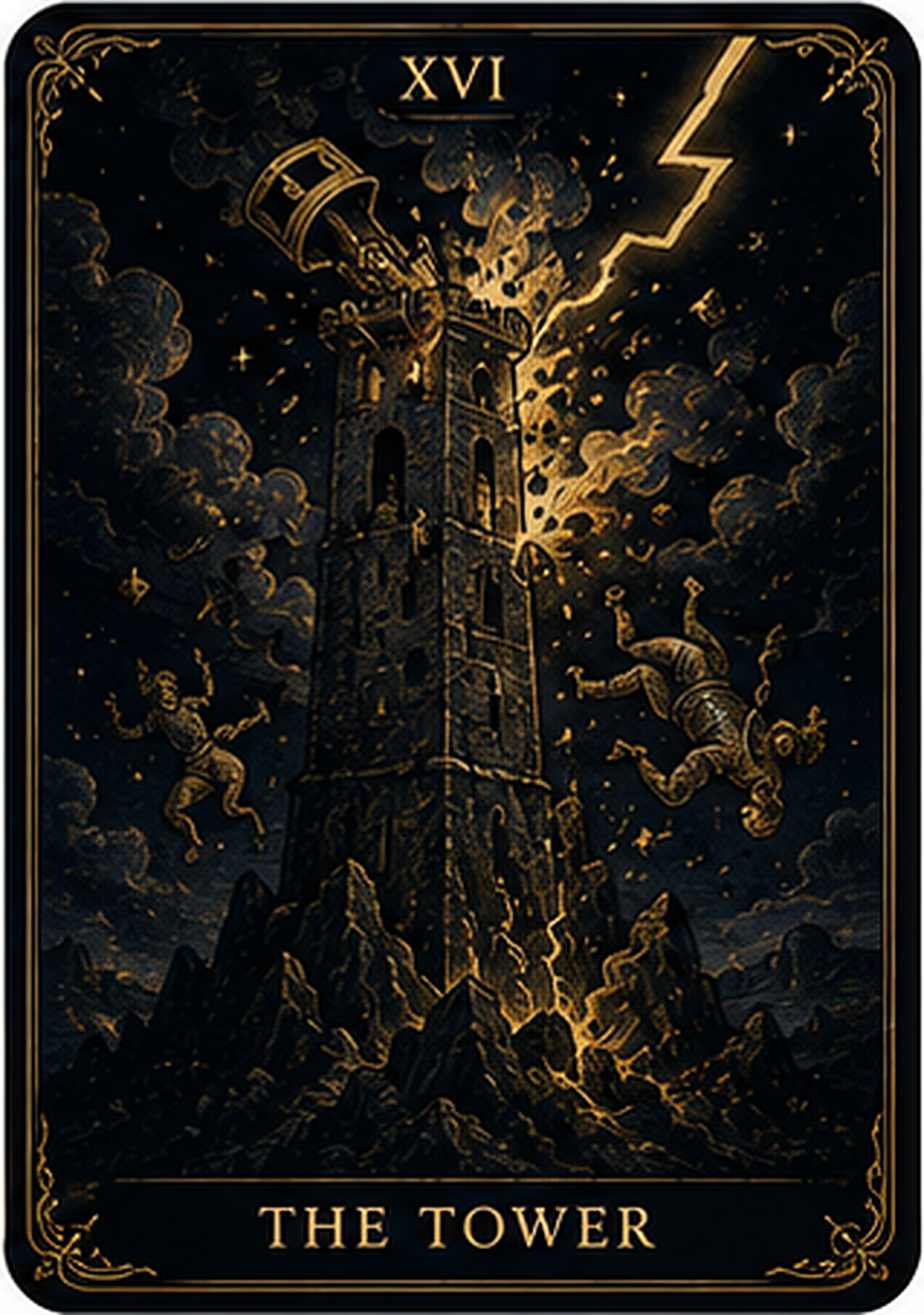
Atall stone tower stands on a rocky peak, its crowned top blown entirely off by a bolt of lightning, flames already bursting from its windows. Two human figures tumble headfirst through the open air, arms outstretched, falling away from a structure that looked, only a moment earlier, like the most solid thing for miles. Small tongues of flame rain down around them, twenty-two in most printings, one for every card in this whole sequence.
Numbered XVI, the Tower is this deck's most sudden, most violent card, and its arrival here is no accident. This Archive's own Devil chapter closed with a promise: a chain worn long enough eventually stops feeling like a choice, and a fence built rigid enough eventually only comes down one way. This is that way. Nothing here asked for permission first.
The One Myth That Barely Needs Translating
The Book of Genesis describes a unified humanity attempting to build a tower tall enough to reach heaven itself, an act of collective pride met with direct, corrective intervention: their languages were scattered, cooperation on the project became impossible, and the tower was left unfinished, its builders unable to even understand one another well enough to try again. The story of Babel is, essentially, this exact card already told in words: structure built too high on foundations of pride, met with sudden, decisive correction from somewhere far beyond the builders' control.
A second, quieter tradition runs alongside Babel specifically. Medieval and Renaissance Christian thought commonly read a lightning strike on any real tower, church spire, or grand building as a visible sign of divine displeasure, an omen requiring no further explanation to an audience who had grown up watching real storms take down real structures. Some early French decks even called this card La Maison Dieu, "the House of God," a title that reads two ways at once: either the tower itself was a corrupted, false house of God being struck down, or the lightning was God's own house arriving to do the striking.
What the Card Actually Shows
The Blown-Off Crown — false authority, removed by force
The tower's crowned top is struck cleanly away, the same symbol of rulership this Archive has already traced through the Emperor's own throne, shown here failing under real pressure for the first time.
The Lightning Bolt — a truth that cannot be argued with
A single, decisive strike arrives from outside the tower entirely, revelation this card never frames as gradual or negotiable.
The Two Falling Figures — the same captives, still falling
Tumbling from the tower's height, they closely echo the two figures this Archive's own Devil chapter already traced, chained once, now simply thrown clear by the very structure that held them.
The Flames Bursting From the Windows — nothing left concealed
Fire consumes the tower's interior in full view, whatever was hidden inside now visible to anyone watching from the ground.
The Falling Yods — every path, momentarily disrupted
Twenty-two small flame-shaped drops rain down alongside the figures, matching the twenty-two cards of this entire Major Arcana sequence, no single path in this Archive exempt from this card's arrival.
The Solid Rock Beneath — a foundation that was never actually the problem
The mountain itself remains entirely intact; only the tower built upon it falls, proof that the ground was never unstable, only what was built too proudly on top of it.
Upright and Reversed
Upright, the Tower favours sudden, undeniable revelation: a false belief exposed all at once, a structure built on a shaky foundation finally, visibly failing, a shock that, however painful in the moment, clears away something that was genuinely never stable to begin with. It rarely appears to describe gradual change; it appears when the truth arrives all at once, whether anyone was ready or not.
Reversed, the card most often describes disaster narrowly delayed rather than genuinely avoided, fear of an inevitable reckoning keeping a crumbling structure standing a little longer through sheer refusal to look at it directly. Some readers use the reversed card to describe internal collapse, a private crisis of belief happening quietly, without the dramatic external event the upright card usually depicts.
The Tower in Love
Drawn upright in a love reading, the Tower often points to a sudden, painful revelation, a truth that had been avoided for far too long finally surfacing all at once, a relationship's real instability made undeniable rather than quietly suspected. It rarely describes a small disagreement; it appears when something genuinely foundational has to be confronted, whether either person feels ready or not.
However devastating in the moment, the card frequently marks the actual end of a relationship that was never truly stable, clearing space, eventually, for something built on considerably firmer ground. Reversed, it can describe a reckoning being delayed rather than avoided entirely, both people sensing the instability and choosing, for now, not to look directly at it, or a private, internal collapse of belief in the relationship that has not yet become an outward, visible event.
The Tower in Work and Money
In a career reading, the Tower frequently appears around a sudden job loss, a business collapse, or an organisational upheaval that arrives without warning and reshapes everything built on top of it. However disruptive, it rarely appears to punish; it appears when a structure was genuinely never as stable as it looked, and the collapse, painful as it is, finally makes that instability impossible to keep ignoring.
With money specifically, the card can describe a sudden financial shock, an investment or plan that collapses all at once rather than gradually, exposing risk that had been quietly present the whole time. Reversed, it warns of a looming financial reckoning being delayed through avoidance, or anxiety about a collapse that has not yet actually arrived, though the underlying instability genuinely has.
Strengths, Weaknesses, and the Thin Line Between Them
The Light
- Revelation. A truth finally undeniable, however unwelcome.
- Honesty. Facing what a collapse actually exposed.
- Liberation. Freedom from a structure that never truly held.
- Clarity. Seeing exactly what was never actually stable.
- Renewal. Rebuilding, this time, on ground that can hold it.
The Shadow
- Chaos. Destruction embraced without any real purpose.
- Denial. Refusing to see what the collapse already proved.
- Trauma. A shock so severe it prevents any real rebuilding.
- Bitterness. Blaming the strike instead of the shaky tower.
- Paralysis. Standing in the rubble, unwilling to start again.
The Tower Beside Other Cards
Beside the Devil, card XV, last chapter's promise lands exactly as expected: a cage finally checked, and found, as it always secretly was, unlocked. Beside the Emperor, card IV, an even older promise finally closes, ten full chapters after this Archive first warned that every fence he builds is eventually tested, and that some, built too rigid to bend, only ever come down through sudden collapse.
Her most gentle pairing sits with the very next card in the sequence, the Star, card XVII: devastation, immediately followed by the quietest, most hopeful card in the entire deck, this Archive's clearest picture yet of exactly what waits on the other side of a fall this necessary.
Correspondences of the Tower
The Tower Across the Great Traditions
Tarot de Marseille — La Maison Dieu, God's own house
Titled "the House of God" rather than "the Tower" in early decks, a name that reads as either the false structure being struck down or the striking force itself, sometimes shown with falling coins or figures rather than flame-shaped drops.
Rider-Waite-Smith — the crown, struck clean
The lightning bolt, blown crown, and falling yods this chapter has already described in full, catastrophe staged with unusually precise, almost architectural detail.
Thoth — the Tower, and a piercing eye
Crowley and Harris added an all-seeing eye near the top of the composition, war and Mars symbolism made explicit, the destruction framed as the direct, unavoidable consequence of a piercing revelation rather than simple bad luck.
What Survives Every Version — the ground, always intact
House of God, precise architectural collapse, or war made visible, every tradition keeps the same quiet detail: the mountain beneath the tower never once actually breaks.
What This Card Actually Asks of You
The question is not how to prevent the strike. By the time this card ever appears, the lightning has usually already arrived; this is one of the few cards in the whole deck less about a coming choice than about an honest response to one that has already been made for you. The real question is whether you are willing to actually look at what the fall revealed, rather than immediately rebuilding the exact same tower on the exact same unstable ground.
Drawn in a reading, the Tower is rarely asking the querent to have prevented the collapse. It is asking them to actually learn from what it exposed. This Archive's opening Tarot chapter called the whole deck a mirror rather than a fortune, and this card holds up one of its harshest, most necessary reflections: proof that some structures only ever reveal how unstable they were by falling, and a plain, difficult reminder that the rock underneath was always solid enough to build on properly, if anyone had checked it first.
two figures still fall through open air, arms outstretched, already past the point of catching themselves,
and the rock underneath the whole ruined structure has not moved an inch.
A tower once built tall enough to reach heaven itself, and struck back down for the reaching; a house of God whose very name could mean either the false thing destroyed or the true thing doing the destroying: every version of this card has always been asking the same plain, unwelcome question. Not whether the fall could have been stopped, but whether you are finally willing to see what it revealed.
FOR THE CURIOUS
The Tower of Babel appears in Genesis 11. Medieval and Renaissance readings of lightning strikes on real towers and church spires as omens of divine displeasure are documented across historical scholarship. The Rider-Waite-Smith imagery described in this chapter is Pamela Colman Smith's 1909 design. The Thoth deck's reinterpretation is Aleister Crowley and Lady Frieda Harris's, completed across the 1940s.
Next in Tarot: Chapter Nineteen, The Star, the quietest hope in the whole deck, arriving exactly where this card left the ground bare.
The rest of this is yours, not a type.
Reveal my chart