The Wheel of Fortune
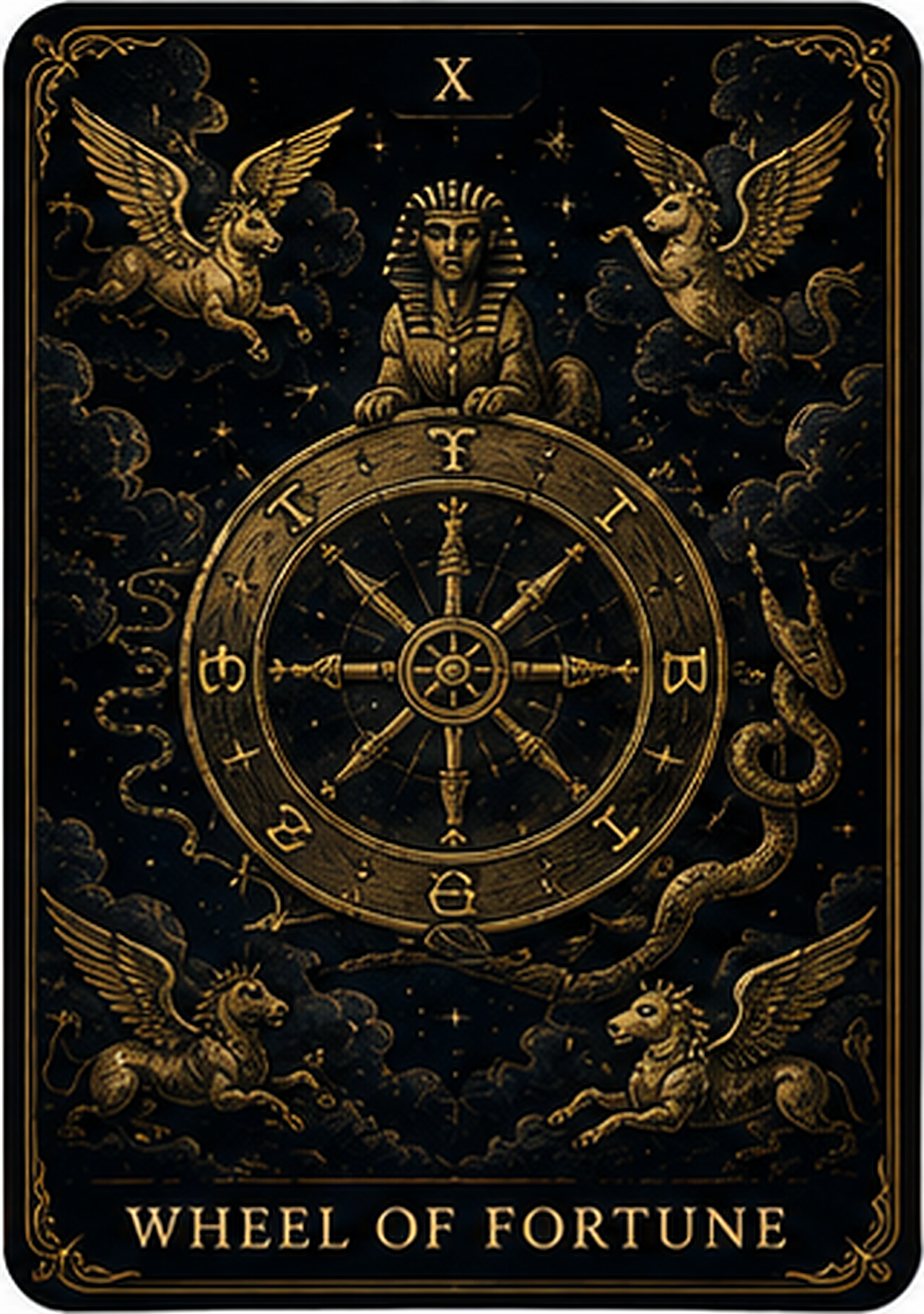
The Wheel of Fortune
The One Force No Lantern Was Ever Going to Steer
Agreat wheel turns in an open sky, marked with strange, overlapping letters and alchemical symbols. In each corner of the card a winged creature, a man, an eagle, a lion, and a bull, reads quietly from an open book, entirely undisturbed by the motion below them. A sphinx sits fixed at the top of the wheel, sword in hand. On one side a snake descends; on the other, a jackal-headed figure climbs. Nothing in the scene asks whether any of this is fair.
Numbered X, closing this Archive's first full cycle of the Major Arcana, the Wheel of Fortune marks the exact limit of everything the deck has built so far: will, calm, patience, solitary wisdom, all of it real, all of it useful, and none of it capable of actually stopping a wheel that was never built to consult anyone before it turns.
The Wheel That Never Once Explained Itself
Roman religion pictured Fortuna as a goddess who governed luck itself, frequently shown blindfolded and turning a great wheel that carried kings up to power and cast them back down again with the same careless motion, merit playing no part in either direction. The single most influential text to fix that image in the Western imagination was written under genuinely desperate circumstances: Boethius's Consolation of Philosophy, composed in the sixth century while its author sat imprisoned, awaiting his own execution.
In it, Boethius describes a vision of Lady Philosophy explaining that Fortune's wheel was never broken; it was simply never going to be fair, and true peace could only be found in something the wheel's spinning could not actually touch. The image spread through medieval art and literature for centuries afterward, kings painted at the wheel's summit and the same kings painted crushed beneath it a quarter-turn later, a blunt, recurring reminder, sic transit gloria mundi, thus passes the glory of the world.
What the Card Actually Shows
The Four Corner Creatures — fixed signs, and the Evangelists
A winged man, an eagle, a lion, and a bull each read calmly from an open book, doubling as the four fixed zodiac signs and the four Christian Evangelists at once, wisdom untouched by the wheel's own motion.
The Sphinx on Top — stillness, at the centre of change
Fixed and unmoving despite sitting directly atop the turning wheel, the sphinx holds a sword, intelligence and readiness that never has to move to stay in control of itself.
The Descending Snake — fortune, falling
A serpent slides down one side of the wheel, sometimes identified with the Egyptian figure Typhon, marking the downward turn every rise eventually meets.
The Ascending Jackal — fortune, rising
A jackal-headed figure, echoing the Egyptian god Anubis, climbs the opposite side, the same wheel's upward turn, granted with exactly as little explanation as its downward one.
The TARO Letters and Alchemical Symbols — the wheel, spelling itself out
Letters arranged to read TARO, ROTA, ORAT, or TORA circle the wheel's rim, alongside symbols for mercury, sulfur, and salt, chance dressed in the same coded language the whole deck speaks.
The Open Sky — no ground to stand on at all
Unlike almost every earlier card in this sequence, nothing here touches solid earth; the entire scene floats, exactly the way genuine luck offers nothing steady to hold onto.
Upright and Reversed
Upright, the Wheel of Fortune favours a genuine turning point, arriving through circumstance rather than effort, an opportunity that shows up on its own timeline, a shift in luck that finally, visibly moves in someone's favour. It rarely appears to reward a specific action; it appears to mark a moment where timing itself, not merit, is doing most of the actual work.
Reversed, the card points either to a genuine run of bad luck, external circumstances working against a person through no fault of their own, or to a subtler failure: a cycle repeating itself again and again because its lesson was never actually learned the first several times it appeared. Some readers use the reversed card to describe someone resisting a change that was always going to happen anyway, exhausting themselves fighting a wheel that was never going to stop turning for their benefit.
The Wheel of Fortune in Love
Drawn upright in a love reading, the Wheel of Fortune often points to a connection that arrived through pure timing, a chance meeting, a reunion neither person engineered, a relationship whose beginning owed more to circumstance than to either partner's careful planning. It favours trusting that timing rather than forcing a result the wheel has not yet actually offered.
It can also mark a genuine turning point inside an existing relationship, a sudden shift for better or worse that arrived from outside the couple's own choices entirely, a job move, a family circumstance, an unexpected piece of news. Reversed, it can describe a relationship caught in a repeating negative cycle, the same argument, the same pattern, returning again because its actual lesson was never addressed the first time it appeared, or simply a stretch of romantic bad luck that has nothing to do with either person's worth.
The Wheel of Fortune in Work and Money
In a career reading, the Wheel of Fortune frequently appears at a genuine inflection point, an opportunity that shows up unannounced, a layoff or restructuring that had nothing to do with individual performance, a sudden change in an entire industry that no one inside it actually caused. It favours adaptability over resistance, recognising a real opening the moment it appears rather than waiting for a more convenient one.
With money specifically, the card can describe a genuine windfall, or a genuine loss, arriving from outside anyone's direct control, market conditions, an inheritance, an unexpected bill. Reversed, it warns against either blaming pure bad luck for a pattern that actually has a fixable cause, or against paralysis in the face of change that was always going to happen with or without anyone's cooperation.
Strengths, Weaknesses, and the Thin Line Between Them
The Light
- Adaptability. Meeting real change without resisting it needlessly.
- Trust. Faith that a difficult stretch is not the whole story.
- Opportunity. Recognising and taking a genuine opening.
- Humility. Remembering that not every outcome was earned.
- Resilience. Steadiness that holds through an unfair turn.
The Shadow
- Fatalism. Using fate as an excuse to stop acting at all.
- Denial. Refusing to notice a cycle that keeps repeating.
- Missed timing. Letting a real opening pass by unclaimed.
- Entitlement. Assuming good fortune was always deserved.
- Victimhood. Blaming the wheel for what was actually fixable.
The Wheel of Fortune Beside Other Cards
Beside the Hermit, card IX, the pairing this Archive named plays out exactly as promised: hard-won personal clarity, found entirely alone, meeting the one force that solitude was never actually going to be able to steer. Beside the Chariot, card VII, the deck's earlier lesson meets its honest limit: everything willpower proved it could hold together, set directly against the one wheel no amount of determination can actually slow down.
Her most forward-looking pairing sits with the very next card in the sequence, Justice, card XI: blind, impersonal chance, immediately followed by a figure who weighs, considers, and deliberately decides, the deck's clearest pivot from a world governed by luck to a world that finally, formally, answers for consequence.
Correspondences of the Wheel of Fortune
The Wheel of Fortune Across the Great Traditions
Tarot de Marseille — figures attached to the rim
Often shown with small human or animal figures literally attached to the wheel's own turning rim, sometimes cranked by a blindfolded or monkey-like figure, fortune pictured as something people are physically carried by rather than simply witness from a distance.
Rider-Waite-Smith — the fixed signs, watching calmly
The four corner creatures, the sphinx, and the TARO letters this chapter has already described in full, chance surrounded by symbols of steady, unmoved wisdom.
Thoth — Fortune, and elaborate cosmic imagery
Crowley and Harris named the card simply "Fortune" and surrounded it with denser Kabbalistic and planetary symbolism tied to Jupiter, leaning further into the wheel as a genuinely cosmic mechanism rather than a purely human drama.
What Survives Every Version — a wheel, and no explanation
Riders on the rim, watchful fixed signs, or dense cosmic symbolism, every tradition keeps the same core refusal: nowhere does any version of this card explain why the wheel turns the way it does.
What This Card Actually Asks of You
The question is not whether you can control the wheel. This card is, in some sense, the deck's most honest admission that you cannot. The real question is whether you can find something steady enough inside yourself, the way Boethius found philosophy while awaiting his own execution, that the wheel's turning cannot actually reach, no matter which direction it happens to spin next.
Drawn in a reading, the Wheel of Fortune is rarely asking the querent to work harder or plan more carefully. It is asking them to notice which parts of the current situation are genuinely theirs to influence, and which parts were simply never going to ask. This Archive's opening Tarot chapter called the whole deck a mirror rather than a fortune, and this one card sits closest to admitting the limit of that claim: some things really were always going to be left to chance, and the only real choice left is how steadily a person meets them.
a sphinx keeps its footing without ever needing to move at all,
and a philosopher's six-hundred-year-old letter still insists that peace was never going to be found in the wheel's current position.
A goddess who never once removed her blindfold, a prisoner who found philosophy steadier than his own fast-approaching execution, kings painted at a wheel's summit and crushed beneath the very same wheel a quarter-turn later: every version of this card has always been asking the same plain question. Not whether the wheel is fair, but whether you have found anything inside yourself steady enough that its turning cannot actually reach it.
FOR THE CURIOUS
The Roman goddess Fortuna and her wheel are documented across classical sources. Boethius's Consolation of Philosophy was composed in the early sixth century CE and remains a foundational text of medieval philosophy. The Rider-Waite-Smith imagery described in this chapter is Pamela Colman Smith's 1909 design. The Thoth deck's reinterpretation is Aleister Crowley and Lady Frieda Harris's, completed across the 1940s.
Next in Tarot: Chapter Thirteen, Justice, the wheel's blind turning, finally met with a deliberate weighing.
The rest of this is yours, not a type.
Reveal my chart